
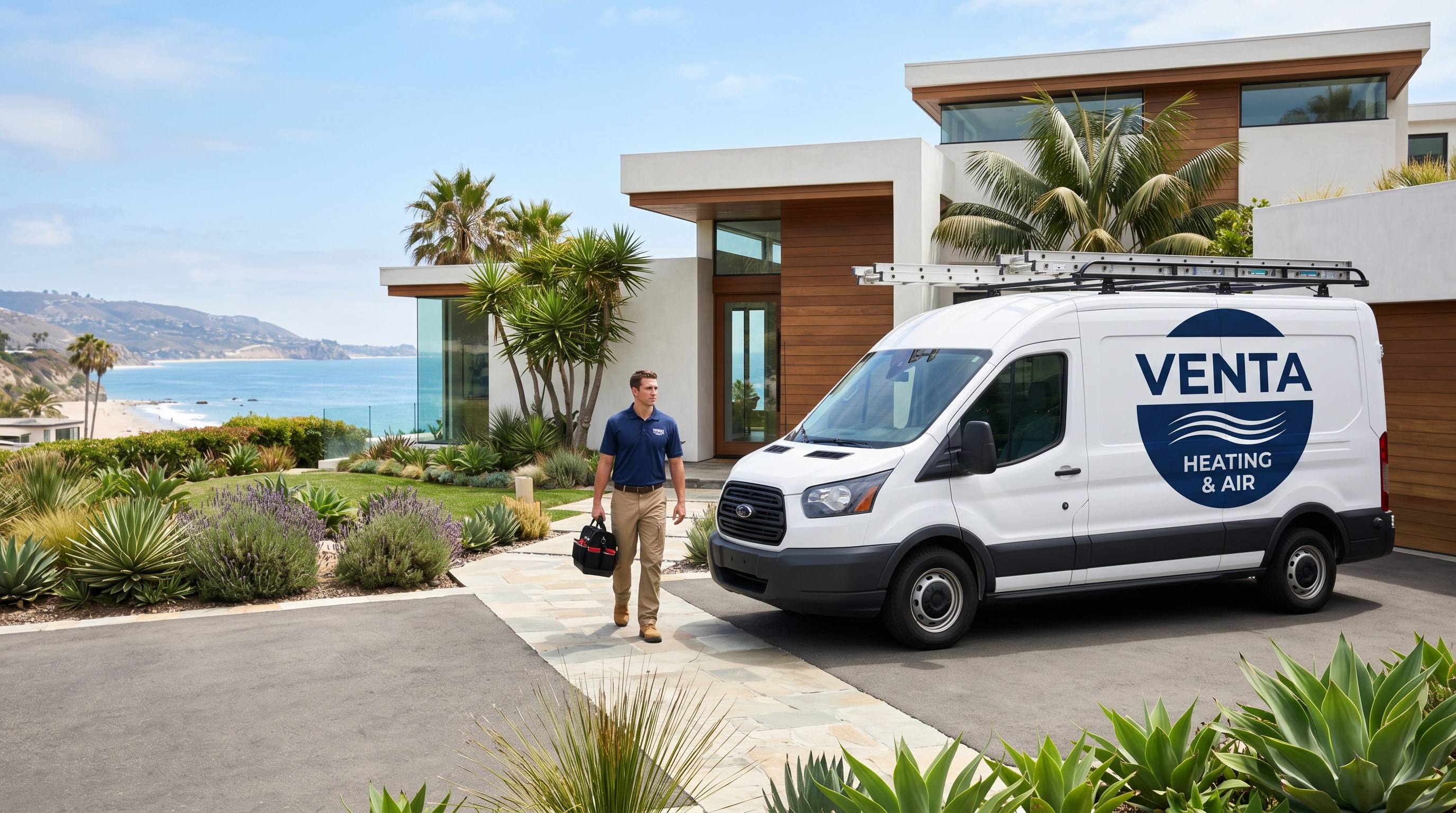
Dana Point sits between Laguna Beach and San Clemente on the PCH bluff, with roughly 33,000 residents spread across four ZIP codes (92624, 92629, 92672, 92675) and six distinct sub-neighborhoods that each want a different HVAC answer. The Lantern Village historic core has mid-century cottages from the 1930s through the 1960s on Blue, Violet, Golden, and Amber Lantern streets. Capistrano Beach has Doheny-era Spanish Colonials from 1928–1940 on the Palisades bluff. Monarch Beach and Niguel Shores (92629) bring mid-1990s-and-newer construction next to the St. Regis. The Strands and the Headlands are the post-2010 luxury bluff developments. Dana Point Harbor and Marina cluster waterfront condos and houses around the basin. Dana Hills and the Tennis Villas are 1970s–1980s tract homes east of PCH, sheltered enough that the salt-corrosion problem largely doesn’t apply.
Three things make HVAC here different from inland Orange County: the salt-air corrosion, the historic housing stock with no existing ductwork, and Coastal Commission jurisdiction on the bluff-top properties. Get any one of those wrong and the install fails — corroded coils in six years, ducts that don’t fit a 1932 attic, or a stop-work notice from the Commission. We size every Dana Point install around all three.
Salt-air corrosion: who needs coastal-grade and who doesn’t
Within roughly half a mile of Dana Point Harbor or the Capistrano Beach surfline, the sea-spray aerosol off the water carries chloride directly onto outdoor coil fins. Standard copper-aluminum hybrid condensers pit through in 4–6 years here against the 10–12 they’d give inland. We’ve pulled six-year-old units off Lantern Village rooftops with the windward third of the coil reading like sandpaper. Honest opinion: if you live within half a mile of Dana Point Harbor and your condenser is standard copper-aluminum hybrid, plan for 6 years not 12 — salt air doesn’t care what the warranty says.
The coastal-grade answer is all-aluminum micro-channel coil construction with stainless hardware and a manufacturer coastal coating package. Three setups we install most in the Dana Point salt zone:
- Carrier Infinity 25VNA60 variable-speed heat pump with the factory coastal-coating package. Quiet at low-load run, qualifies for SCE residential heat-pump incentives, 10-year parts warranty. Installed $15,500–$19,500 on a 4-ton replacement including the coastal premium.
- Lennox SL18XC1 in the coastal-rated configuration as the “step down from variable” option. Two-stage compressor, modest efficiency gain over single-stage, $13,800–$16,500 installed.
- Trane XV20i variable-speed with WeatherShield coastal coating and matched TAM9 air handler, factory 12-year compressor warranty. Installed $15,800–$19,800 on a 4-ton.
Coastal-coating premium runs about $800–$1,200 over standard galvanic on the same tonnage. East of PCH in Dana Hills and the Tennis Villas you’re sheltered enough that the premium isn’t worth it — a Trane XR16 with TruComfort variable speed at standard configuration is the right call there, $11,800–$13,500 installed. We tell you which zone your address sits in and quote accordingly.
Capistrano Beach Spanish Colonials and Lantern Village cottages: ductless is the answer
The 1928–1940 housing stock above Doheny on the Capistrano Beach palisades was built with plaster walls, low attics, and Spanish tile roofs. The 1930s–1960s Lantern Village cottages are similar. None of these homes have existing ductwork worth keeping, and chasing trunk-and-branch ducts through them means tearing into the architecture owners paid Dana Point prices to preserve.
Ductless mini-split is our primary recommendation for that housing stock. The Mitsubishi MSZ-FH18NA indoor head paired with a multi-zone MXZ outdoor handles a typical 4-zone Spanish Colonial cleanly — two heads on the main level, two upstairs, one outdoor unit tucked behind landscaping. Daikin Aurora is our alternative when the project wants cold-climate-rated heating reliability. Indoor heads run 38–45 dB — quieter than the original electric baseboard most of these homes still have. Composite real-world example: 1932 PCH home in Capistrano Beach, 2,100 sqft, four-zone Mitsubishi mini-split with all-aluminum coils, $20,400 total install with permitting. Detail on configurations: mini-split service page.
A note on the Harbor-zone condos and the post-2010 Strands and Headlands homes — those already have proper ductwork and the question becomes coil construction (always coastal-grade here) and zoning. Variable-speed ducted equipment with coastal coating is the right call. The Monarch Beach and Niguel Shores tracts (mid-1990s and newer) split the difference: existing ductwork is usually serviceable, and the salt exposure is moderate enough that mid-tier corrosion-resistant coils handle it without needing the full coastal package.
Bluff-top properties and Coastal Commission permits
The Strands, the Headlands, Capistrano Beach palisades, and the immediate Harbor edge sit inside California Coastal Commission jurisdiction. Any exterior equipment change — new condenser pad, relocation closer to the bluff edge, screening that affects a view corridor — needs a Coastal Development Permit on top of the city of Dana Point Building & Safety mechanical permit. Realistic timeline is 4–8 weeks vs the standard 5–10 days for a non-coastal install.
We prep the CDP submittal (site plan, equipment cut sheets, screening detail, photo simulation if the unit is visible from the public viewshed) and walk it through the city counter ourselves. In-kind replacement on an existing pad sometimes qualifies for an exemption and we’ll push for that first. The abatement orders we’ve seen on unpermitted bluff-top equipment installs are painful and expensive to unwind — don’t let any contractor skip this step.
Heat-pump conversion in Dana Point
For most Dana Point homes the heat-pump conversion math works. Winters here rarely break below 45°F, heating load is modest, and the 2024–2025 atmospheric-river seasons have pushed more owners to look at electrification anyway. Dana Point is in SCE/SDG&E territory (not LADWP), and the SCE residential heat-pump rebate stack still has equipment-specific incentives we apply at quote time. Federal IRA Section 25C ($2,000 heat-pump tax credit) terminated December 31, 2025 under OBBBA and is not available for 2026 installs. Anyone quoting it now is working off outdated material.
Honest exception: if your existing gas furnace is 8–10 years old and high-efficiency, and only the AC condenser needs replacement, a condenser-only swap matched to the existing furnace is often cheaper short-term than full heat-pump conversion. We give both quotes side by side with the 10-year operating-cost comparison. Full installation scope: heat-pump installation service page and AC repair service page for diagnostic and repair work on what you already have.
Marine layer humidity and sizing
May Gray and June Gloom park the marine layer over Dana Point from late spring through midsummer, and indoor relative humidity climbs into the 65–75% range overnight. AC removes humidity as a side effect of cooling — but only if the system runs long enough to do so. An oversized fixed-capacity unit cools the room in eight minutes, shuts off, and leaves moisture in the air. Result: rooms that feel cool and clammy, condensation on cold-water pipes, occasional mold blooms behind built-ins on an exterior wall.
We measure the building before quoting tonnage — Manual J load calc on every install. Most of the time the right system in a 2,000 sqft Dana Point home is 2.5 to 3 tons, not the 4-ton “rule of thumb” another contractor will quote. Variable-speed equipment that modulates at 30–50% capacity for hours dehumidifies as it cools, which is what the marine layer requires.
Service area within Dana Point and beyond
We reach every Dana Point neighborhood from the south-OC route out of Irvine: Lantern Village, Capistrano Beach, Monarch Beach, Niguel Shores, The Strands, the Headlands, Dana Point Harbor and Marina, Dana Hills, the Tennis Villas, and the streets above PCH in 92624, 92629, 92672, and 92675. Coverage extends through Laguna Niguel, Mission Viejo, San Juan Capistrano, San Clemente, Laguna Beach, and Aliso Viejo with comparable response times. Wider view: all of Orange County.
Why Dana Point homeowners choose Venta
We tell you which corrosion zone your address actually sits in and we don’t sell coastal-grade upgrades to Dana Hills owners who don’t need them. We handle the Coastal Commission paperwork for bluff properties instead of pretending it doesn’t exist. Manual J load calc on every install — no square-footage guesses. $89 standard diagnostic with a written fixed-price quote before any work. Permits pulled in your name, HERS verification scheduled by us, SCE rebate paperwork filed for you. CSLB #1138898 (C-20). Call (949) 785-5535 or email irvine@ventahvac.com.