
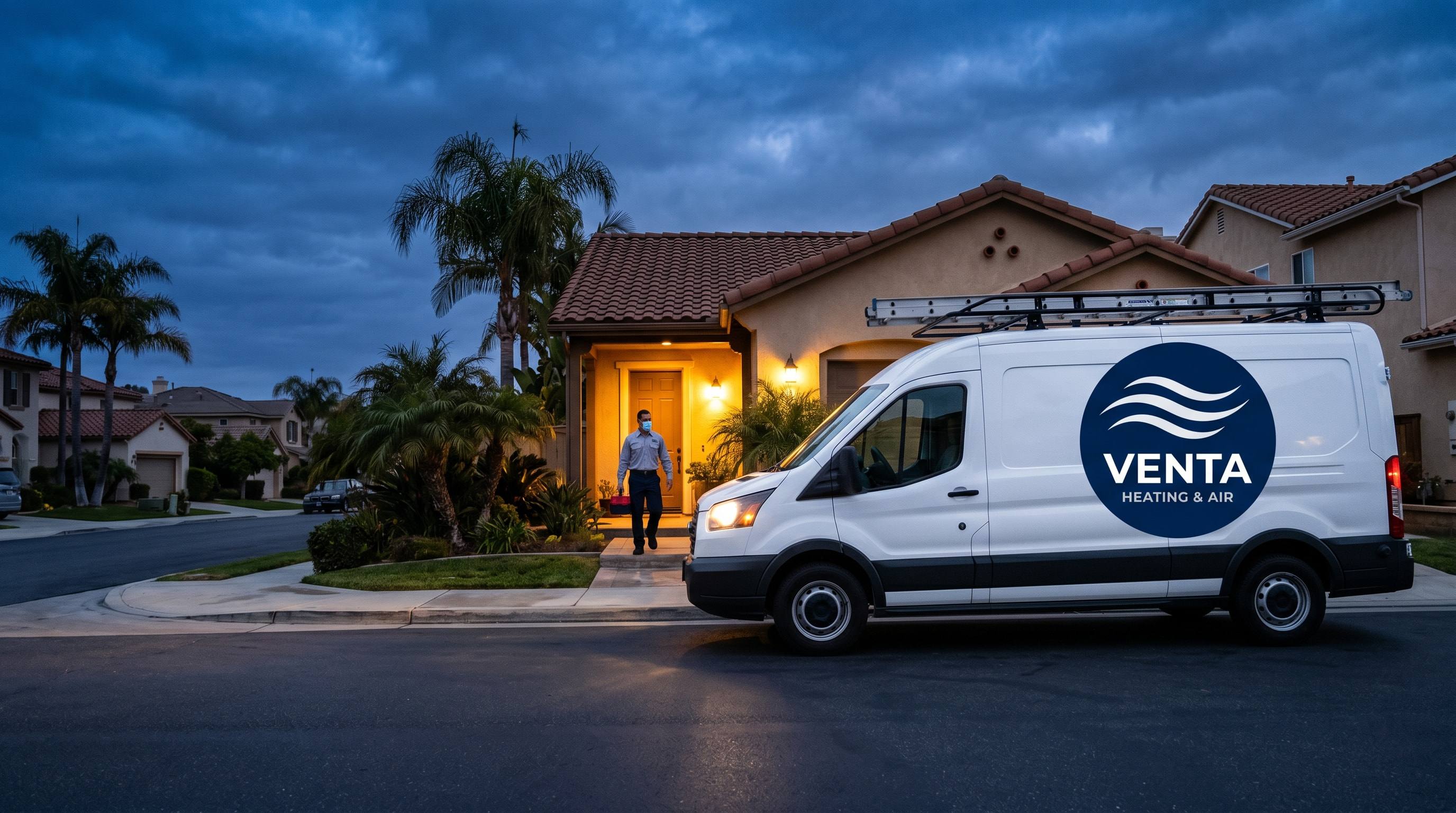
If your AC just died at 11 p.m. in August, or your furnace stopped working when the Santa Ana winds dropped Valley temperatures into the 40s overnight, you’re on the right page. Venta Heating and Cooling runs phone coverage 24/7 and same-day truck dispatch 8 AM–8 PM across all five Southern California counties we serve. After-hours calls (8 PM–8 AM) are documented and scheduled for first dispatch the following morning, with a confirmed arrival window before you hang up.
What actually happens when you call
Most LA HVAC chains advertise 24/7 emergency service. What that often means in practice: a phone-bank operator says “we will dispatch right away” at 2 AM and a tech actually arrives at 11 AM the next day. We do not do that. The honest answer is better than the false promise.
When you call (424) 766-1020 at any hour, a Venta dispatcher (real human, day or night) picks up. They confirm your address, ask three diagnostic questions (Is the system on or off? Any burning smell? Any water or gas odor?), and explain what to do in the meantime. If you call between 8 AM and 8 PM, they check which on-call technician is closest to you and give you an honest arrival window typically 60–120 minutes out (90–180 in the Inland Empire and Ventura County). If you call between 8 PM and 8 AM, they document the call, give you stabilization steps, and confirm a first-dispatch arrival window for the morning. We tell you up front so you can decide.
Why Southern California eats HVAC systems alive
Most of our after-hours calls cluster into three predictable patterns:
- July–September heat waves. When inland temperatures stay above 95°F for three days running, AC capacitors and contactors that were marginal in June fail under continuous load. We see capacitor failures spike 4–5x during heat-dome events. (Why a capacitor dies is something we walk through in our piece on why your AC isn’t blowing cold air.)
- October–November Santa Ana winds. Sudden temperature swings, voltage sags, and dust-storm events stress both AC and furnace systems. Outdoor condensers ingest ash and dirt; ignitors fail on the first heating call of the season. We wrote about Santa Ana effects on HVAC equipment if you want the full breakdown.
- Weekend and holiday surprises. Systems fail on Saturday before guests arrive far more often than statistically reasonable: because that’s the first time the system has run hard since spring. Spring tune-ups catch most of these in advance, but if yours didn’t happen, we’re who you call.
What we actually fix on after-hours calls
Roughly 80% of our emergency tickets resolve on the same visit because the failures repeat. The most common ones in order of frequency:
- Run capacitor blown: outdoor unit hums but won’t spin. Replace in 20–40 minutes. $185–$295 after hours.
- Contactor pitted/welded: unit won’t engage at all or won’t shut off. $195–$320.
- Frozen evaporator coil: system iced over from low refrigerant or restricted airflow. We thaw, locate the cause, and fix the underlying issue (filter, blower, refrigerant). See frozen evaporator coil for what usually causes this.
- Condensate pump or float switch: indoor air handler shut itself off because the drain pan filled. $220–$420.
- Furnace ignitor or flame sensor: furnace clicks but won’t fire, or fires for 7 seconds and shuts down. Bring your own coffee; we’ll have heat in 45 minutes. $245–$485.
- Tripping breaker: dangerous; we diagnose root cause (compressor short, blower motor short, wiring fault) before resetting anything.
Repairs we won’t do on an after-hours call: full compressor replacement, refrigerant line repair on R-454B (the new low-GWP refrigerant we’ll cover on our AC repair page), or any system replacement. Those get a temporary stabilization on the morning dispatch and a real solution scheduled for a follow-up day.
Honest after-hours pricing
Our standard daytime diagnostic is $89. The after-hours diagnostic fee is $149. After-hours labor carries a $50–$80 surcharge over standard rates. The diagnostic covers truck roll, full system inspection, and a written estimate. The repair itself is quoted at flat-rate pricing before we touch anything, we don’t bill hourly, and we don’t apply emergency multipliers on the repair line beyond the documented surcharge.
If you decide not to proceed with the repair, you pay only the diagnostic. If you proceed, the diagnostic is rolled into the total. That’s it.
When you should NOT wait for us
Three situations are not HVAC calls, they’re 911 calls:
- Smell of gas inside the house. Leave the building. Don’t flip switches, don’t use the phone inside. From a neighbor’s house or outdoors, call SoCalGas at 1-800-427-2200 or 911.
- CO alarm sounding. Get everyone out. Call 911. We can replace a cracked heat exchanger after the fire department clears the scene.
- Visible flames or smoke from the air handler or furnace closet. Cut power at the breaker if safe to do so. Get out. Call 911.
Service areas & regional dispatch
We dispatch from six regional crews so you’re never waiting for a tech to drive 90 miles. Each region has its own direct line:
- Los Angeles County (West LA main): (424) 766-1020: covers Santa Monica, Beverly Hills, Culver City, West Hollywood, the Westside.
- San Gabriel Valley: (626) 499-5530, Pasadena, Glendale, Burbank, Arcadia, Monrovia.
- Orange County: (949) 785-5535 — see our OC emergency dispatch page for response times by city.
- Ventura County: (805) 977-9940 — see our Ventura County emergency dispatch page for Santa Ana wind and post-fire smoke remediation context.
- San Bernardino County: (909) 757-6455 — see our Inland Empire emergency dispatch page for heat dome and mountain considerations.
- Riverside County: (951) 744-9188 — covered on our Inland Empire emergency dispatch page.
You can call any of these numbers and reach the regional on-call tech directly, or call the main West LA line and we’ll route you. The number in the sidebar on each city page is the local one.