
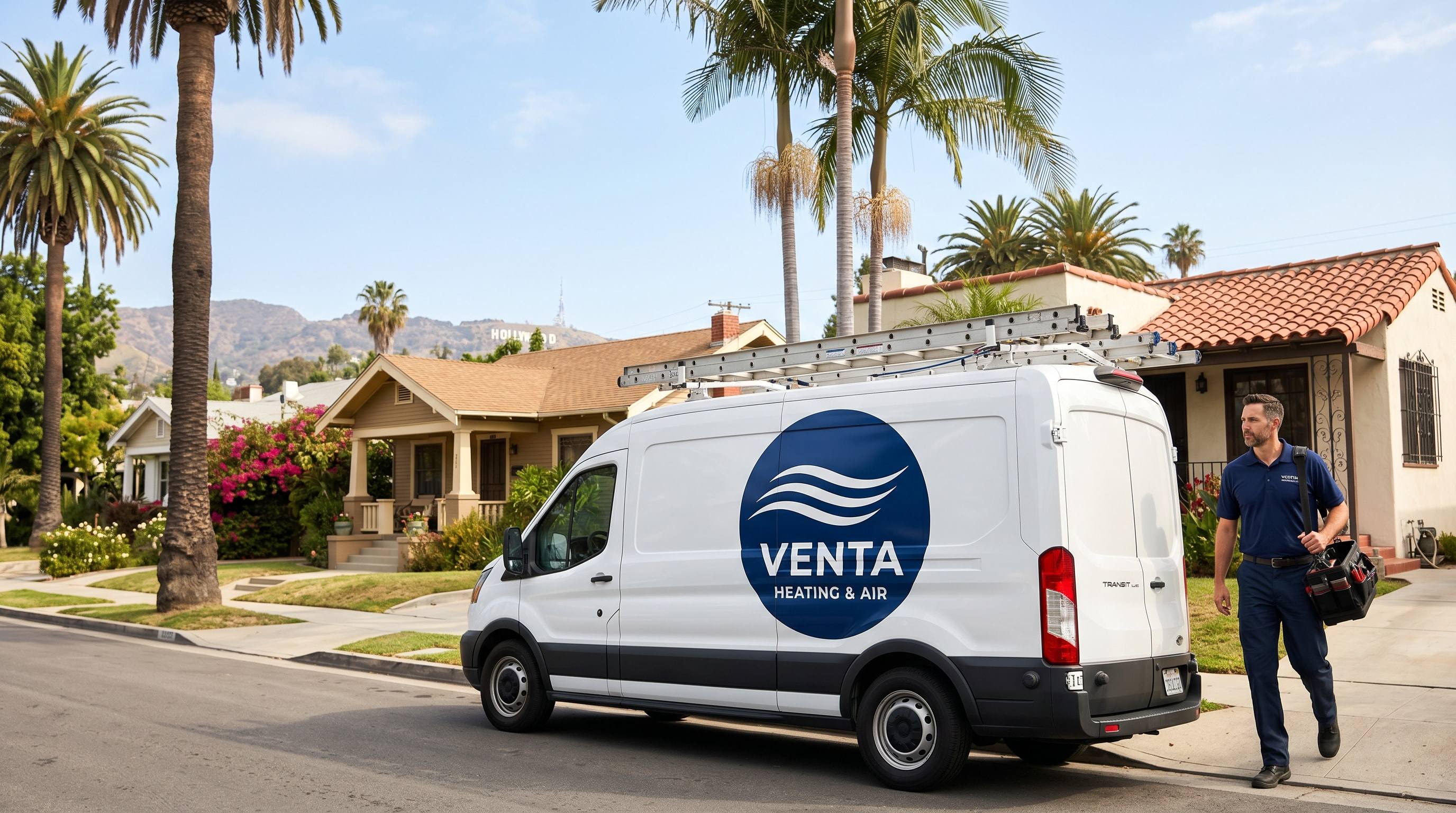
The colorist’s booth in a post house off Riverside Drive hits 76°F by 2pm and the calibration drifts. The mix stage on Olive Avenue picks up an audible 60-cycle hum from a contactor that’s been chattering for three weeks. The voiceover booth in the converted Magnolia Park garage runs 4 dB louder than the engineer can use because the previous shop installed a 78-dB outdoor condenser six feet from the booth wall. Those are three real Burbank service calls from the past month, and they’re the failure modes that define HVAC work in this city.
Burbank is a residential market and a media-production market sharing the same zip codes, and the equipment that works for one often fails the other. Residential calls in Magnolia Park, Burbank Hills, and Rancho look like every other SFV city — pre-war bungalows without ducts, 1980s tract homes with aging condensers, the same mix you’d see in Sherman Oaks. The commercial calls along the Media Mile are different: tight temperature tolerances (±1°F in color suites), low-NC noise targets so the system doesn’t bleed into recordings, redundancy on critical rooms, service windows that fit shooting and edit schedules.
The temperature-stability problem in color and mix
Standard residential AC cycles on for 8–12 minutes, blasts cool air, shuts off, drifts back up 2–4°F before the next cycle. That’s fine in a bedroom. It destroys monitor calibration in a color suite, where reference monitors and broadcast monitors have temperature coefficients that shift the displayed image as the room temperature drifts. We solve this on commercial Media Mile work with variable-speed equipment that modulates from 25% to 100% capacity continuously, holding setpoint within ±0.5°F across an 8-hour edit session, paired with thermostats that report rather than hide the actual delivered temperature.
For home offices and converted-garage edit suites, the same logic applies at smaller scale. Single-zone variable-speed mini-splits (Mitsubishi MSZ-FH or LN series, Daikin Quaternity) hit the temperature stability and run at 19–22 dB on low fan, quiet enough to not bleed into recordings.
The airport-noise overlay
BUR (Hollywood Burbank Airport) puts a steady takeoff-and-landing soundtrack over much of the city. Homeowners who already deal with that don’t want a 78 dB outdoor condenser adding to it. Modern variable-speed inverter equipment runs 55–62 dB, quieter than conversation. We carry sound spec sheets for every system we quote and steer clients toward Mitsubishi, Bosch, and Carrier Infinity for the quietest residential options. The cost premium over a single-stage 14.3 SEER2 unit is $1,500–$3,500 depending on tonnage, often eligible for TECH Clean California rebates that close most of that gap on a heat pump configuration.
Pre-war bungalows: ductless or nothing
A meaningful share of Magnolia Park, Rancho, and Burbank Hills foothill streets are 1920s–1940s bungalows that were never built for central air. Forcing ducts into them means soffit drops, ceiling chases, and torn-up plaster. Mini-split heat pumps avoid all of that, we install them weekly in these neighborhoods. Single-zone $4,200–$6,800 installed; three-zone whole-house $10,500–$15,500. The math against ducted retrofit on these properties isn’t close. Detail: mini-split service.
SFV inland heat, the Hollywood Hills wall
Burbank sits on the SFV side of the Hollywood Hills and runs 8–15°F warmer than Hollywood on the same day. AC sized off Westside rules of thumb is consistently undersized here. We measure the home with Manual J load calculations tuned to the actual SFV climate zone and recommend SEER2 16+ inverter systems for properties running AC continuously through summer. The 1,800 sq ft tract home in central Burbank that another shop quoted at 2.5 tons is usually a 3-ton job once we run the actual numbers.
1970s–80s tract ductwork
Newer Burbank tract housing along the airport corridor and east toward Glendale was built with R-4.2 attic flex duct. After 35–55 years of attic heat, most of it tests at 25–40% leakage on HERS verification. We measure on every replacement quote so the leakage number is on paper before you decide. A new $9,000 system delivering through 35%-leaky ducts performs about like a $5,000 system delivering correctly — the duct work is often the higher-impact half of the project.
Home-office and home-recording HVAC
Post-pandemic, a meaningful share of Burbank media-industry residents work from a home office or a converted garage that’s become a recording booth, edit suite, podcast studio, or color-grading station. That changes HVAC requirements: tighter temperature control than a normal bedroom (±1–2°F vs. ±3–4°F), low background noise (NC-25 or quieter), isolation from the rest of the house’s thermostat schedule. We solve this with single-zone ductless mini-splits dedicated to the work room, Lutron-integrated smart thermostats for unattended schedule control, and acoustic isolation on the indoor head where needed. We’ve done a lot of these in Magnolia Park and Toluca Woods garage conversions over the past 3 years.
The Media Mile commercial scope, plainly
- Rooftop packaged unit service and replacement on production-office buildings.
- Split DX systems in edit bays and color suites with tight temperature tolerances.
- Mitsubishi VRF on larger post-production buildings where zoning matters.
- Ductless retrofits in bungalow-converted offices.
- Dedicated outdoor air systems where required for occupancy density.
- After-hours service windows that fit shooting and post schedules: 5am, midnight, weekends, no surcharge.
Coverage
Burbank residential and commercial: Magnolia Park, Burbank Hills, Rancho, Media District, Downtown Burbank, Toluca Woods, the Media Mile. Beyond city limits we serve Glendale, Sherman Oaks, Van Nuys, Pasadena, and West Hollywood. Wider county view: Los Angeles County HVAC.
Service expectations: $89 diagnostic, fixed-price written quote upfront, sound data sheets at quote not after install, permits in your name. CSLB #1138898 (C-20).