
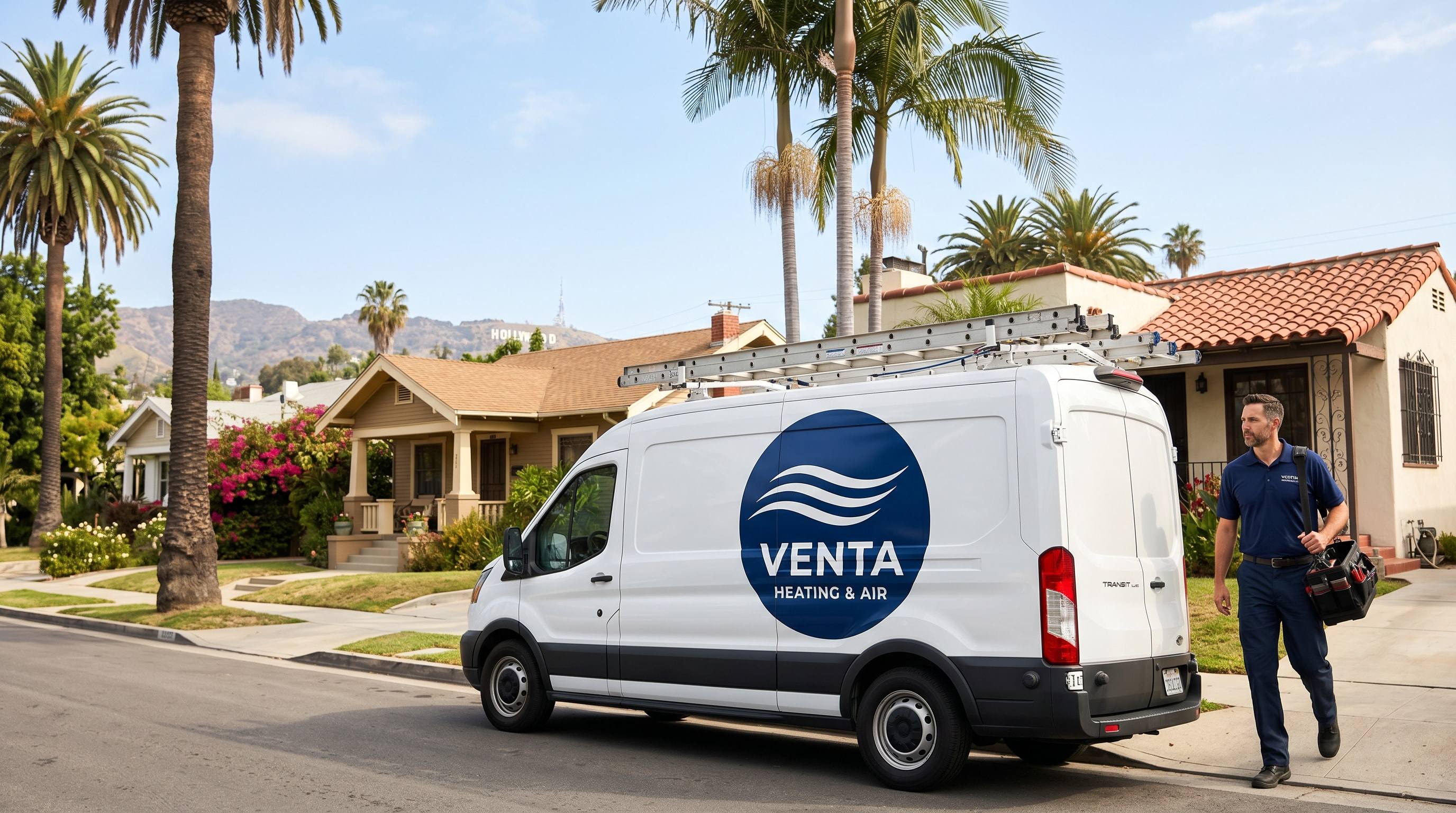
South of Ventura Boulevard, last August. A 1968 Royal Oaks ranch home, original galvanized ductwork in the attic, a 4-ton condenser hammering away on a 105°F afternoon. Supply-air temperatures coming out of the registers were running only 10°F off return, about half what a healthy system should deliver. The owner had paid a different shop $2,400 the previous spring for what they called a “system tune-up”: new capacitor, refrigerant top-off, filter swap. None of which addressed the actual problem.
The ducts were leaking 38% of conditioned air into the attic before it ever reached the house. The new AC she was about to buy (the recommendation from the previous shop, $11,500 quoted) would have performed exactly the same way. We test ducts on every replacement quote in Sherman Oaks because they almost always look like that.
What we found on that Royal Oaks job
Three issues stacked on top of each other. The original 1968 galvanized ductwork had failing cloth-tape joint seals at every transition, typical for the era; cloth tape ages out around 30 years and they were on year 56. The 4-ton condenser was correctly sized for the cooling load but oversized for the ductwork now able to carry: the system was throttling itself. And the hillside south-of-the-Boulevard exposure meant west-facing afternoon sun was hitting the kitchen and primary bedroom for 4–5 hours daily, which the original Manual J at install time had underestimated.
Our quote: full duct replacement ($4,800), 17 SEER2 variable-speed inverter condenser swap to the same 4-ton tonnage (the load was right, the delivery wasn’t), and a smart thermostat with humidity setpoint to handle the marine-layer afternoons. Total $11,200. Roughly the same as the previous shop’s like-for-like quote, but with a system that would actually move the air.
Why 1950s–60s ranch ducts fail HERS testing
Most central Sherman Oaks built out 1948–1968. The original ductwork (galvanized rectangular trunks feeding round-metal branches with cloth-tape sealing) has been failing at the joints for 60+ years. HERS leakage testing now routinely shows 30–45% loss on these systems. The math is uncomfortable: a new $9,000 AC delivering its full nameplate capacity through 35%-leaky ducts performs about like a $5,000 AC delivering correctly. You’d be ahead of the game with the cheaper unit and the duct replacement.
We HERS-test on every replacement quote. The number goes on paper before you decide.
When variable-speed inverter equipment makes sense (and when it doesn’t)
Most Sherman Oaks installs end up as variable-speed inverter systems. Mitsubishi, Carrier Infinity, Lennox SL, Daikin Fit, Bosch IDS. Run-time math at south-Valley cooling-hour totals (1,200–1,500 hours/year) makes the operating-cost payback work in 5–7 years. Premium installed pricing $8,500–$12,500.
But not always. Three honest cases where we recommend something else:
- Existing furnace has 8+ good years left and you only need to swap the AC. A quality two-stage condenser at $5,800–$7,500 often pencils better than the inverter.
- Property is going on the market within 2–3 years. The inverter premium doesn’t recover at sale; buyers don’t price differently between SEER2 14.3 and SEER2 17.
- You’re north of the Boulevard with low cooling-hour exposure (shaded lot, mostly north-facing windows). The math gets thin.
Smart-home integration without overkill
Sherman Oaks has unusually high penetration of whole-home automation: Lutron RadioRA 3, Control4, Crestron, Savant. We work with these every week. Ecobee Premium and Honeywell T10 Pro thermostats both speak Lutron and Control4 native; Carrier Infinity, Lennox iComfort, and Mitsubishi Kumo Cloud handle multi-zone control via their own apps and integrate with Control4/Crestron through proprietary drivers.
Practical: bring your integrator’s name to the quote. We pre-program zoning schedules, geofencing, and humidity setpoints during commissioning so the integrator just adds the device to your scenes. We don’t make you re-run conduit because we picked the wrong protocol.
South-of-the-Boulevard hillside cooling loads
Hillside properties south of Ventura Blvd absorb west-facing afternoon sun for hours longer than flat lots. Cooling loads run 25–35% above what coastal-LA rules of thumb suggest for the same square footage. We measure the home (window orientation, ceiling heights, infiltration, internal gains) before quoting tonnage; we don’t guess from square footage.
Coverage
Sherman Oaks proper plus Encino, Van Nuys, Studio City, Valley Village, Woodland Hills, and Burbank. Same-day during business hours; the dispatcher gives you a real arrival window when you call. Wider county view: Los Angeles County HVAC.
Service expectations, written down: $89 diagnostic with a fixed-price written quote before any work begins, no commission on parts upsell, permits pulled in your name, HERS testing scheduled by us. CSLB #1138898 (C-20).