
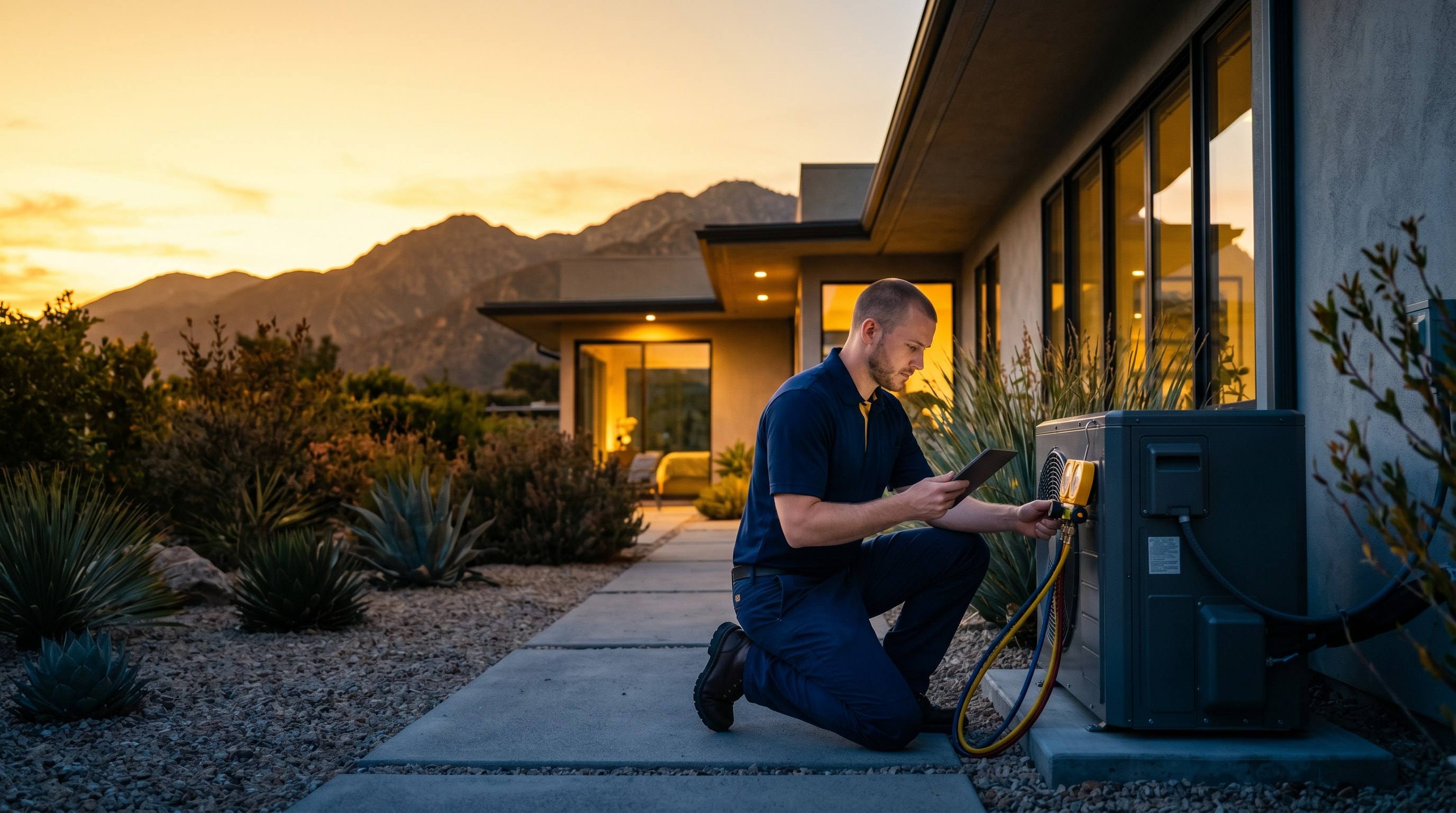
A heat pump is a single piece of equipment that does both heating and cooling. It works like an air conditioner that runs in reverse: in summer it pulls heat out of your house, in winter it pulls heat from the outdoor air and dumps it inside. Air-source heat pumps were borderline in Minnesota winters until recent inverter technology made them viable below freezing; in Southern California, where outdoor temperatures rarely drop below 35°F even inland, they’ve been the right answer for a decade.
This guide covers what a heat pump actually is, why SoCal's climate is one of the best fits in the country, how performance differs from coastal to inland to high desert, and how to choose between ducted and ductless configurations. Installation cost, equipment brands, the 2026 rebate stack, Manual J sizing, A2L refrigerant, and the permit / HERS process all live on a dedicated page: heat pump installation. If your existing heat pump isn’t working, see heat pump repair.
Why heat pumps fit SoCal climate so well
Heat pumps move heat instead of generating it. In heating mode they pull heat from outdoor air (yes, even at 35°F) and dump it inside. In cooling mode they reverse and work as a regular AC. The colder the outdoor air, the harder the equipment works: that’s why heat pumps used to struggle in Minnesota winters. Modern variable-speed inverter systems work fine down to 5°F. Southern California rarely sees temperatures below 35°F even in inland areas. That’s the sweet spot.
What this means in operating-cost terms: a modern heat pump runs at COP 3.5–4.5 in our climate (each $1 of electricity moves $3.50–$4.50 of heat). A 95% AFUE gas furnace runs at COP 0.95 against natural gas. At 2026 SCE / LADWP / SoCalGas rates, the heat pump usually wins on operating cost in coastal and mid-basin LA, breaks even in the Valley, and depends on the cooling load in the Inland Empire.
For homes already replacing both an aging furnace and an aging AC at the same time, a heat pump consolidates the equipment from two units to one with similar installed cost — before rebates.
2026 rebate stack at a glance
The federal IRA Section 25C tax credit ($2,000 on heat pumps) terminated December 31, 2025 under OBBBA; the active 2026 stack is utility-led. LADWP pays $1,250 per ton on ducted heat pumps and up to $2,500 per ton on ductless in their territory. SCE rebates run $300–$1,200 outside LADWP. TECH Clean California ($3,000–$8,000 when funded) and HEEHRA are both waitlisted statewide.
For full 2026 California rebate detail including LADWP, SoCalGas, TECH waitlist status, HEEHRA / HEAR / HOMES, and worked stack examples by scenario, see our California HVAC Rebates & Tax Credits 2026 pillar.
Coastal vs. inland heat pump performance
Climate zone matters for sizing and operating cost:
- Coastal (Santa Monica, Malibu, Huntington Beach): mild year-round. Heating load is small. Cooling load is small. Smallest tonnage works. Operating cost lowest. Heat pump easily wins on the math.
- Mid-basin LA (West Hollywood, Culver City, Beverly Hills): moderate cooling load, light heating. Heat pump wins on operating cost and equipment consolidation.
- San Fernando Valley (Burbank, Sherman Oaks, Woodland Hills): heavy cooling load, real (45°F) winter nights. Variable-speed heat pump is the standout choice.
- San Gabriel Valley (Pasadena, Glendale, Arcadia): similar to Valley.
- Inland Empire (Riverside, San Bernardino): heavy cooling load, occasional cold snaps in winter. Larger tonnage, look at variable-speed inverter for efficiency at part-load.
- High desert & mountain (Palmdale, Lancaster, Big Bear, Wrightwood): real winter heating loads. Cold-climate heat pump (rated to 5°F or lower) or dual-fuel (heat pump + gas backup) is the right call here, not a standard heat pump.
Ducted vs. ductless mini-split
Two main configurations:
- Ducted heat pump: outdoor condenser + indoor air handler / evaporator coil, uses your existing ductwork, one thermostat per zone. Best for homes with intact ductwork. $7,500–$11,000 installed before rebates.
- Ductless mini-split: outdoor unit + one or more indoor heads mounted high on walls, no ducts needed. Each head has its own thermostat. Best for homes with no ductwork (older bungalows, ADUs, additions), single-zone problems, or rooms central never reaches. $4,200–$6,800 single-zone, $10,500–$18,000 multi-zone. Our mini-split page has the full breakdown.
We install Mitsubishi Hyper-Heat (MXZ-3C30NAHZ2 multi-zone), Daikin Fit (DZ20VC ducted), Bosch IDS, Carrier Infinity (25VNA8 variable-speed), Lennox dual-fuel, and Trane XV20i heat pump and mini-split equipment. Brand-by-brand fit and pricing in our heat pump brand comparison.
Permits, HERS, and electrical capacity — short version
Every heat pump install in California requires a city or county permit and Title 24 / HERS verification (duct leakage, refrigerant charge, static pressure). Most LA homes are 100–200A service; a 3-ton heat pump needs a dedicated 30–50A circuit, and an old panel may need a service upgrade ($2,500–$4,500) or a smart-panel / load-management alternative.
Full permit, HERS, A2L refrigerant, and Manual J scope is on our heat pump installation page. Background reading: HVAC permits in LA and California HERS testing.
Ready to install or need repair?
This page is the conceptual guide. The action pages are next door:
- Installing a new heat pump: pricing, equipment selection, Manual J load calculation, A2L refrigerant, permit and HERS process, real install timeline, composite examples. Get an installation quote →
- Existing heat pump not working: common failure modes by brand (Mitsubishi P-codes, Carrier Infinity touch faults, Daikin D-Checker, Lennox dual-fuel crossover), same-day regional dispatch, repair-vs-replace framework. Need heat pump repair →
Service areas
We install and service heat pumps across Los Angeles County, Orange County, Ventura County, San Bernardino County, and Riverside County. Each region has dedicated dispatch numbers in the footer. For comparison reading: AC installation, furnace installation, HVAC repair.