
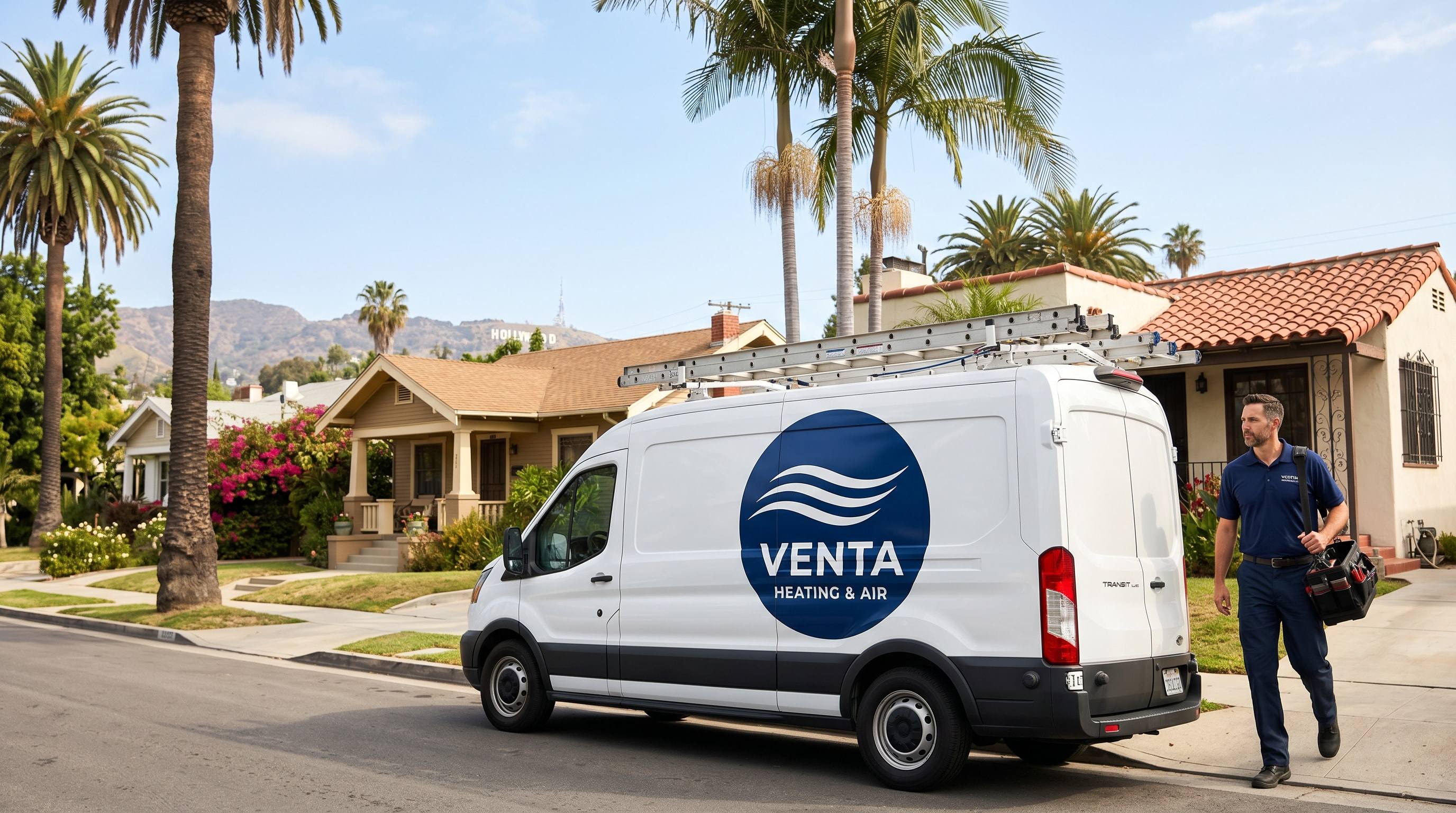
Most contractors think Culver City is just another Westside suburb. They're wrong about the climate, wrong about the housing stock, and very wrong about what the customer base actually needs. The Westside-suburb assumption produces oversized 4-ton equipment in 1928 Spanish bungalows that should have a properly sized 2-ton mini-split, generic office HVAC scopes for tenants whose actual problem is a server room nobody quoted dedicated cooling for, and lazy permitting work routed to LA City, which is the wrong jurisdiction here entirely.
Culver City has its own building department. Its own marine influence pulled inland through the Ballona Creek corridor. Its own cluster of post-production houses, edit suites, color-grading bays, and tech tenants whose comfort problem isn't really a comfort problem, it's a 24/7 thermal-load problem the building HVAC was never designed to handle. Our service work here is built around those three realities, not around the West LA template that gets recycled by every contractor working out of a Westchester yard.
The server-room mistake we see almost weekly
An edit house on the Hayden Tract called us in February after their fourth complaint to the building engineer in three weeks. Office temps were fine. The 14-rack colocation closet was hitting 91°F by 3 p.m. with two AVID stations actively rendering. Building HVAC schedules off at 7 p.m. and the rendering didn't. Their previous HVAC contractor had quoted a "supplemental rooftop unit" at $28,000 routed through the building's existing duct trunk, which would have over-cooled the open-plan office, under-cooled the closet, and required after-hours building-engineer authorization every weekend.
The right answer was a dedicated 2-ton inverter mini-split on its own dedicated 240V circuit, low-temp kit so it could run on 48°F February nights without locking out, MERV-13 filtration to keep dust off the racks, and a separate thermostat the tenant controls 24/7 without going through building. $7,400 installed. They've had no thermal-cycling shutdowns since.
What the marine influence does to Manual J here
Culver City sits about four miles inland with the Ballona Creek corridor pulling marine air east through the city. July afternoons run 4–8°F cooler than Mid-Wilshire and 10–15°F cooler than the SGV on the same day. Morning marine layer is heavier than in West Hollywood, lighter than in Mar Vista. The result: real cooling load, but moderate.
The wrong answer is the 4-ton or 5-ton install routinely pushed in inland tract markets. We measure the home before quoting tonnage, and the right system here for most Culver City single-family is a 2- or 3-ton variable-speed setup that can modulate down during coastal-influence months and actually pull humidity. Oversized fixed-capacity equipment short-cycles in this climate and leaves rooms feeling clammy. We've replaced more than a few of those.
1920s–30s Spanish bungalows: why ducted is almost always wrong
Carlson Park, the Helms district, Lucerne–Higuera, the original downtown blocks, the streets around Veterans Park: a meaningful share of the housing here is 1920s and 30s Spanish Colonial and Mediterranean Revival. Lath-and-plaster walls, no attic in many cases, original layouts that don't accept duct chases without major destruction.
Mini-split heat pumps are the answer almost every time. Single outdoor condenser, two 3-inch wall penetrations, no soffit drops, no plaster damage. Single-zone runs $4,200–$6,800; a three- or four-zone whole-house lands $10,500–$16,500. We coordinate Culver City Historic Preservation Program review where it applies. Detail: mini-split installation.
Independent permitting (this trips up contractors weekly)
Culver City is its own incorporated municipality with its own Building Safety Division. Not LA County. Not LA City. Mechanical permits for AC change-out, furnace replacement, and new installs go through Culver City Building: period. The Title 24 / HERS verification still applies (duct leakage, refrigerant charge, fan watt-draw). Historic Preservation Program properties may need additional review for visible outdoor equipment. Commercial tenant improvements in studio-adjacent office buildings often loop in Culver City Planning as well.
We pull permits in your name and coordinate inspections. Door-knocking contractors who quote you a $200 permit fee from "LA Building" got the jurisdiction wrong, that's the first sign they don't actually work this market.
What our commercial scope looks like
The volume of TI work in Culver City office stock is genuinely high. We coordinate with general contractors, building engineers, and property managers on:
- New VAV box installation and rebalancing for refit floor plans.
- Supplemental cooling for high-density office layouts that exceed the building HVAC's design intent.
- After-hours zone control programming for tenants on non-standard work cycles.
- Ductwork modifications and rerouting where new walls land on existing duct paths.
- Dedicated mini-split design for server rooms, edit bays, and color-grading suites.
- Continuous-duty inverter equipment with MERV-13+ filtration for sensitive rack environments.
2026 rebate stack and the residential math
Culver City is on SCE for electric service. The active 2026 stack: SCE rebates $300–$1,200 depending on equipment HSPF2, SoCalGas furnace-removal incentives when capping the gas line. TECH Clean California ($3,000 standard, $4,000 moderate, up to $8,000 low-income) is currently waitlisted on single-family heat pump HVAC (funds fully reserved November 14, 2025) — we submit reservations in case funding reopens. Federal IRA Section 25C ($2,000) was terminated December 31, 2025 under OBBBA and is no longer in the 2026 stack. A typical $9,500 Culver City heat pump conversion lands $7,500–$8,500 net under the active stack. If TECH funding reopens during the project window, the $3,000 standard tier deducts on top. Detail: TECH Clean California rebates and what's actually available in 2026.
Where we're honestly not the right fit
Two cases worth being upfront about. First, if your apartment is in an Irvine Company-style master-managed building (Hackman, Gateway, or a few of the larger property-management portfolios) you usually have to go through their approved-vendor list and we can't bypass that. Second, sometimes the like-for-like swap pencils better than the inverter we'd usually quote: if you have a healthy 8-year-old AC and the only failed component is a $300 capacitor, replacing the unit because we'd rather sell you a heat pump is bad advice. We tell you when that's the case.
Coverage
Downtown Culver City, the Helms Bakery district, Carlson Park, Lucerne–Higuera, Fox Hills, Veterans Park, Sunkist Park, Studio Village, the Hayden Tract / Silicon Beach corridor, and the Sony Pictures area. Beyond city limits: Mar Vista, Palms, Cheviot Hills, Westchester, Playa Vista, and Mid-City. Neighbor pages: Santa Monica, West Hollywood, Brentwood.
(424) 766-1020 reaches a real person on the West LA dispatch line. CSLB #1138898 (C-20). Upfront pricing in writing before any work begins.