
AC problems we fix across LA every week
Most AC failures in Southern California fall into a handful of patterns we see over and over. Knowing what’s most likely from the symptom saves time when you call — we bring the right parts on the first truck.
AC running but not cooling. Top three causes: dirty condenser coil restricting heat rejection, refrigerant undercharge from a slow leak, or a weak compressor that no longer pulls down to target pressures. Roughly 40% of “not cooling” calls in Pasadena and the San Gabriel Valley during a heat wave turn out to be coil cleaning plus a capacitor — under $400 total. The other 60% are split between leak detection work and compressor diagnosis. Full diagnostic walkthrough: AC running but not cooling.
AC won’t turn on at all. Usually a tripped breaker, dead thermostat batteries, failed low-voltage transformer, or a contactor that’s welded itself open. Cheap to diagnose, cheap to fix. About 1 in 5 calls in this category gets solved at the thermostat before the tech even opens the cabinet.
Capacitor failure. The single most common AC repair in LA, period. The dual-run capacitor inside the condenser fails at year 5–8 in coastal zones (Santa Monica, Manhattan Beach) and year 8–12 in inland LA. Symptoms: humming compressor that won’t start, slow startup, or no outdoor unit response while the thermostat clicks on. We carry the four most common capacitor sizes (35/5, 40/5, 45/5, 50/5 µF) on every truck. Replacement runs $185–$295.
Frozen evaporator coil. Ice on the refrigerant lines or indoor coil. Causes: airflow restriction (dirty filter or coil), low refrigerant charge, or stuck blower wheel. Shut the AC off, switch the fan to “on” for 60–90 minutes to thaw, then call. Running a frozen system damages the compressor — $2,800 part doing what a $30 filter could have prevented. Full guide: frozen evaporator coil.
Water leaking inside. Clogged condensate drain line. Algae and dust build up over time and block the line, water backs up into the secondary pan or onto the ceiling. We clear it with nitrogen or a wet-vac at the outdoor termination. Usually 30 minutes, $145–$245. Detail: clogged AC drain line.
AC short cycling. Turns on, runs 3–5 minutes, shuts off, repeats. Could be a low refrigerant charge tripping the low-pressure switch, an oversized system, a dirty coil overheating the compressor, or a thermostat placement problem (direct sun, near a supply register). Short cycling burns compressors fast — don’t let it run for days. Full guide: AC short cycling.
Strange noises. Grinding from the outdoor unit is usually a failing condenser fan motor bearing. Loud humming on startup is a capacitor going. A rhythmic clicking at startup is the contactor chattering. Hissing at the indoor coil is a refrigerant leak — that one is a stop-using-it call. Full guide: HVAC strange noises.
If your AC is icing over, leaking water across drywall, or producing a burnt-electrical smell, shut the breaker off and call us before continuing to run it.
AC repairs by symptom
Jump straight to the failure you’re dealing with — each page has its own diagnosis, flat-rate pricing, and repair detail:
AC repair cost in Los Angeles 2026
Honest pricing, parts and labor included. These are real ranges from our service tickets across all five counties:
| Repair | Typical cost | Time |
|---|---|---|
| Diagnostic visit | $89 (waived with repair) | 30–60 min |
| After-hours diagnostic | $149 | 30–60 min |
| Dual-run capacitor (35–50 µF) | $185–$295 | 20–30 min |
| Single-run capacitor | $145–$245 | 20 min |
| Contactor (24V single or double pole) | $165–$285 | 30–45 min |
| Hard-start kit installation | $185–$345 | 30 min |
| Low-voltage transformer | $185–$345 | 30–45 min |
| Thermostat replacement (basic) | $185–$385 | 45–60 min |
| Thermostat replacement (Nest, Ecobee, communicating) | $285–$585 | 60–90 min |
| Condensate drain line clearing | $145–$245 | 30 min |
| Condenser coil cleaning (chemical) | $245–$485 | 60–90 min |
| Evaporator coil cleaning (in-place) | $385–$685 | 1.5–2 hr |
| Refrigerant leak detection (UV dye + electronic) | $245–$485 | 1–2 hr |
| R-410A refrigerant recharge (per lb) | $85–$145 | varies |
| R-454B refrigerant recharge (per lb, 2025+ units) | $125–$225 | varies |
| TXV (thermostatic expansion valve) replacement | $585–$895 | 2–3 hr |
| Condenser fan motor (PSC) | $485–$795 | 1–1.5 hr |
| Condenser fan motor (ECM) | $685–$1,085 | 1–1.5 hr |
| Blower motor (PSC) | $485–$895 | 1.5–2.5 hr |
| Blower motor (ECM variable speed) | $785–$1,485 | 1.5–2.5 hr |
| Control board (single-stage) | $385–$685 | 1 hr |
| Control board (communicating) | $585–$985 | 1.5 hr |
| Compressor replacement (out of warranty) | $2,400–$4,200 | 4–6 hr |
Honest line on these prices: refrigerant repairs are the most variable cost category in AC work. A small leak at a Schrader valve (the service port) is $185 — replace the valve core, recharge, done. A leak inside the indoor coil itself is a replace-the-coil conversation at $1,400–$2,400. We won’t quote refrigerant top-offs without finding the leak first. Topping off a leaking system is a $200 bill that lasts six weeks.
On R-22 systems (pre-2010, the older refrigerant phased out): we don’t recommend repairs that involve refrigerant work. R-22 costs $150–$600 per pound right now and climbing. Spend that money toward a replacement instead.
Roof-mounted package units in older Beverly Hills and Pasadena homes can add 25–40% to labor due to access (ladder work, OSHA fall protection requirements, two-tech minimums on most roof jobs). Crawlspace and attic indoor units in tight spaces add similar overhead.
When AC repair makes sense vs replacement
The “50% rule” you’ll see on contractor sites — replace if the repair cost is 50% or more of new system cost — is too simple for LA’s mix of housing stock and equipment ages.
Repair almost always wins when:
- Unit is under 10 years old
- Single component failure (capacitor, contactor, motor, fan)
- Repair total under $800
- System matched to home (correct tonnage, decent ductwork)
- SEER 13+ rating (still reasonable efficiency for LA climate)
Replacement starts making sense when:
- AC is 14+ years old
- Multiple major components failing in the same year
- Compressor failure on a unit past 12 years
- R-22 refrigerant system (phasing out, refrigerant cost climbing)
- Indoor coil leak combined with low SEER (under 13)
- Repair quote exceeds $1,800
A real-shape example we worked in Sherman Oaks last summer: 2009 Carrier 24ACA6 condenser, 16 years old, low on R-410A and noisy compressor. Diagnosis showed a slow leak at the indoor coil ($1,800 repair) plus a compressor pulling 8% high amp draw — borderline, 12–24 months until failure. The math: $1,800 today plus a likely $3,400 compressor next summer on a 16-year-old single-stage 13 SEER unit. Replacement with a 16 SEER2 Carrier 24SCA6 + matched coil landed at $9,400 installed. Five-year energy savings versus the old unit’s degraded performance: roughly $1,200. Net of LADWP rebate ($1,000 for the property’s zone): about $7,200 effective replacement cost. We replaced, customer hasn’t called since.
That same call on a 2019 unit, we replace the capacitor and walk out. Newer unit, fixable problem.
How AC repair works at Venta
We don’t do drive-by diagnostics or vague phone quotes. Every call follows the same process:
- Phone screen. We ask about symptoms, brand, age, and what you noticed. This lets the dispatcher bring the right parts on the first visit. About 75% of common AC repairs we complete in one trip because of this.
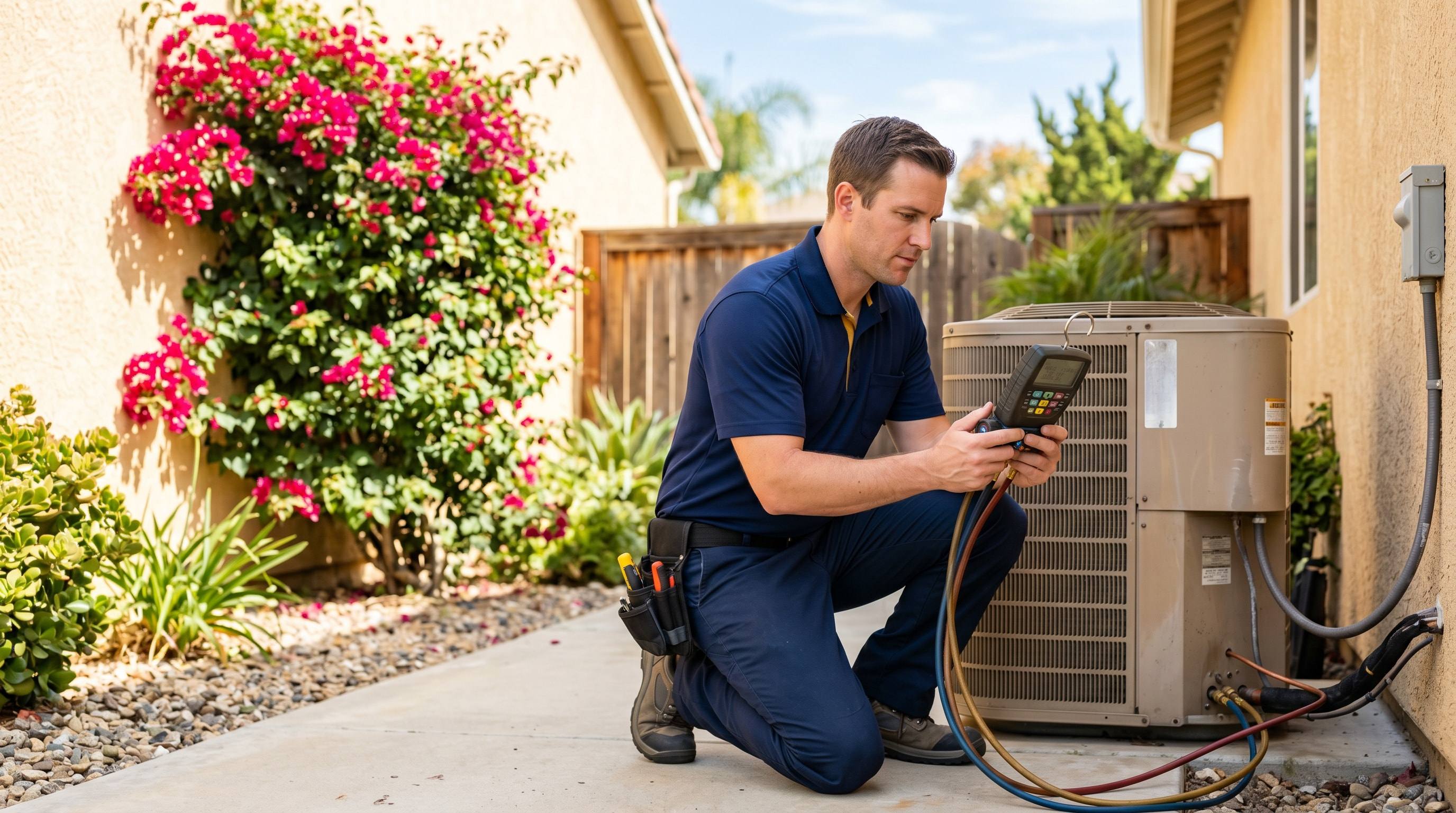
- On-site diagnostic. $89 flat fee, $149 after-hours, applied to the repair if you proceed. The tech reads error codes, measures amp draws on every motor, checks refrigerant pressures with manifold gauges, inspects the contactor and capacitor with a meter, and pulls the disconnect to verify line voltage. If it’s a heat pump, we test the reversing valve and defrost board.
- Written quote before any work. Part number, labor hours, total. No “trust me” pricing, no commission-driven upsells. If we recommend replacement instead of repair, we’ll show you the full comparison.
- Repair with OEM or quality aftermarket parts. Carrier, Lennox, Trane warranties require OEM components — we won’t void your warranty without telling you. For mid-tier brands (Goodman, Rheem, York), name-brand aftermarket capacitors and contactors are fine and we use them where appropriate.
- Refrigerant verification with gauges. Every repair touching the refrigerant circuit ends with superheat and subcool readings, not “feels cold at the vent.” We document the readings.
- 30-day labor warranty, parts warranty per manufacturer. Same problem returns within 30 days, we come back free.
AC brands we service
We repair every major residential central AC and heat pump brand sold in California over the last 25 years:
Carrier, Bryant (Carrier subsidiary), Lennox, Trane, American Standard (Trane subsidiary), Goodman, Amana (Goodman subsidiary), Rheem, Ruud (Rheem subsidiary), Daikin, York, Coleman (Johnson Controls subsidiary), Luxaire (Johnson Controls subsidiary), Mitsubishi, Fujitsu, LG, Samsung, Heil, Tempstar, Day & Night, Payne, Comfortmaker, ICP, Maytag, Armstrong Air, Ducane, Concord, Frigidaire, Nordyne, Westinghouse, and Gibson.
We do not service deeply obsolete equipment where parts are no longer manufactured (some pre-1995 units, certain regional brands long defunct). We’ll tell you upfront if that’s the case rather than waste your diagnostic fee. Brand-specific guides: brands hub.
Service area & response times
AC repair across all five Southern California counties. Each region runs from its own dispatch line so calls don’t bounce:
| Region | Response time | Phone |
|---|---|---|
| West LA, Westside | 60–120 min | (424) 766-1020 |
| Pasadena, San Gabriel Valley | 60–120 min | (626) 499-5530 |
| Thousand Oaks, Ventura County | 90–150 min | (805) 977-9940 |
| Irvine, Orange County | 60–120 min | (949) 785-5535 |
| San Bernardino, mountains | 90–180 min | (909) 757-6455 |
| Riverside, Inland Empire | 90–180 min | (951) 744-9188 |
City-specific AC repair pages:
Beverly Hills · Santa Monica · Pasadena · Sherman Oaks · Glendale · Burbank · Woodland Hills · Long Beach · Irvine · Newport Beach · Mission Viejo · Thousand Oaks · Riverside · San Bernardino · Palm Springs
A note on heat wave response times: when a heat dome event hits LA basin and inland temperatures pass 100°F for three or more days, call volume spikes 5–7x baseline. Every AC contractor in the region is buried at the same moment. We staff up for those events but the homeowners who’ve gone two summers without a tune-up are usually the ones calling at 4 PM on day three of 105°F. If you want to avoid that call, schedule annual maintenance in April or May before the heat builds.
Why choose Venta Heating and Cooling
CSLB licensed C-20 #1138898. California requires a C-20 license for residential HVAC work. Contractors operating without one are unlicensed, unbonded, and uninsured — you have no recourse when the work fails. Our license number appears on every invoice, in our website footer, and on the side of every truck. Verify any HVAC contractor at the CSLB License Check (cslb.ca.gov) before signing a contract.
Upfront pricing, no commission-driven techs. Our technicians aren’t paid commission on parts sold or systems upsold. They’re paid for fixing problems. That removes the pressure to “find” issues that don’t exist — a common complaint about LA HVAC chains where every diagnostic visit ends in a $12,000 replacement recommendation.
OEM parts where it matters. A generic capacitor installed on a 2020 Carrier under warranty voids the warranty. We won’t do that without your knowledge. Our quotes specify the part source.
Manifold gauges on every refrigerant call. Most LA companies skip pressure readings because the techs don’t carry the gear or aren’t trained on R-454B (the new low-GWP refrigerant required on 2025+ residential systems). We do. R-454B handling requires updated recovery equipment and EPA Section 608 certification — we have both.
Bonded and insured. General liability ($2M), workers comp, commercial auto. Required by California for licensed contractors, but worth mentioning because unlicensed operators in LA aren’t carrying any of it.
A note on 2026 rebates and tax credits
If you’re researching AC replacement quotes, you may be reading older articles that mention the federal Section 25C tax credit ($600 for AC, $2,000 for heat pumps). That credit expired December 31, 2025 under the One Big Beautiful Bill Act. Equipment installed in 2026 does not qualify for a federal tax credit, period.
What’s still active in our service area:
- LADWP rebates for high-efficiency AC and heat pumps in their territory (Los Angeles city, parts of the basin). Heat pump rebate up to $1,250/ton ducted. Verify your property is in LADWP service area before assuming.
- SCE rebates for qualifying high-efficiency cooling, typically $200–$500 depending on SEER2 rating.
- SoCalGas rebates for high-AFUE furnace upgrades (relevant if you’re doing dual-fuel).
- TECH Clean California heat pump program — currently waitlisted as of mid-2026, funding fully reserved.
Full breakdown: see our 2026 California rebate guide.
For pure repair work, none of this is relevant — repairs aren’t rebated. We mention it only because the most common AC replacement question we get since January 2026 is “is the federal tax credit really gone?” Yes. It’s really gone.
Schedule AC repair today
Most repairs scheduled before 2 PM are completed same day. Call your regional dispatch number above, or use our free estimate form. CSLB License C-20 #1138898. Licensed, bonded, insured. Serving Los Angeles, Orange, Riverside, San Bernardino, and Ventura counties.