
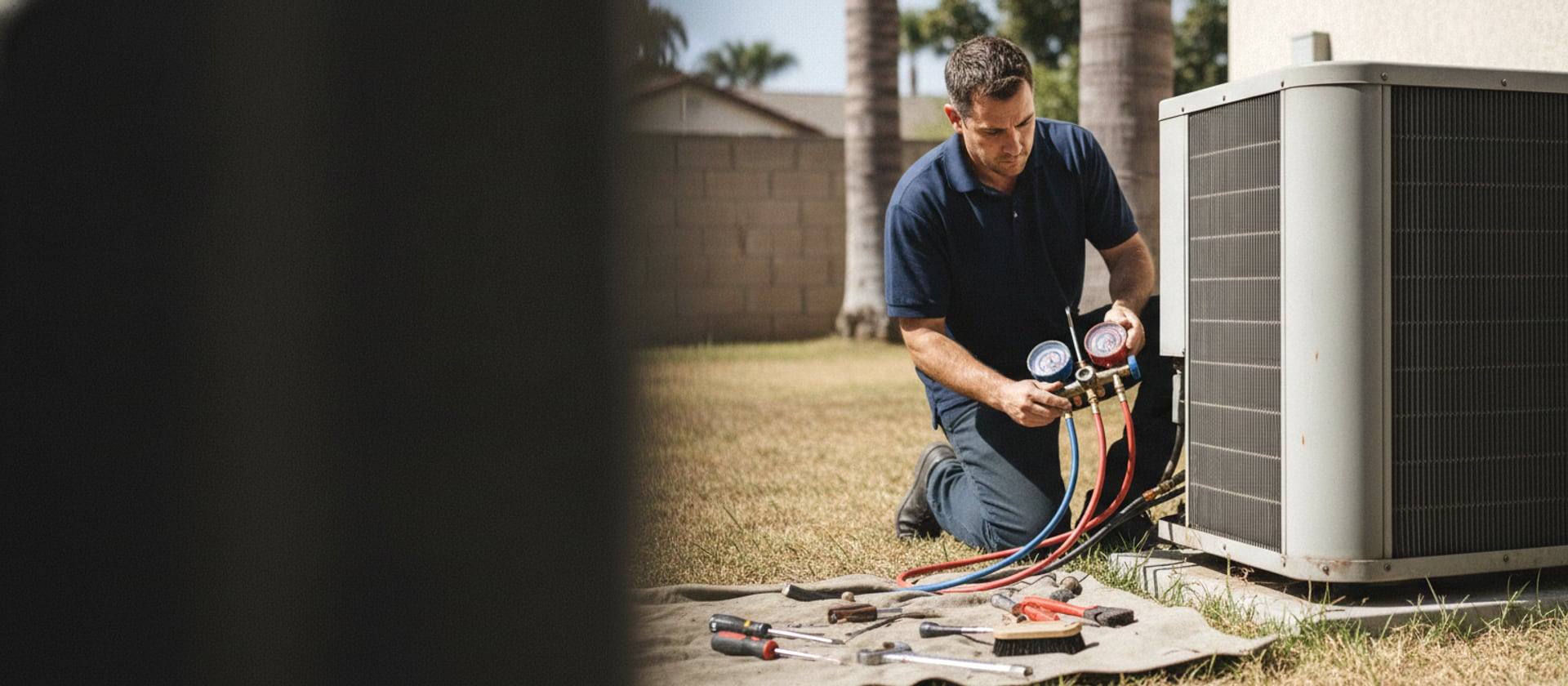
It was 78°F in West LA on April 12th. The system had been off for eight months. Homeowner flipped the thermostat to COOL, the condenser kicked on, and within four minutes the high-pressure switch tripped and the unit locked out. By the time we got there at noon the cabinet was hot to the touch and the homeowner was apologizing for the dust on the outdoor coil. The dust was not the problem. The capacitor had drifted 14% under nameplate over the winter, the contactor was pitted from a Santa Ana event in November, and a wasp had built a nest in the service-port cap. None of that was going to fix itself on its own.
Spring tune-ups exist because of this exact scenario. After 15+ years running these calls across LA, the SGV, and the Inland Empire, I can tell you the patterns are boring and consistent: equipment that sat idle from October to April does not wake up gracefully in May. Capacitors drift. Contactors pit. Bearings dry out. Drain pans grow biofilm. Filters that were "fine in October" are stiff cardboard in April. The first 95°F day in LA arrives somewhere between May 5 and May 25 most years, and that is when the call queue jams. The homeowners who scheduled in March barely notice the heat dome. The ones who waited spend three days waiting on a same-day appointment that is suddenly six days out.
What an idle SoCal AC actually does over the winter
The industry brochures call this "system rest." It is not rest. It is six months of slow electrical and mechanical drift while you are not looking. Three things consistently degrade between October and April:
Run capacitors are the canary. They are heat-sensitive electrolytic components and they lose microfarads gradually whether the system runs or not. Most 45/5 dual-run capacitors I pull off two-year-old units in spring are reading 41–43µF and 4.6µF. Still inside spec. Run them through one 105°F afternoon in July and they collapse to 32µF. That is the no-cool call at 4pm on a Saturday.
Contactors collect a winter's worth of insect bodies, oxidation, and (in the foothill belt) Santa Ana wind grit. The pitting that develops on the contact pads is invisible until you put a meter across it. Once the resistance climbs above ~0.4 ohm at the contacts, the compressor sees brownout voltage on every start. Compressor windings do not enjoy that.
Outdoor coils in LA pick up Santa Ana fallout in October and November, then sit. By April the fine debris has bonded to the aluminum fins with one rainy season's worth of moisture. A garden-hose rinse will not move it. We use a foaming alkaline cleaner, soft-brush from the inside out, and the water that comes off looks like coffee.
The 15-point checklist, in the order it actually happens on a truck
Real visit, not a clipboard exercise. About 90 minutes on most homes. The order matters because each step informs the next.
- Walk-around of indoor and outdoor units. Cabinet condition, lineset insulation, refrigerant-line frost or oil staining, condensate evidence on the slab.
- Filter pull. Photographed if it is bad. We carry the common 16x25, 20x25, 16x20 in 1- and 4-inch on the truck.
- Thermostat verification against a digital thermometer at the return. Smart thermostats drift, especially the cheap ones.
- Blower compartment: squirrel-cage cleanliness, mount integrity, belt on the rare older unit that still has one.
- Blower amp draw compared to nameplate. High amps means restricted return or dirty wheel.
- Evaporator coil: cleanliness, fin condition, drain pan slope, primary and secondary drain.
- Condensate flush: nitrogen blowout on accessible lines, vinegar on the rest, P-trap clean. (More: clogged drain line guide.)
- Outdoor coil clean: foaming coil cleaner top down, dwell, brush, rinse from the inside out at low pressure. Pressure-washers bend fins, full stop.
- Outdoor fan motor: bearing noise on hand-spin, blade condition, amp draw.
- Capacitor microfarads against rated MFD. Replace anything more than 6% below rating: that is the threshold where July heat will kill it.
- Contactor: pitting, contact resistance, coil pull-in voltage.
- Refrigerant pressures, both sides, against the charging chart for current outdoor temperature.
- Superheat and subcool. The honest measure of refrigerant charge and metering-device health. Anyone who skips this is guessing.
- Static pressure across the air handler. Flags duct problems the homeowner did not know they had.
- Electrical torque check on disconnect, contactor, and control-board terminals. Loose connections cause roughly 8% of the summer breakdowns I run.
Written report follows, with any developing issues flagged at three levels: fix now, fix before next summer, monitor.
What you should do yourself between visits
Four homeowner tasks. None require tools more complicated than a vacuum and a pair of garden gloves.
- Change the filter every 60–90 days. Pets or allergies, every 30–45. Highest-ROI maintenance step in residential HVAC. Full guide: AC filter replacement.
- Clear 24 inches around the condenser. Trim ivy, move stored items, sweep the slab. Dryer lint from a neighbor's vent six feet away will absolutely end up in your fins.
- Open at least 75% of supply registers. Closing rooms to "save money" raises static pressure and shortens blower life. The math does not work; the duct losses eat the savings.
- Walk past the indoor unit once a month and listen. New noise is a warning. Vibration that was not there last month is a warning. Trust your ears.
What's overhyped, and what we actually skip
This is where the industry-veteran disclaimer earns its keep. Not every "tune-up step" on a glossy checklist is worth the time, and some are upsell theater.
- Refrigerant top-off as a routine line item. A correctly charged sealed system does not lose refrigerant. If it is low, you have a leak and topping off without finding it is malpractice. We charge to spec when the system is low; we do not pad invoices with phantom freon.
- Duct cleaning bundled into a tune-up. Skip it unless you can see actual contamination, post-construction debris, or rodent evidence. Most duct-cleaning sales pitches at the end of a tune-up are the upsell, not the diagnosis.
- UV lights on coils that are not biofouled. Useful in coastal humid installs with documented biological growth. Mostly oversold inland.
- "Premium spring specials" at $49. Math does not work for an honest 90-minute visit at that price. The visit is short, surface-only, and the close is a sales pitch for replacement.
What we do not skip: superheat / subcool measurement, capacitor microfarads, and combustion or electrical safety checks. Those are the steps that catch the failures.
Real cost ranges in the LA market
- $49–$79 "spring special": 25–35 minutes, surface inspection, sales pitch at the end. Be skeptical.
- $89–$129 basic tune-up: 45–60 minutes, capacitor ohms, coil rinse, gauge check. Reasonable on newer systems.
- $159–$189 comprehensive: 75–110 minutes, full 15-point above, written report, foaming coil clean, static-pressure and superheat / subcool measured. The right call on anything 5+ years old.
- $189–$279 annual plan: Spring AC + fall furnace, priority dispatch, 10–15% off repairs. Pencils for households doing both seasons anyway.
Upfront pricing on every visit. The tech writes the number on the work order before opening a panel. For a deeper teardown of what HVAC tune-ups actually cost across LA — chain pricing, independent pricing, what the $89 quote really includes — we wrote a separate cost guide.
Signs the visit should be a repair, not a tune-up
If any of these are present, schedule a diagnostic instead. A tune-up will not fix them and the technician is going to call you partway through to convert the appointment anyway.
- System runs but does not cool. See why is my AC not blowing cold air.
- Rattle, grind, or screech from the outdoor unit.
- Visible ice on the suction line or indoor coil.
- Water pooling near the air handler.
- Outdoor breaker tripping repeatedly.
- Burning smell on startup.
The actual lifespan math from our service records
Not industry brochure averages. Numbers from systems we have followed across multiple years in our service area.
- Yearly maintenance: average AC service life 14–17 years; compressor failure before year 12 under 8%.
- Skipped years: average 9–12 years; compressor failure before year 12 closer to 22%; annual energy cost 12–25% higher.
On a $9,500 system, the cheapest way to add six years to its life is a $189 spring visit. The alternative is paying for a replacement six years sooner.
The warranty trap nobody reads
Carrier, Lennox, Trane, Daikin, and Rheem all condition their 10-year parts warranty on documented annual maintenance by a licensed contractor. I have personally watched a year-eight compressor warranty claim get denied because the homeowner could produce records for years 1, 2, 5, and 6, but nothing for 3 and 4. The denial letter cited the gap. Keep the invoice and the written report. That paperwork is what stands between you and a $2,400 out-of-pocket compressor in year 8.
Plan vs. per-visit — the honest math
For households with AC + furnace, the plan almost always wins. Two visits at $159–$189 each is $318–$378. The plan covers both at $189–$279. Priority dispatch is the part most people undervalue until July, when non-plan callers are quoted "first available is two weeks out" and plan callers are quoted "tomorrow morning." That gap alone is worth real money in a 105°F week.
Call Venta Heating and Cooling at (424) 766-1020 to schedule a comprehensive 15-point AC tune-up across LA, OC, SGV, SB, Riverside, and Ventura counties. CSLB #1138898 (C-20). See our maintenance plans.