
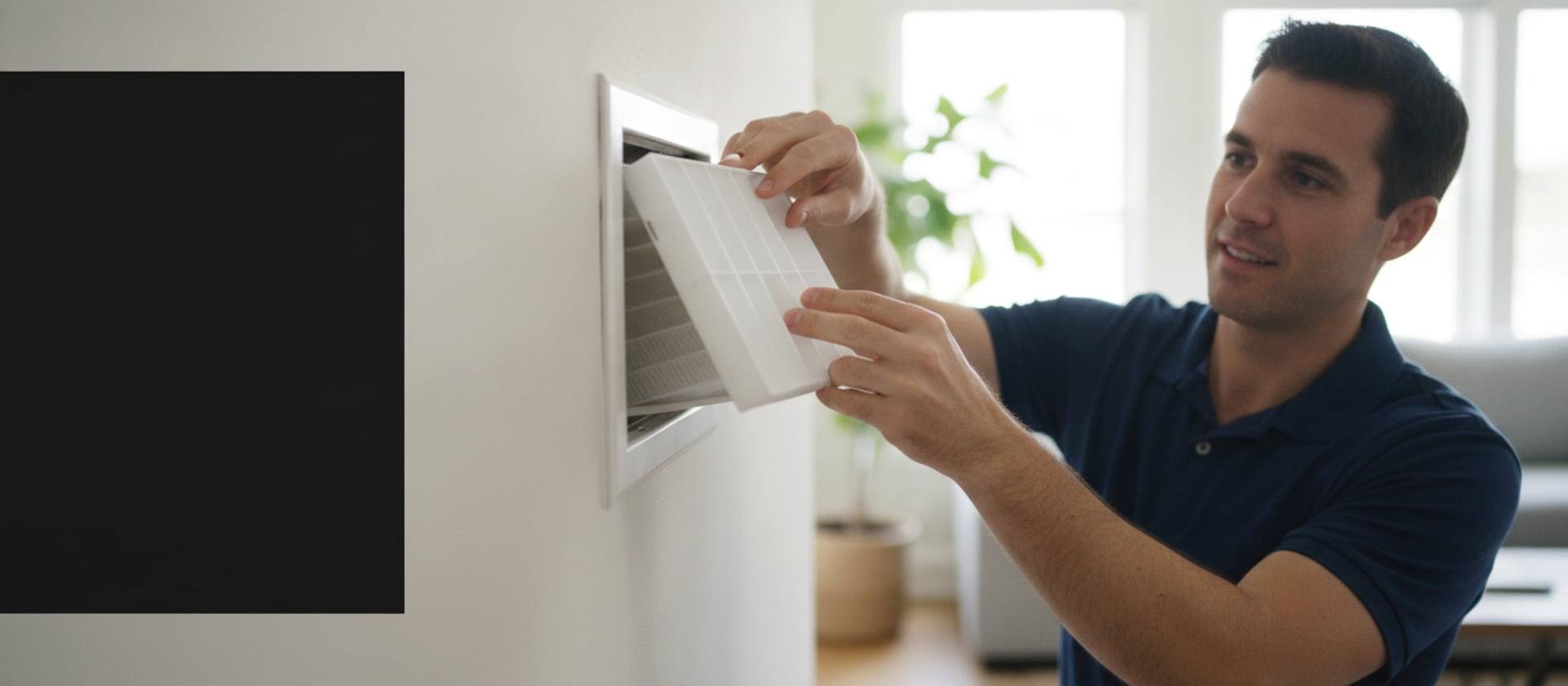
Do not pay $640 to replace a blower motor. About 1 in 4 of those calls we run traces back to a $15 air filter that someone has not changed since 2023. The pattern is so consistent I can usually tell from the homeowner's description on the phone. The blower runs, then it slows, then it makes a hot-electrical smell, then it stops. By the time we get there the motor windings are cooked, the run capacitor is fried, and the homeowner is staring at a four-figure invoice that started as a three-dollar piece of pleated cardboard.
An $18 filter changed every 60 days is the cheapest, highest-ROI maintenance step in residential HVAC. It costs less than a restaurant lunch, takes 90 seconds, and prevents about 35–40% of the "AC not cooling" calls we run in summer. Yet roughly half the homes I walk into have a filter so loaded the technician can lift it out and the dust holds the shape of the slot. One in twenty has no filter at all. The slot is empty. The blower has been pulling unfiltered attic air across the evaporator coil for who knows how long, and the coil is a felted gray mat.
What clogged filters actually destroy
This is the cost ladder. The further down you go, the more expensive the next failure becomes.
- $0: restricted airflow. System runs longer to hit setpoint. Energy bill goes up 8–15%. You may not notice for a season.
- $320–$485 — frozen evaporator coil. Low airflow drops the suction-line temperature below freezing, condensate freezes solid on the coil, and now you have a block of ice instead of a heat exchanger. Bonus damage if it thaws into the duct system. (See frozen evaporator coil.)
- $640–$1,180 — blower motor failure. Restricted return raises static pressure, motor pulls higher amps to maintain RPM, windings overheat, motor cooks. Often takes the run capacitor with it.
- $1,400–$2,800, evaporator coil contamination. Coil that has been pulling unfiltered air for years builds up a biofilm and dust mat that no chemical clean can fully remove. Replacement is the answer.
- $1,800–$3,400: compressor failure. The end of the line. Repeated low-airflow operation runs the compressor hot. Windings break down. We almost always quote replacement against repair at this number.
The math is uncomfortable. A $216-per-year filter habit (six $18 filters, swapped every 60 days) protects equipment that runs $9,000–$14,000 to replace. Skip it for three years to save $648, and the odds of a four-figure repair before year five climb materially.
Why SoCal eats filters faster than the national average
National HVAC content repeats "every 90 days" as if every climate is the same. It is not. Three things load filters here at rates the rest of the country does not deal with:
Dust load is higher. Inland LA, the SGV, the foothill belt, and Riverside / SB run high airborne particulate because of basin geography, sparse rainfall, the asphalt-and-concrete surface ratio, and Santa Ana wind fallout. Filters here clog faster than the same filter would in Seattle.
Pollen runs nearly year-round. Eucalyptus, oak, sycamore, and palm pollen are present in every season here. Ornamentals add March through October. Allergic households measure this in real symptom severity tied directly to filter age.
Wildfire smoke is the multiplier. Fire season (July through November in our service area, sometimes earlier) loads filters at 5–10x normal rates. A MERV 13 that would last 90 days clogs in 14–30 during a serious smoke event. See Santa Ana winds and HVAC for the related coil-fouling problem.
The cadence schedule we actually recommend
Push-back on the universal 90-day rule. The right interval depends on the household, not a brochure.
- No pets, no allergies, coastal climate: every 90 days is fine. The 90-day rule was written for you.
- No pets, no allergies, inland or foothill: every 60–75 days. Higher dust load.
- One or more pets: every 30–45 days during shedding (spring and fall coat-change), every 45–60 otherwise. Two cats roughly double the load. Three or more pets, triple it.
- Allergies or asthma in the household: every 30–45 days regardless of pets, MERV 13.
- Active wildfire smoke event: replace at start of event, again 14–30 days in if it continues.
- After a major Santa Ana: inspect immediately, replace if visibly loaded.
- Construction or remodel on the property: replace at start, again at completion. Drywall dust and sawdust will eat a MERV 13 alive.
- Snowbird / vacation property: leave a fresh filter on the way out, schedule a midpoint check if absent more than 90 days.
- New equipment, year one: every 60 days no matter what. Install dust and break-in particulate.
How to find your filter size
The size is printed on the cardboard frame of your existing filter: width by height by depth in inches, like 16x25x1. If the filter is missing or unreadable, measure the slot opening to the nearest 1/4 inch and match depth to the slot.
Common SoCal residential sizes I see most weeks:
- 1-inch single-filter: 14x20x1, 16x20x1, 16x25x1, 20x20x1, 20x25x1, 25x25x1.
- 2-inch: same widths and heights, deeper, used on some media cabinets.
- 4–5 inch media cabinets: 16x25x4, 20x25x4, 20x25x5. Higher capacity, lasts 6–12 months.
Slots that miss a standard size by more than 1/2 inch are usually custom, we can measure and source on a maintenance visit.
What MERV actually means, and what to ignore
MERV is the standardized particle-capture rating, 1–20. Higher captures smaller particles and restricts airflow more. The honest version of the chart:
- MERV 1–4 (fiberglass throwaway): Catches dryer-lint-sized particles. Avoid. The $1.50 per filter is a false economy.
- MERV 6–8 (basic pleated): The default. Fine for non-pet, non-allergy households on healthy modern equipment.
- MERV 11: Captures pet dander, mold spores, finer dust. Right band for most SoCal pet households.
- MERV 13: Captures smoke, bacteria, fine particulate including most of what is in wildfire smoke. Right for allergies and fire season.
- MERV 16: Hospital-grade. Will overload residential blowers not designed for it. Do not buy on impulse.
- MERV 17–20 (HEPA): Purpose-built systems only. Do not force into a standard residential AC. Use standalone HEPA purifiers in the rooms you actually live in instead.
What's overhyped: chasing higher MERV
This is the most common mistake I see, especially after fire-season news cycles. Homeowner reads that MERV 13 catches smoke particulate, swaps a MERV 8 for a MERV 16 hoping for "even better," and a week later the system is short-cycling, the blower is whining, and the supply registers feel anemic. A clean MERV 8 changed monthly outperforms a clogged MERV 13 changed twice a year. Filtration efficiency does nothing if you have starved the airflow.
If your blower whines, the system short-cycles, or registers stop blowing well after a filter upgrade, you went too high. Drop back. The right answer for fire-season smoke in a typical residential system is MERV 13 in the HVAC plus standalone HEPA in bedrooms, not a hospital-grade filter forced into a 1998 air handler.
Pleated, HEPA, electrostatic, carbon — which to actually buy
- Standard pleated (MERV 6–13): cardboard frame, paper or polyester media. Disposable. $5–$25 per filter. Right for most homes.
- True HEPA (MERV 17+): $35–$80, purpose-built systems only.
- Electrostatic / washable: $25–$60 upfront, 5–10 year life, MERV 4–8. Per-year cost is similar; the wash-and-dry routine kills it for most households.
- Carbon-impregnated: $20–$40, useful in apartments above restaurants or near heavy traffic for VOC and odor.
Step-by-step replacement, for first-timers
- Turn the thermostat to OFF. Stops the blower from sucking on an open slot.
- Find the filter. Most common: a hallway-wall or ceiling return grille (the large vented grille with a thumb-latch panel) or a slot at the air handler cabinet itself.
- Note the arrow direction on the existing filter frame. It points toward the blower.
- Slide the old filter out carefully. If it is heavily loaded, it will shed dust — have a trash bag ready.
- Slide the new filter in with the arrow pointing the same direction.
- Secure the grille or panel.
- Turn the thermostat back on.
- Write the install date on the cardboard frame with a Sharpie. Removes the "when did I do this last?" guess work.
- Set a calendar reminder for the next interval.
Real prices, not Amazon-search-result prices
- Fiberglass throwaway (MERV 1–4): $1–$4. Avoid.
- Standard pleated MERV 8: $5–$12.
- Pleated MERV 11: $9–$18.
- Pleated MERV 13: $14–$25.
- Media cabinet 4–5 inch (MERV 11–13): $35–$65, 6–12 months between changes.
- Reusable washable: $25–$60 upfront, 5–10 years of service.
When the filter is not the problem
If you swapped a fresh filter in and the system still is not cooling, the issue is downstream. Usual suspects: dirty outdoor coil, low refrigerant from a leak, failed run capacitor, frozen evaporator coil. The full troubleshooting tree is in why is my AC not blowing cold air. Same-day diagnostic at (424) 766-1020.
Our maintenance plans include filter delivery on most tiers, we ship the right size and MERV at the right cadence. Call (424) 766-1020 or see maintenance plans.