
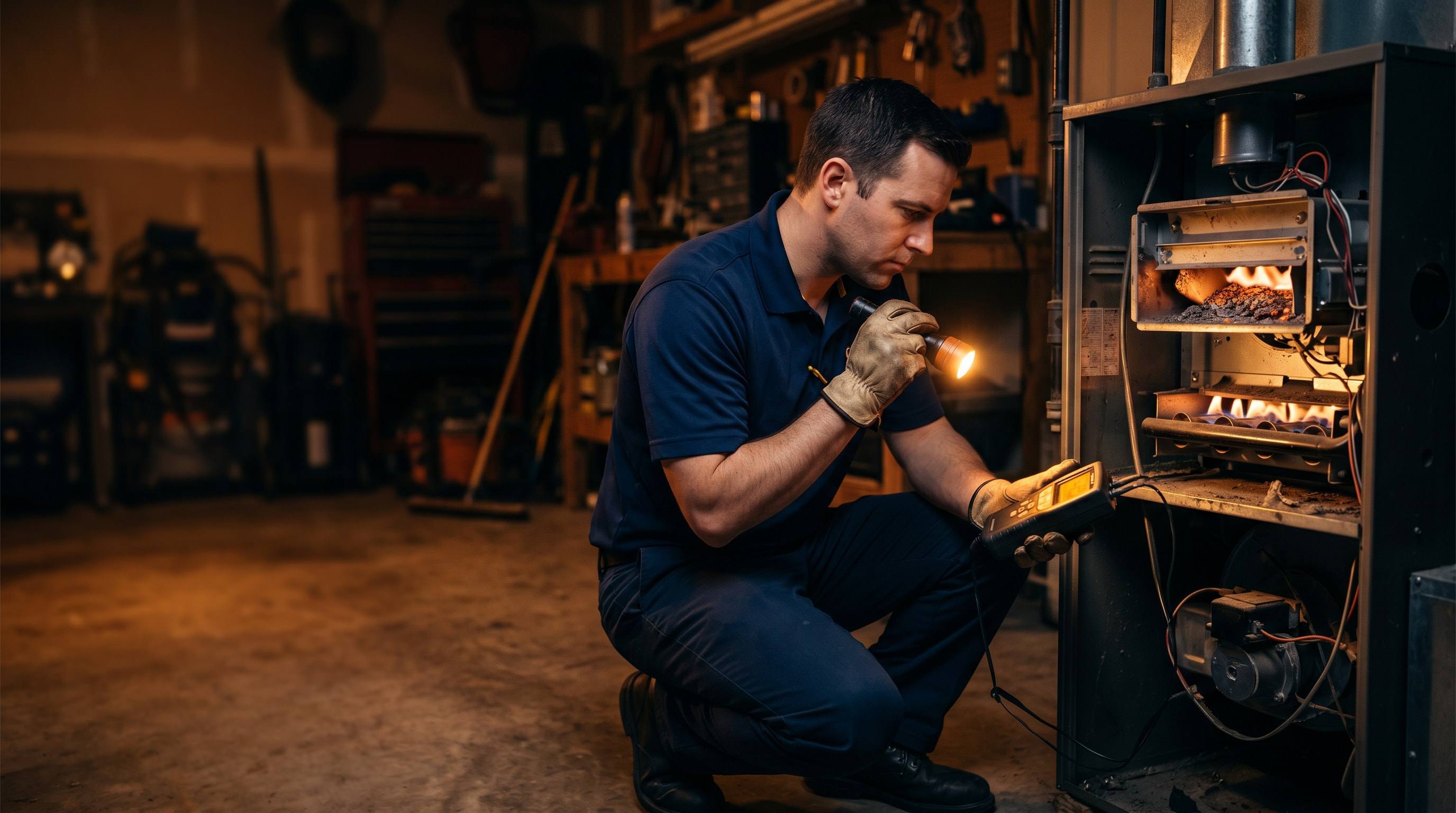
Most Southern California homeowners only think about their furnace twice a year, once when they turn it on the first cold morning in November, and again when it doesn’t work. Valley nights regularly drop into the low 40s in winter, foothill cities like Pasadena and Glendale see frost mornings, and properties in Big Bear or Wrightwood actually freeze. A dead furnace on the first cold snap goes from "annoying" to "we need this fixed today." We’re who you call.
Common furnace problems we repair
The seven failure modes we diagnose most weeks during heating season:
- No heat at all: thermostat issue, blown fuse, gas supply, or failed ignition. Usually 30-second to 60-minute fix once diagnosed.
- Furnace blowing cold air, thermostat fan-mode, dirty filter overheating limit switch, ignition failure, or duct leak. Full guide: furnace blowing cold air.
- Short cycling — dirty filter (60% of cases), oversized furnace, thermostat location, flame sensor, or limit switch. Full guide: furnace short-cycling.
- Pilot light won’t stay lit, dirty thermocouple (most common), faulty thermocouple, gas supply, draft, or pilot orifice. Full guide: pilot light troubleshooting.
- Strange noises — banging, squealing, grinding, popping. Each sound has a specific cause. Full guide: HVAC strange noises.
- Dirty air filter symptoms, reduced airflow, system overheating, registers blowing weak. Detail: filter replacement guide.
- Thermostat issues, battery, calibration, wiring, smart-thermostat firmware. Detail: thermostat troubleshooting.
Furnace repairs by symptom
Jump straight to the failure mode you’re dealing with — each page has its own diagnosis, flat-rate pricing, and repair detail:
Diagnostic process — flat $89, rolled into the repair
Our diagnostic is a flat $89 in business hours ($149 after-hours), and it gets applied to the repair quote if you proceed. You don’t pay twice. The diagnostic itself isn’t a 5-minute glance — we cover symptom interview, thermostat verification, filter and return-air check, ignition system inspection (igniter resistance, flame-sensor microamp draw, gas valve), heat exchanger inspection, electrical (control board, low-voltage wiring, amp draws), and venting/draft check.
By the end of the diagnostic we know what failed, why, and what it costs to fix. You get a written flat-rate quote before we touch the next tool. Decline the repair, you pay only the diagnostic. No upsells, no commission-driven sales, no surprise add-ons.
Furnace repair cost breakdown
Real flat-rate prices for typical furnace repairs in LA:
- Hot-surface igniter, the glowing element that lights the burners: $245–$485 installed.
- Thermocouple (older standing-pilot furnaces): $185–$295.
- Flame sensor — clean or replace: $185–$295.
- Pressure switch: $245–$385.
- Limit switch: $185–$295.
- Gas valve: $385–$685.
- Draft inducer motor: $580–$1,100.
- Blower motor (ECM or PSC): $480–$890.
- Control board: $480–$950.
- Heat exchanger: $1,500–$3,500, at this level we always quote replacement against repair, especially on furnaces 12+ years old.
Repair vs. replace — when to stop repairing
Three rules we run on every furnace repair quote over $1,000:
- The 50% rule: repair > 50% of replacement cost on a furnace 15+ years old → replace.
- The $5,000 rule: age × repair quote > $5,000 → replace. (22-year-old furnace, $300 repair = 6,600 → replace.)
- Cracked heat exchanger: not repairable → replace. CO risk is real.
If repair makes sense, we fix it and leave. If replacement makes sense, we say so, furnace installation page covers the replacement scope. The active 2026 stack — LADWP heat pump rebate $1,250–$2,500 per ton in LA city limits, SoCalGas furnace-removal incentive — often makes heat-pump conversion competitive with same-fuel furnace replacement net of incentives. (TECH Clean California $3,000–$8,000 is currently waitlisted; federal IRA 25C terminated December 31, 2025.) Detail: TECH Clean rebates, furnace replacement cost, and the full 2026 rebate guide.
Carbon monoxide safety — critical
Gas furnaces produce CO as a byproduct of combustion. A properly working heat exchanger and venting system carries that CO outdoors. A cracked heat exchanger or blocked flue can dump CO into the home, and CO is colorless, odorless, and lethal at high concentrations.
Three rules: (1) install CO alarms on every floor, especially near sleeping areas. They’re $20–$40 each and required by California code in homes with gas appliances. (2) If a CO alarm sounds, leave the house and call 911: don’t troubleshoot. (3) If you smell gas, leave and call SoCalGas (1-800-427-2200) or 911. Don’t flip switches, don’t use phones inside.
We test CO during every diagnostic and tune-up. If we find a cracked heat exchanger, we red-tag the furnace and shut off gas service to it before we leave.
Brands we repair
All major furnace brands: Carrier, Trane, Lennox, Goodman, Rheem, Bryant, American Standard, York, Coleman, Amana, Heil, Tempstar, Comfortmaker, Ruud, Daikin, Bosch. We carry common ignitors, flame sensors, capacitors, and limit switches on every truck for the eight most-installed furnace lines in SoCal. Less common parts are typically next-day from local supply houses (Johnstone, Geary Pacific, Baker, Lennox parts).
Why furnaces fail in SoCal — the idle paradox
Southern California furnaces fail differently than furnaces in Minnesota. There, furnaces run hard from October through April and wear out from heavy use. Here, furnaces sit idle for 8–9 months a year and then get pushed hard for 6–12 weeks of cool weather. The failure modes are different:
- Flame sensors fouled by 8 months of summer dust accumulation.
- Ignitors at end of life failing on the first heating call.
- Spider webs and rodent nests in burners and venting.
- Thermostat batteries dead after summer of no use.
- Condensate lines clogged on 96% high-efficiency furnaces.
- Voltage spikes from Santa Ana wind events taking out control boards. Detail: Santa Ana winds and HVAC.
- Gas valve solenoids stiffened from disuse: an important pattern on furnaces older than 12 years.
The fix is preventive: a fall furnace tune-up in October catches most of these before the first cold call. Detail: fall furnace maintenance, maintenance plans.
SCAQMD compliance and furnace replacement
If the diagnostic ends in "this furnace needs replacement, not repair," the next decision involves SCAQMD Rule 1111 compliance. Within South Coast AQMD jurisdiction (most of LA County, all of OC, urbanized portions of Riverside and San Bernardino), only low-NOx and ultra-low-NOx furnaces meeting 14 ng/J or 40 ng/J emissions can be legally installed. Every major brand sells SCAQMD-compliant lines (Carrier Comfort/Performance/Infinity, Trane S-/X-series, Lennox SL/ML, Bryant 215/313 series, Rheem RGRA, Goodman), but out-of-state models shipped from suppliers without the rule are sometimes labeled "Not for use in SCAQMD" on the box and will fail inspection. We only quote SCAQMD-compliant equipment for this region. Heat-pump conversion avoids Rule 1111 entirely (no combustion = no NOx). The active 2026 stack on the heat-pump path is utility-led — LADWP heat pump rebate $1,250–$2,500 per ton in LA city limits, SCE $300–$1,200 elsewhere, plus SoCalGas furnace-removal incentive — often making the heat-pump path competitive with same-fuel furnace replacement. (TECH Clean California $3,000–$8,000 is currently waitlisted on single-family heat pump HVAC; federal IRA 25C $2,000 was terminated December 31, 2025 under OBBBA.) Detail: SCAQMD regulations and your HVAC.
What to do while waiting for the tech
If your furnace is down and you’re waiting for a same-day or next-morning service window, three practical things help:
- Replace the air filter while you wait: this might solve the problem outright (60% of "broken furnace" calls trace to a dirty filter), and even if it doesn’t, the tech needs a clean filter to diagnose airflow accurately.
- Check the thermostat is set to HEAT, AUTO fan, with batteries that aren’t flat. Smart thermostats sometimes reset to OFF after firmware updates.
- If the house is cold overnight in winter, close interior doors to concentrate heat in occupied rooms, run ceiling fans on reverse (low speed, clockwise from below) to push warm air down from the ceiling, and don’t use the oven as a heater (CO risk and not very effective). If you have a fireplace, this is what it’s for.
- Smell gas? Stop everything. Leave the house, call SoCalGas (1-800-427-2200) or 911, do not flip switches or use phones inside. After the building is cleared, we can diagnose 24/7.
Same-day furnace repair service
Same-day in business hours across West LA, San Gabriel Valley, and most of OC: typical arrival 2–4 hours from booking. Inland counties (San Bernardino, Riverside) and Ventura typically same-day or next-morning. After-hours emergencies (no heat overnight in winter, gas smell) route through our 24/7 emergency line at (424) 766-1020 with live dispatch and a typical 60–120 minute arrival in LA/OC.
Service areas & regional dispatch
We repair furnaces across all five counties with regional dispatch:
- Los Angeles County West LA: (424) 766-1020
- San Gabriel Valley (Pasadena, Arcadia, Glendale, Burbank): (626) 499-5530
- Orange County: (949) 785-5535
- Ventura County: (805) 977-9940
- San Bernardino County: (909) 757-6455
- Riverside County: (951) 744-9188
The number in the sidebar on each city page is your local one. Or call the West LA main line and we’ll route you.
Related guide
Hot-surface ignitor failures are the most common single-component furnace fault we see. Symptoms, diagnosis, and replacement pricing: ignitor failure symptoms and cost.