
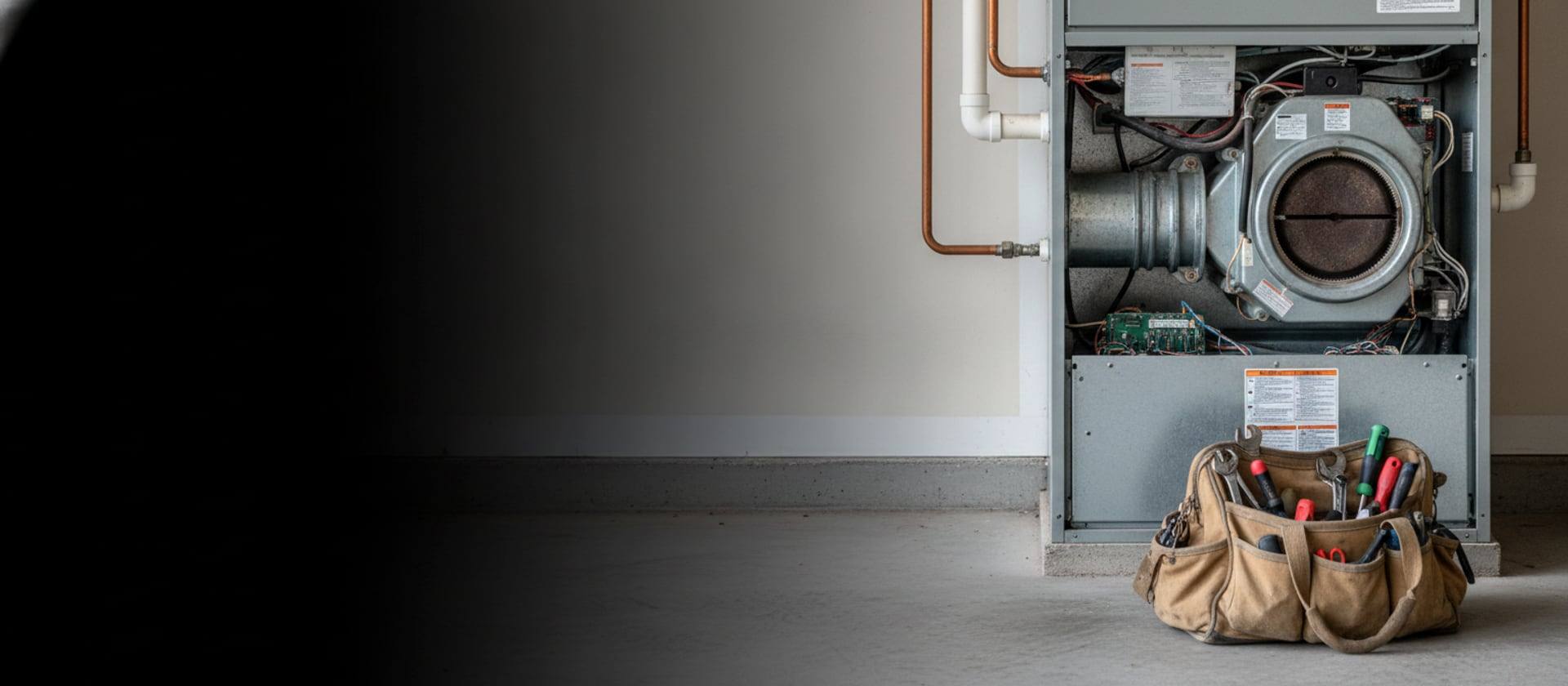
It was 38°F overnight in Glendale. The furnace had been kicking on for 90 seconds, shutting off, kicking on again six minutes later, all night. The homeowner texted me at 5:47am: "Is this the heat exchanger? I read it might be the heat exchanger." I told her to pull the filter and send me a picture. She sent a picture of a 1-inch pleated MERV 11 that had not been changed since the previous March. Nine months in a Glendale home with two cats. The filter looked like a slab of pet-hair felt with a cardboard frame around it. We had her swapping it inside ten minutes, and by 7am the cycle pattern was back to normal, 12-minute runs with comfortable 25-minute idle periods between calls.
That is the most common short-cycle call I run, and it is the one I want to walk through here. Because if you are reading this on the same kind of cold morning, with the same cycle pattern, the answer is probably the same.
What "short cycling" actually means
Short cycling is when a furnace fires, runs for under 5 minutes, shuts down, restarts within minutes, shuts down again, on and on. A healthy SoCal furnace cycle runs 8 to 15 minutes per call, then sits idle for 15 to 45 minutes before the next one. Short cycling compresses both numbers: run time too short to warm the house, off time too short for the system to settle.
You feel it as the furnace clicking on and off constantly, rooms that never warm up despite the system seeming to "run all day," energy bills climbing, and sometimes loud popping or banging at startup.
Why this is not just an annoyance
Three real costs that pile up faster than people expect:
- Fuel waste of 20 to 30%. The first 30 to 60 seconds of every cycle is the most fuel-intensive part (heating the cold heat exchanger up to operating temperature). Triple the cycle count and you triple that startup tax
- Premature wear on igniters, gas valves, and blower motors. These parts are rated in cycles, not run-hours. A short-cycling furnace can stack 10 to 20 years of cycle wear into a single bad winter
- Heat exchanger thermal stress. Repeated heating and cooling cycles crack heat exchangers years before their rated life. A cracked heat exchanger is a CO risk and forces full furnace replacement
Do not ignore it for a month. Two weeks max, then diagnose and fix.
The filter, again, because it is 60% of these calls
This is what we see in roughly 60% of short-cycling calls, including my Glendale customer last winter. A filter that has been in there since spring is restricting return-air flow into the furnace. Without enough air through the heat exchanger, cabinet temperatures climb past the safe limit. The high-limit safety switch trips and cuts the burners. The blower keeps running to dump heat. Once the cabinet cools, the limit resets, the burners fire again, and you get the same pattern over and over.
Fix: pull the filter, hold it to the light, replace if you cannot see through it. Most homes use 16x25x1 or 20x25x1, MERV 8 to 13. $15 to $45. Filter replacement guide.
If the limit still trips 20 minutes after a fresh filter, the airflow restriction is deeper, collapsed flex duct in the attic, undersized return drop, dirty blower wheel. That is a tech call.
An oversized furnace cannot fix itself
If the furnace has short-cycled since the day it was installed, it is almost certainly oversized for the house. An oversized unit heats the air around the thermostat too quickly, the thermostat satisfies its call, burners shut down, and the rest of the house has not actually warmed up. Within five minutes the air around the thermostat cools to the temperature of the rest of the house, the call returns, and the next short cycle begins.
This was the most common 1980s and 90s install mistake in SoCal residential. Builders and contractors used "1 BTU per square foot" rules of thumb and oversized by 25 to 50%. The proper fix is replacement with right-sized equipment, ideally variable-speed inverter equipment that can modulate capacity instead of slamming on at full output. On every install we measure your home before we quote tonnage. Detail: furnace installation.
The thermostat is in a bad spot
A thermostat next to a supply register, in afternoon sun from a south-facing window, near a kitchen, or right above a return grille gets a wildly inaccurate reading. It hits setpoint fast (because the disturbing source heated it up), shuts the furnace off, then drops back below setpoint just as fast once the source dissipates.
Calibration drifts too. Older mechanical thermostats drift 3 to 5°F over time. Smart thermostats occasionally lose calibration after firmware updates. Quick test: put an accurate room thermometer next to the thermostat for 20 minutes and compare. More than 2°F off, recalibrate or replace.
Relocating a hardwired thermostat is a $145 to $295 service call. Cheaper alternative: an Ecobee or Nest with a remote sensor placed somewhere representative.
Heat exchanger problems
A cracked, warped, or scaled heat exchanger causes short cycling indirectly. Cracks trigger flame-rollout sensors or pressure switches that cut burners. Scaled exchangers (corrosion buildup on the heat-transfer surfaces) overheat at lower load levels and trip the high-limit early.
Heat-exchanger replacement is rarely cost-effective on furnaces over 12 years old. We usually quote full furnace replacement at that point ($4,800 to $9,500 installed) or a heat-pump conversion that nets less after TECH Clean California rebates. Detail: TECH Clean California rebates.
One non-negotiable: a cracked heat exchanger is a carbon monoxide risk. If we find one, we red-tag the furnace, kill it at the disconnect, and recommend immediate replacement. Not next week. Now.
The 7-second shutoff pattern (flame sensor)
The flame sensor is a small metal rod sitting in the burner flame. Its job is confirming to the gas valve that the flame is actually burning. If the sensor is dirty (carbon buildup) or failing, it loses the signal, the gas valve shuts, the burners cut off.
The fingerprint is a 7-second shutoff: ignition, flame visible for about 7 seconds, then nothing. Restart, repeat. If you hear that exact rhythm, this is your cause.
Fix: $185 to $295 to clean or replace. Often combined with broader ignition work on older furnaces, see pilot light troubleshooting if the system is from before electronic ignition.
Bad blower motor
A blower motor with worn bearings or a degraded capacitor does not move enough air. Same downstream effect as a dirty filter: heat exchanger overheats, limit trips, cycle repeats.
Tells: grinding or squealing from the indoor cabinet (see HVAC strange noises), reduced airflow at registers even with a clean filter, or amp draw above nameplate when a tech measures it. Blower motor replacement runs $480 to $890. A capacitor-only fix on the blower runs $185 to $295.
Flue or vent blockage
The flue takes combustion gases out of the house. Block it (bird nest, dryer vent crossover, debris, snow on the cap up in Big Bear) and the pressure switch detects the blockage and cuts the burners. Once the system cools, pressure normalizes, the system tries again, the same pattern continues.
Rare in lowland SoCal but real. Bird and rodent nests in spring and fall, debris driven into flue caps after Santa Ana winds. Background: Santa Ana winds and HVAC. Fix runs $145 to $385 depending on access, often combined with a draft inducer or pressure-switch check.
Run this list before you call
You can resolve 60 to 70% of short-cycling cases without a tech. In order:
- Replace the air filter, even if it does not look terrible. $15 to $45, 5 minutes
- Open every supply register in the house, closed registers in too many rooms create system back-pressure
- Confirm thermostat is on HEAT, fan on AUTO, setpoint 5°F above current room temp. Fresh batteries
- Walk the return grille, no furniture pushed against it, no dust mat caked over it
- Walk the outdoor flue or vent termination, look for nests or debris
- Stand near the indoor cabinet for one full cycle and listen, squealing or grinding (blower motor), 7-second shutoff (flame sensor), or normal-sounding cycles that are just too short (oversized or thermostat issue)
If you make it through that and the cycle pattern still has not normalized, our $89 fixed-price diagnostic ($149 after-hours) lays out exactly what is wrong in writing before any work begins. Detail: furnace repair. Related: furnace blowing cold air, pilot light won’t stay lit.
Call Venta Heating and Cooling at (424) 766-1020, same-day diagnostic across Southern California. CSLB #1138898 (C-20).