
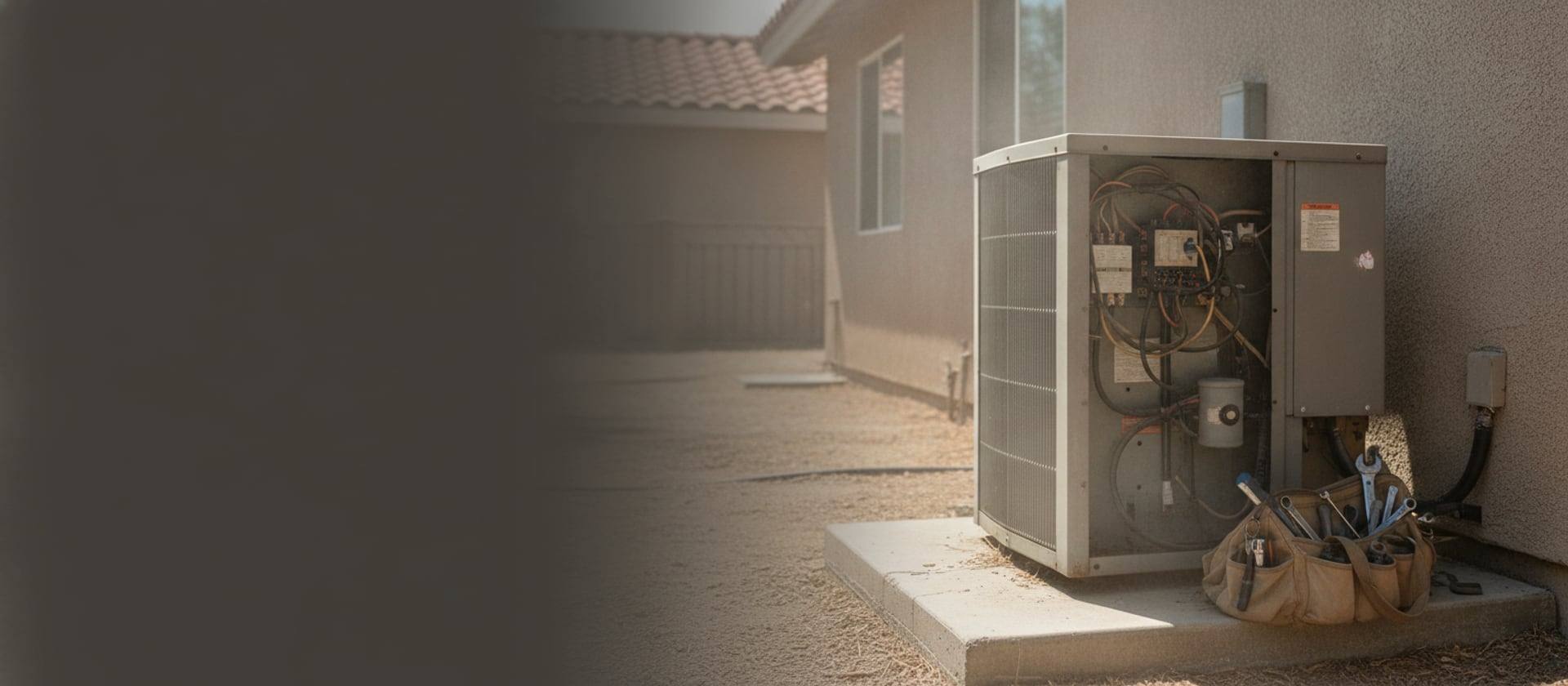
Do not pay $3,400 for a compressor replacement before reading this. Half the "expensive" HVAC noise calls we run are sub-$300 fixes that another tech could have written up at ten times the price. A rattling outdoor unit at $3,400 is almost always a $180 piece of debris in the fan blade. A buzzing AC at $2,200 is usually a $260 capacitor. Even a screeching blower (which sounds catastrophic) is more often a $240 capacitor on the blower motor than the $890 motor itself.
The trick is matching the sound to the cause before anyone hands you a quote. Every HVAC noise means something specific, and we hear all of them every week across LA, Orange County, and the Inland Empire. Here is the translation key.
Banging or clanging
Loud, irregular, metallic. Almost always something has come loose or broken inside the cabinet.
Indoors at the blower: a wheel out of balance, a loose set screw on the motor shaft, a blade that hit the housing. Caught early it is a $200 to $400 fix. Let it run a week and you destroy the blower assembly ($480 to $890).
Outdoors at the condenser: a broken compressor mount, debris in the fan, or, worst case, internal compressor damage. Loud rhythmic banging from the compressor itself usually means slugging (liquid refrigerant entering the suction line where only vapor should be) or connecting-rod failure. Both kill the compressor.
Action: thermostat off, breaker off, call same day.
Squealing or screeching
High-pitched and continuous. Worn motor bearings, or on older belt-driven blowers, a slipping belt. Belt squeal eases as the system warms up; bearing squeal gets worse the longer the motor runs. Either way it is an early warning rather than an emergency. Schedule service within the week. If the squeal turns to grinding, treat that as urgent.
Hissing (this one means stop)
High-pitched hiss or whistle near the evaporator coil, refrigerant lines, or outdoor condenser. That is a refrigerant leak. Some leaks present as a softer bubbling or gurgling instead. Refrigerant does not leave a puddle, it evaporates the second it hits room temperature.
Why this is the one to take seriously: the system loses cooling capacity, the compressor works harder trying to compensate and often burns out, and R-454B (the refrigerant in everything new since 2025) is A2L-rated, mildly flammable. R-410A and R-22 are non-flammable but they are still displacement-asphyxiation hazards in tight closets.
Action: shut it down, ventilate the space, call. Repair runs $480 to $1,800 depending on where the leak is.
Buzzing
Steady low electrical hum louder than normal operation. Usually electrical, and usually inexpensive:
- At the outdoor unit: a stuck or chattering contactor, or a failing capacitor not delivering enough charge to start the compressor. We test capacitor microfarads against nameplate. Out of spec, $185 to $295 swap
- At the indoor unit: a relay or transformer humming under fault
- From the electrical panel itself: stop, kill the breaker, call an electrician. That is a fire risk we do not handle
Action: persistent buzz schedules service. Buzz plus burning smell shuts down immediately.
Rattling
Intermittent metallic, usually loose hardware. A missing panel screw on the air handler cabinet, a zip tie banging against ductwork, leaves or palm fronds in the outdoor condenser, or a pulley with bearings on the way out.
Quick check outside: system off, walk around the condenser, look for visible debris and clear what you can see. Quick check inside: with the system off, push on the cabinet panels and tighten any visible screws. If the rattle continues after both, it is internal and you need a tech.
Grinding (urgent)
Metal-on-metal grinding from the indoor blower or the outdoor fan motor means the bearing has worn through its lubrication and the motor shaft is contacting the race directly. This is one of the few HVAC sounds where every additional minute of operation makes the repair worse.
Caught at the grinding stage, the fix is a $480 to $890 motor swap. Run it another two weeks and the motor seizes, the windings cook, and sometimes the control board or compressor takes collateral damage, turning a $700 repair into a $2,400 one. Action: shut off, call same day.
Clicking (mostly normal, sometimes not)
One click at startup (relay engaging, contactor closing, gas valve opening) and one at shutdown is healthy. Anything else is a problem:
- Continuous rapid clicking from the outdoor unit, failed capacitor or contactor, compressor not engaging
- Clicking from the thermostat with no equipment response, control board or wiring
- Clicking from the furnace ignition that does not end in burner ignition, failed igniter, gas valve, or safety lockout, see pilot light troubleshooting
Whistling
High-pitched airflow sound from registers or ductwork. Usually not a failure, just air forced through a smaller opening than the system was designed for. Common causes: too many supply registers closed in unused rooms, an undersized return grille, a dirty filter restricting flow, or a small duct leak whistling through the gap.
Whistling that started suddenly often means a duct connection separated and the system is now leaking conditioned air into the attic. Open all registers, change the filter, and if it persists schedule a duct inspection. Background: California HERS testing.
Popping
Sharp short metallic ticks, usually normal, ductwork expanding and contracting as it heats and cools. Most pronounced at startup and shutdown, especially in older sheet-metal systems.
Problem popping is loud, repeated, and accompanied by other symptoms. Repeated popping in the burner area of a furnace can mean delayed ignition, gas pooling and igniting in a small puff before the flame establishes. That is a tech call before it gets worse. Repeated popping at a single register can mean the duct is tearing apart at a connection.
The numbers, so you don’t get oversold
Real LA-area pricing on the most common noise repairs we run, so you have something to compare any quote against:
- Capacitor replacement (compressor or blower): $185 to $295
- Contactor replacement: $220 to $290
- Flame sensor clean or replace: $185 to $295
- Refrigerant leak repair, accessible: $480 to $1,800
- Blower motor replacement: $480 to $890
- Fan blade or fan motor on the condenser: $380 to $720
- Compressor replacement (when it actually is the compressor): $2,400 to $3,800
If a quote comes in higher than the top of one of those ranges, get a second opinion. We are not always the cheapest, but the diagnostic is fixed-price $89 with a written quote before any work, and the quote shows you which line item is which.
Shut it off right now if you hear
- Hissing or whistling near refrigerant lines, leak
- Grinding from any motor, bearing failure in progress
- Loud banging from the outdoor compressor, possible internal damage
- Burning smell, electrical fault
- Smoke or open flame outside the burner area, kill the breaker if safe, leave the house, 911
- Gas smell near the furnace, leave the house, SoCalGas (1-800-427-2200) or 911 from outside
Most other sounds (rattling, mild squealing, normal clicking) can wait until next-day service. Detail: AC repair, HVAC repair.
Related: why your AC isn’t blowing cold, furnace short-cycling, frozen evaporator coil. AC noise repairs by cause: noisy AC diagnosis, fan not spinning, contactor replacement.
Call Venta Heating and Cooling at (424) 766-1020, real person answers 24/7 across Southern California. CSLB #1138898 (C-20).