
Your AC stopped cooling. The house is climbing past 80°F, you have things to do, and you do not want to spend the next two hours panicking on hold. Take a breath. We work this exact problem two or three times a day all summer, and roughly half the time the homeowner can fix it before the truck would have arrived. The other half needs us, and that is fine too.
What follows is the order we run through it on the phone with people who call before booking. Start at the top. By the time you hit the bottom, you will either have cool air again or you will know exactly what to tell whoever you call.
Two quick forks before you start. If your AC won’t turn on at all — no hum, nothing at the vents — that’s a power or startup problem, not a cooling one, so go to AC not turning on. And if you’d rather see the causes ranked by likelihood with a diagnostic decision tree than work top to bottom, read AC running but not cooling. This page is the sequential homeowner walkthrough.
Start with the filter (yes, really)
I know. Everyone says check the filter. We say it because more than a third of the no-cool calls we run end at the filter. The filter clogs, airflow over the indoor coil collapses, the coil gets too cold, ice forms, and now you have two problems instead of one.
Pull the filter from the return grille or the air handler. Hold it toward a window. If light does not come through, it is done. Same size, MERV 8 to 13, $15 to $45 at any hardware store. In SoCal, replace every 60 to 90 days, sooner if you have pets or live within a quarter mile of the 405. Step-by-step: how to change your AC filter.
Is the indoor coil iced over?
If the filter has been bad a while, the coil may already be frozen. Counterintuitive, but a frozen AC stops cooling because the ice insulates the coil from the air passing across it. You will sometimes notice water on the floor near the air handler hours later when the ice melts.
Open the air handler cabinet, or look at the larger insulated copper line outside near the condenser. Frost or visible ice means a frozen coil. The fix is patience: thermostat to OFF, fan to ON, walk away for three to four hours. Do not poke at the ice, do not point a hair dryer at it. Replace the filter while you wait. If it freezes again the next day, something deeper is wrong (low refrigerant or a dirty coil) and you are out of DIY land. Full procedure: frozen evaporator coil.
The thermostat itself
Before you blame the equipment, give the thermostat 60 seconds:
- Mode set to COOL, not OFF or HEAT or AUTO
- Fan set to AUTO, not ON. Fan ON blows room-temperature air whenever the system is not actively cooling and feels exactly like a broken AC
- Setpoint at least 3°F below the current room temperature so the system actually has a reason to call
- Fresh batteries if the screen looks dim or the unit is battery-powered
About one in eight no-cool calls ends here. Companion guide: thermostat not working.
Walk outside to the condenser
Two things to look at, both fixable in the next ten minutes if you catch them.
Dirty coil. The metal fins wrapped around the outdoor cabinet need free airflow to dump heat. After Santa Ana wind events, after pollen season, after the cottonwoods drop, those fins matt up with debris. Heat rejection drops 15 to 30%. Cut power at the disconnect on the wall next to the unit, brush off loose debris, then spray gently from the inside out with a garden hose at low pressure. Never a pressure washer, the fins fold like aluminum foil. Trim anything growing within two feet of the cabinet.
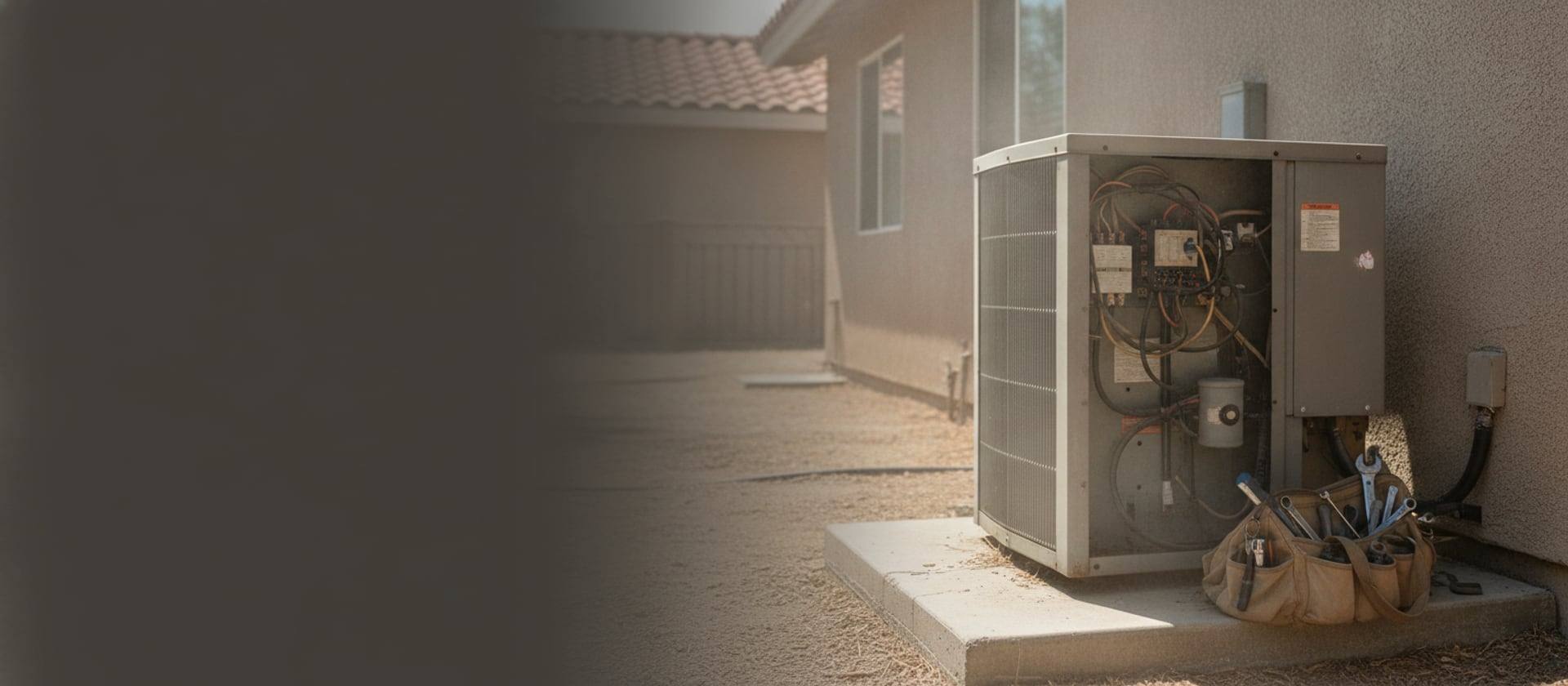
Listen. If the outdoor unit hums but the fan does not spin, or the compressor tries to start and trips, you are almost certainly looking at a failed run capacitor. This is the most common breakdown we run from June through September across inland LA. Capacitors are rated for ten years on the spec sheet and last five to seven in Riverside and the SGV because they cook in the heat. The part is $40 to $80, the bill once we get there is $185 to $295 for the swap. Stay out of the cabinet. A capacitor holds enough voltage with the breaker off to send you to the ER. We had a Pasadena call last June where the homeowner pulled the cover off, touched the terminal with a screwdriver, and bought a $19,000 ambulance ride. Just call.
If the air handler is iced and the filter was fine
That points at refrigerant. Your AC moves heat with R-410A (installed 2010 to 2024) or R-454B (the 2025-and-later standard). The circuit is sealed. If you are low, you have a leak somewhere. Adding a can from a hardware store does three bad things: it is illegal without EPA Section 608 certification, the universal blends sold online are wrong-spec for modern systems and can damage the compressor, and you have not fixed the leak so the new charge walks out in two weeks.
Symptoms: ice on the larger insulated line outside, hissing near the indoor or outdoor unit, performance fading over weeks rather than failing overnight. Repair runs $380 to $760 for an accessible single-pinhole leak plus refrigerant. Indoor coil leaks are worse because the coil itself usually has to come out.
One thing we will say honestly: on a 12-plus-year-old system still running R-410A, refrigerant prices are climbing as production phases down. We do not always recommend chasing a leak on equipment that old. The math sometimes works better as a planned replacement with an R-454B heat pump and the TECH Clean California rebate ($3,000 to $8,000) knocking the price down. We run both numbers for you on paper before you decide.
Compressor noises and breaker trips
When the outdoor unit hums, never starts, and the breaker pops every time you reset it, the compressor itself is in trouble. Loud clattering or metal-on-metal grinding from the outdoor cabinet is the same conversation. On a system under eight years old, the compressor is often still under parts warranty (most manufacturers cover ten) and the swap is the right call. On twelve-plus, replacement of the condenser and indoor coil together (ideally as a heat-pump conversion with rebates) almost always pencils out better than a $2,400 to $3,800 compressor on aging equipment. Cost breakdown: AC replacement cost in Los Angeles.
Where to draw the line
You should be doing the filter, the gentle hose-down of the outdoor coil, thermostat checks, and a frozen-coil thaw with the system off. You should not be opening the condenser cabinet, touching refrigerant, swapping capacitors, or chasing breaker trips. We are EPA-certified for R-410A and R-454B, fully insured, and the diagnostic is fixed-price $89 with a written quote in your hand before anything gets unscrewed. CSLB #1138898 (C-20), same-day across LA, OC, SGV, SB, Riverside, and Ventura counties. Call (424) 766-1020 for West LA, or grab the regional number off your local city page.
Call Venta Heating and Cooling at (424) 766-1020. A real person answers 24/7. Fixed $89 diagnostic, written quote before any work. CSLB #1138898 (C-20).
Related reading
- Frozen evaporator coil: causes, fixes, and prevention
- Thermostat not working, what to check first
- Clogged AC drain line, how to clear it
- Santa Ana winds and HVAC
- AC repair service and annual maintenance plans
- Failure-mode repairs: refrigerant leak, fan not spinning, compressor replacement, leaking water