
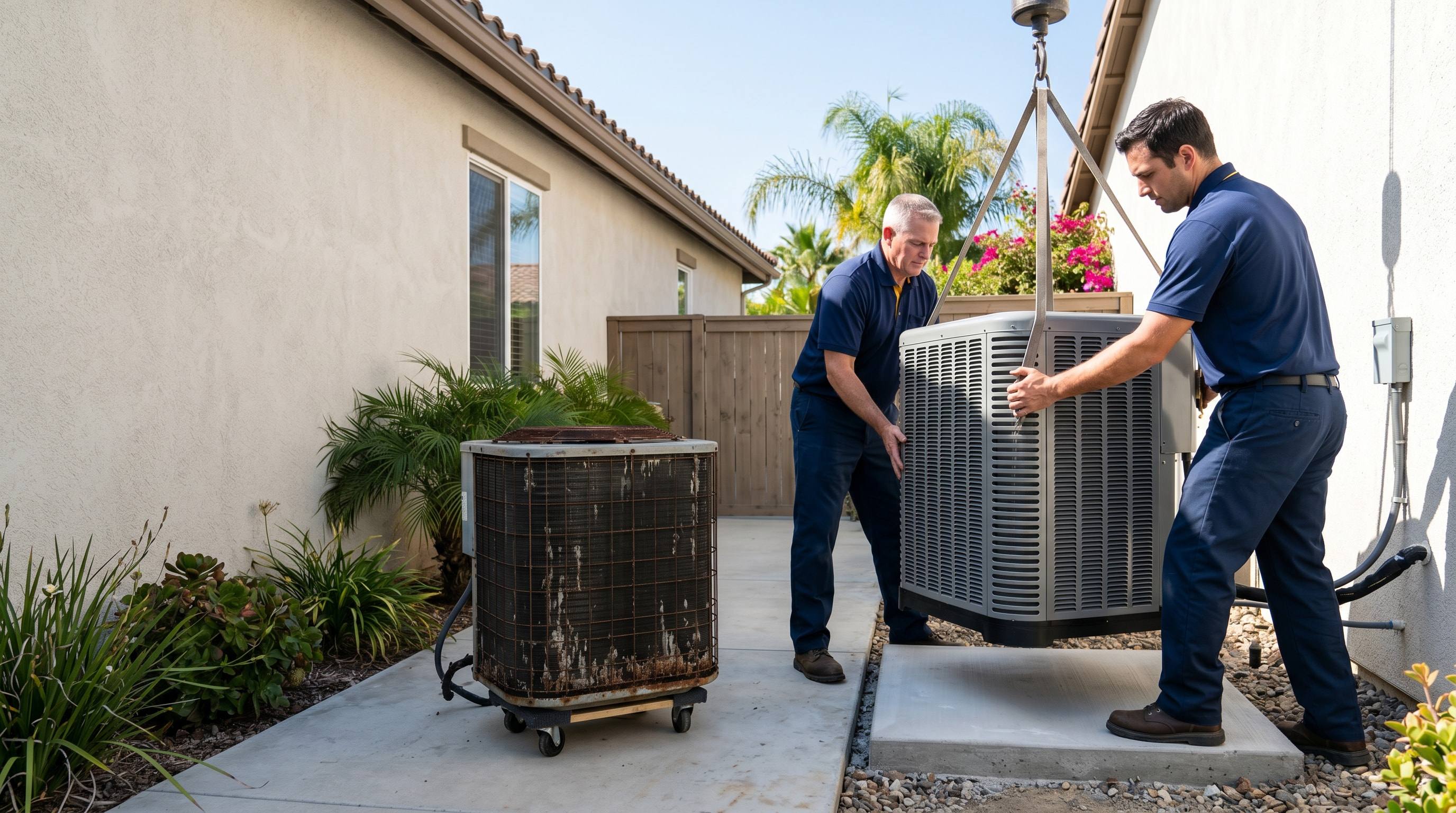
The replacement decision is the most expensive single HVAC choice most homeowners make, and the one most easily corrupted by a contractor on commission. A 14-year-old SoCal AC system that needs a $1,200 evaporator coil leak repair is a real judgment call: another 2–3 years of life vs. starting fresh with a 16+ SEER2 variable-speed system that runs 30–40% more efficiently and qualifies for $3,000–$8,000 in rebates. We run that math honestly with both repair and replacement numbers in writing, no commission to push you toward replacement.
Signs you need AC replacement
Any one of these alone isn’t decisive; multiple at once usually is:
- System is 12+ years old: SoCal AC averages 12–18 year lifespan; past 12 you’re in second-half territory.
- R-22 refrigerant: production banned 2020, top-offs run $1,000–$2,500. Not worth feeding.
- Repair quote exceeds 30% of replacement cost: or fails the $5,000 rule (age × repair cost > $5,000).
- SEER under 13: modern 16+ SEER2 cuts kWh 30–40% on the same cooling load.
- Frequent service calls: 2+ repairs in the last 12 months on the same system.
- Rooms cool unevenly: symptom of system that’s undersized, oversized, or has degraded duct/coil performance.
- Noisy operation: condensers should run 55–75 dB; older systems hitting 80+ dB indicate fan or compressor wear.
- High humidity at low setpoints: oversized or short-cycling system that can’t dehumidify.
- Visible coil corrosion: coastal salt-air damage that will progressively worsen.
- Compressor failure: a $2,500–$3,500 repair on a 10+ year old system rarely makes sense.
Repair vs. replace — the math
Three honest frameworks we use at every diagnostic visit:
- The $5,000 rule: age (years) × repair cost ($) > $5,000 = lean toward replacement. A 12-year-old system needing a $500 capacitor and a refrigerant top-off equals $6,000: over the threshold, weigh replacement.
- The 30% rule: if the repair quote exceeds 30% of replacement cost, replacement usually wins on long-term math.
- The R-22 rule: any R-22 system needing more than a $400–$500 repair almost always favors replacement once you factor in refrigerant cost and efficiency gain.
AC replacement cost range in 2026
Fully installed across SoCal, including permit, HERS verification, warranty registration, and rebate filing:
- Straight split-system replacement (matched condenser + coil, existing furnace and ducts): $5,500–$7,500.
- Premium 16+ SEER2 variable-speed (line-set replacement, smart thermostat): $8,500–$11,000.
- Full system replacement (condenser + coil + furnace + thermostat): $9,000–$14,000.
- Heat pump conversion (replaces both AC and gas furnace): $8,500–$15,500; net after the active 2026 LADWP / SCE / SoCalGas stack typically lands $5,000–$11,500 in LADWP territory. Federal IRA 25C ($2,000) expired December 31, 2025; TECH ($3,000–$8,000 when funded) is currently waitlisted.
SEER2 selection guide for SoCal
California Southwest region minimum is SEER2 14.3 since 2023 (anything below isn’t legal to install new). Practical SoCal recommendations:
- Coastal LA, OC, Ventura (Santa Monica, Malibu, Newport, HB, coastal Ventura): SEER2 14.3–15 is fine. Cooling load is light enough that the high-SEER premium has long payback.
- Mid-basin LA (West Hollywood, Culver City, Beverly Hills): SEER2 15–16.
- Valley and inland OC/VC (Van Nuys, Burbank, Pasadena, Conejo Valley, Anaheim Hills): SEER2 16–18.
- Inland Empire and high desert (Riverside, San Bernardino, Palm Springs, Palmdale): SEER2 17+ pays back in 4–6 years at 1,800+ cooling hours/year.
R-454B transition — replacement implications in 2026
As of January 2025, all newly manufactured residential AC equipment uses R-454B (A2L) refrigerant. R-410A condensers and coils are no longer being built. Practical 2026 implications: any new system installed today is R-454B. Existing R-410A equipment can still be repaired and serviced for years (R-410A production for service continues). What you can’t do: replace just the outdoor unit on an R-410A system with R-454B equipment, refrigerants don’t mix, indoor and outdoor must match the same refrigerant. If half your R-410A system fails, you usually replace the whole matched system. We’re fully A2L-certified. Detail: Title 24 and A2L refrigerant transition.
Brand selection
We work all six major residential brands honestly. The right brand depends on your home, tenure, and budget, not on which brand pays us the best margin. Quick reference:
- Premium tier (10+ year tenure, inland heat-load, noise-sensitive): Carrier Infinity, Lennox Signature, Trane XV20i.
- Mid tier (most homes, balanced value): Rheem Prestige, Carrier Performance, Trane XL.
- Value tier (rentals, ADUs, budget-constrained): Goodman GSX/GSXC.
- Mini-split / no ductwork: Daikin, Mitsubishi.
Full brand breakdown at our brands hub.
Manual J sizing — why it’s critical
Oversizing is the #1 install mistake we see in SoCal: and it’s almost always the result of square-footage rules of thumb (“1 ton per 500 sq ft”) instead of an actual Manual J load calculation. An oversized AC short-cycles (runs 6–8 minutes, hits setpoint, shuts off, restarts), which (a) never runs long enough to dehumidify so the house feels clammy at 76°F, (b) wears the compressor out 4–7 years early from start-stress, and (c) costs more upfront and to operate. We measure window orientation, insulation, infiltration, and internal gains on every replacement and produce a written Manual J report. Coastal Santa Monica and inland Burbank with the same square footage often need different tonnage.
Ductwork assessment during replacement
Half of replacement underperformance comes from ducts, not equipment. Before quoting we measure: static pressure (target <0.5” WC, often we find 0.8–1.2” on aging systems), supply CFM at each register, return-air capacity, duct insulation R-value, and visible damage or rodent intrusion. Common findings: undersized return air (the #1 cause of cooling complaints in 1990s–2010s tract construction), R-2 or R-4 attic-routed ducts that should be R-8, and rodent-damaged sections that need replacement. Duct repair adds $1,800–$5,500 to a replacement project but is usually the right call when the ducts are already 25+ years old.
Permits and HERS testing
Every AC replacement in California requires a mechanical permit and Title 24 / HERS verification, duct leakage test (<15% target), refrigerant charge verification, and fan watt-draw. We pull the permit in your name with the local AHJ, schedule the third-party HERS rater (typically same-day or within a week), and close the inspection. Skipping is common with unlicensed installers and shows up at sale every time. Background: HVAC permits in LA and HERS testing.
Rebate stack — the 2026 reality
- LADWP heat pump rebate (LADWP territory only): $1,250 per ton ducted, $1,500–$2,500 per ton ductless. The largest active 2026 incentive in LA city limits.
- LADWP central AC rebate: $100 per ton (SEER2 15.2–15.9), $120 per ton (SEER2 16.0+).
- TECH Clean California: $3,000 standard income, $4,000 moderate income, up to $8,000 low-income (<80% AMI), when funded. Heat pump conversions only — gas-AC stays don’t qualify. Status as of May 2026: single-family heat pump HVAC funds fully reserved November 14, 2025; new reservations go on a waitlist.
- Utility incentives: SCE, PWP, Anaheim Public Utilities, SoCalGas all run their own programs: $150–$1,200 typical depending on equipment and program year.
- Federal IRA Section 25C: terminated December 31, 2025 under the One Big Beautiful Bill Act. The $2,000 heat-pump credit and $600 high-efficiency AC credit are gone for 2026 installs. Equipment placed in service on or before December 31, 2025 can still be claimed on a 2025 return.
Full breakdown: TECH Clean California rebates. For the complete 2026 stack across LADWP, SoCalGas, SCE, PWP, BWP, and GWP — including 5 worked stack-scenario tables — see the California HVAC Rebates & Tax Credits 2026 pillar.
Replacement day timeline
- Floor protection — drop cloths from door to equipment.
- Recovery — pull existing refrigerant per EPA into a recovery cylinder.
- Removal: pull old condenser and coil; inspect line set, plenum, disconnect.
- Set new equipment: condenser pad, coil cabinet, isolation pads, electrical disconnect.
- Brazing & nitrogen purge: copper line set brazed under flowing nitrogen.
- Triple-evacuation to 500 microns: vacuum pump, hold, decay test passes.
- Charge by weight + superheat/subcool: charge to spec, verify with gauges.
- Startup and verification: amp draws, supply/return temps, static pressure, condensate test.
- HERS rater visit: same-day or within a week.
- Walkthrough and paperwork: thermostat programming, filter location, breaker labeling, warranty registration confirmation, rebate paperwork.
Heat pump conversion as alternative
For most SoCal AC replacements in 2026, the heat pump path is worth strongly considering. Heat pumps replace both the AC and the gas furnace with a single piece of equipment that does both jobs, no gas line needed, single piece of outdoor equipment, electrical-only operation. The catch is upfront cost ($8,500–$15,500 vs. $5,500–$11,000 for AC-only). The 2026 upside is the active utility stack: LADWP heat pump rebate ($1,250–$2,500 per ton, so $5,000–$10,000 on a 4-ton install in LADWP territory) plus SCE / SoCalGas incentives often brings net cost within $2,000–$3,000 of an AC-only replacement, and operating cost is meaningfully lower for the same comfort. (Federal IRA 25C $2,000 expired December 31, 2025; TECH $3,000–$8,000 is currently waitlisted but submitted in case funding reopens.) Full details: heat pump installation.
Service areas
We replace AC across LA, OC, Ventura, San Bernardino, and Riverside counties. If your AC just died: 24/7 emergency stabilization. Timing the project around utility-rate windows and rebate cycles: when to replace your HVAC in SoCal.