
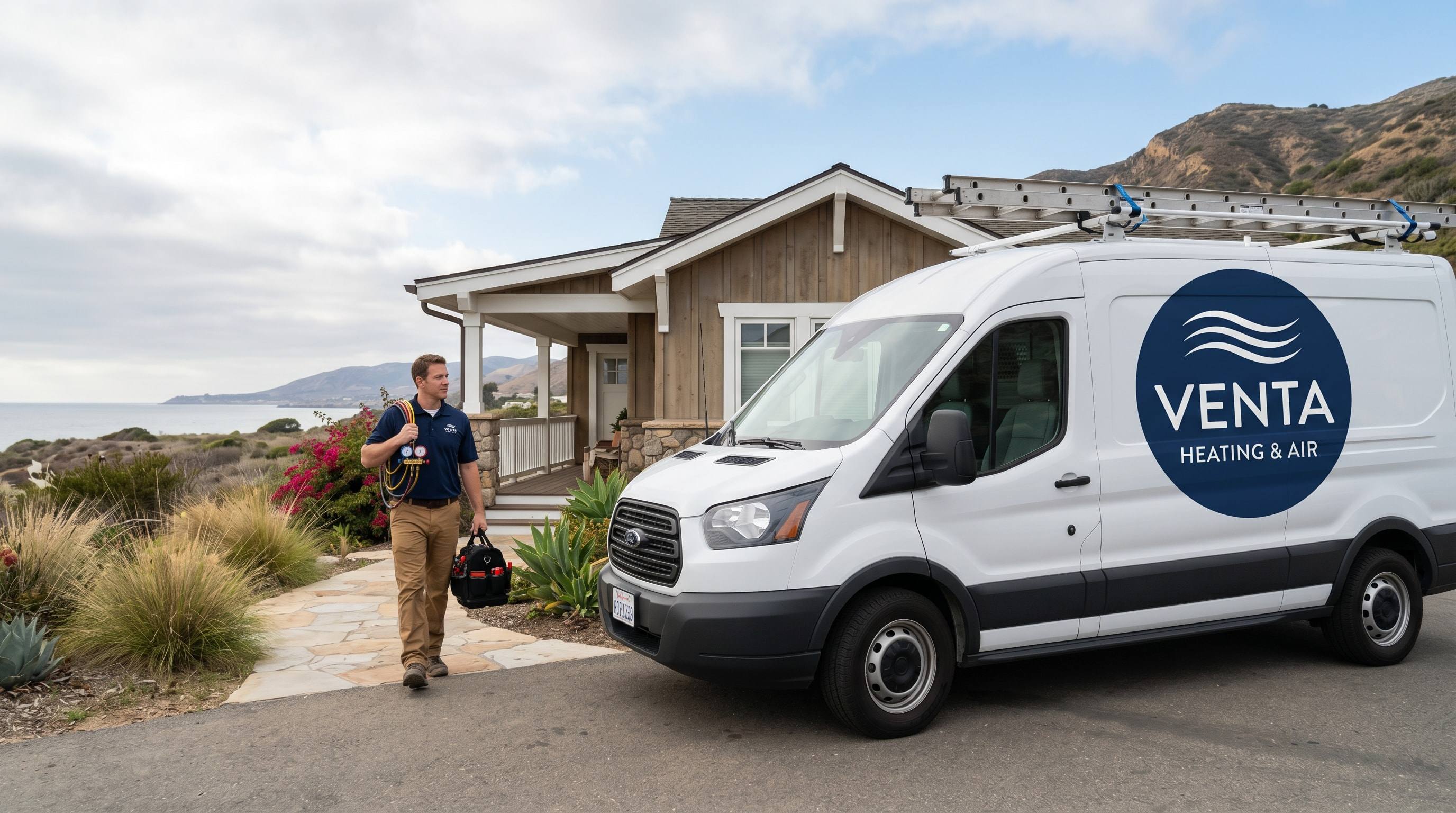
Fillmore is its own thing. Not coastal Ventura, not affluent Conejo Valley, not Oxnard farmland flats. The Santa Clara River Valley runs east from Ventura through Santa Paula, Fillmore, and Piru, and the climate, the housing stock, and the HVAC math all behave differently from the rest of the county. Most contractors who quote here are dispatched out of Thousand Oaks or Ventura and treat Fillmore like a long drive. We treat it like a service area, with bilingual dispatch and a technician who knows the difference between a 1995 rebuild and a 1920s downtown craftsman.
Two facts shape almost every job we do in 93015 and 93016: the 1994 Northridge earthquake left a permanent fingerprint on the housing stock, and the climate is mild enough that heat pump conversions actually pay back faster here than almost anywhere in our service area.
Post-1994 reconstruction stock is hitting end of life now
Fillmore took serious damage in the 1994 Northridge quake. Significant downtown demolition, a wave of FEMA-assisted reconstruction, and a multi-year rebuild cycle that produced a substantial inventory of homes built between 1995 and 2005. That housing is now 20–30 years old, and the original HVAC equipment is hitting the replacement window all at once.
The pattern we see across these post-quake homes is consistent: 80% AFUE single-stage gas furnace (Carrier 58STA, Goodman GMS80, Rheem Classic 80), 10–12 SEER R-22 condenser, builder-grade ductwork sized for the original load. The R-22 systems are already non-viable on refrigerant cost. The furnaces still run but inducer motors and hot-surface igniters are failing on a predictable schedule. If your house was rebuilt 1995–2005 and the HVAC has not been touched, you are about 18 months from the decision.
Pre-1994 stock is a different conversation
The older Fillmore inventory — pre-quake homes that came through 1994 intact, mostly in the historic downtown grid and along Old Telegraph Road — is a different problem. Many were retrofitted with HVAC long after original construction, often with undersized return ductwork and crawl-space supply runs that have settled or been damaged by rodents over decades. The first thing we do on these homes is a static-pressure measurement, not a sizing calculation. If the existing duct system cannot move the air, no amount of new equipment fixes the comfort problem.
Heat pumps actually win here
Fillmore winter lows hover in the high 30s to low 40s, summer highs cap in the low 90s, and the marine influence reaches the valley often enough that 100°F days are rare. That climate envelope is the textbook design point for a residential heat pump. No defrost cycles to manage, no cold-climate model needed, no auxiliary heat strips drawing 10 kW on a January morning.
Real example from a recent install: 2,100 sq ft Fillmore home, post-1994 rebuild, original 80% AFUE furnace and 10 SEER condenser pulled, 3-ton 17 SEER2 Carrier 38MURA heat pump installed with a matched air handler. Total $11,800 installed including permit, HERS, and electrical panel work. SCE rebate $400. SoCalGas furnace-removal incentive $300. Net $11,100 active-stack today.
Federal IRA Section 25C ($2,000) was terminated December 31, 2025 under OBBBA and is no longer in the math for 2026 installs. TECH Clean California single-family heat pump HVAC funds were fully reserved November 14, 2025; HEEHRA fully reserved February 24, 2026. New TECH reservations go on a waitlist, and we file on every qualifying install in case funding reopens during the project window. Full status detail: verified 2026 rebate guide.
Agricultural dust is the wear factor
The wear pattern on Fillmore HVAC systems is not heat. It is dust. Citrus groves, avocado orchards, and active row-crop agriculture surround the city, and the tractor-disking and harvest seasons load the air with fine particulate that finds its way to your filter and condenser coil. Standard 1-inch filters that last 90 days in Thousand Oaks need to be changed every 30 days here during March–May bloom and August–October harvest. Coil cleaning that the manuals call "annual" should actually be every 12–18 months in this microclimate.
The corrective: 4-inch media filter cabinet retrofit ($240–$420), MERV 11 cartridges ($35 each, 6-month change interval), and an annual coil rinse on the maintenance plan. We have homes in town where this changeover added 4–6 years to a system that was about to be condemned.
Bilingual service, locally dispatched
Fillmore has a substantial bilingual community and a meaningful share of agricultural-worker rentals where the absentee landlord is in Ventura or Camarillo. We dispatch bilingual technicians on request, and quote / permit / rebate paperwork can be delivered in Spanish. The Ventura County dispatch line is (805) 977-9940 with a live human, not a call center, and not a flooded-into-LA-traffic queue.
What we cover in the Santa Clara River Valley
- AC repair with upfront written pricing.
- AC installation sized off Manual J, not square-footage rules.
- Heat pump conversion — strong fit for Fillmore's climate envelope.
- Furnace replacement for post-1994 stock at end of life.
- Duct cleaning for agricultural-dust loading.
- Indoor air quality upgrades — 4-inch media cabinets, MERV 13 retrofits.
- 24/7 emergency dispatch.
Coverage extends to Santa Paula, Piru, and the eastern edge of Ventura County. Wider county view: Ventura County HVAC. Nearby: Moorpark, Camarillo, Ventura, Thousand Oaks. CSLB #1138898 (C-20). Permit and HERS in your name.