
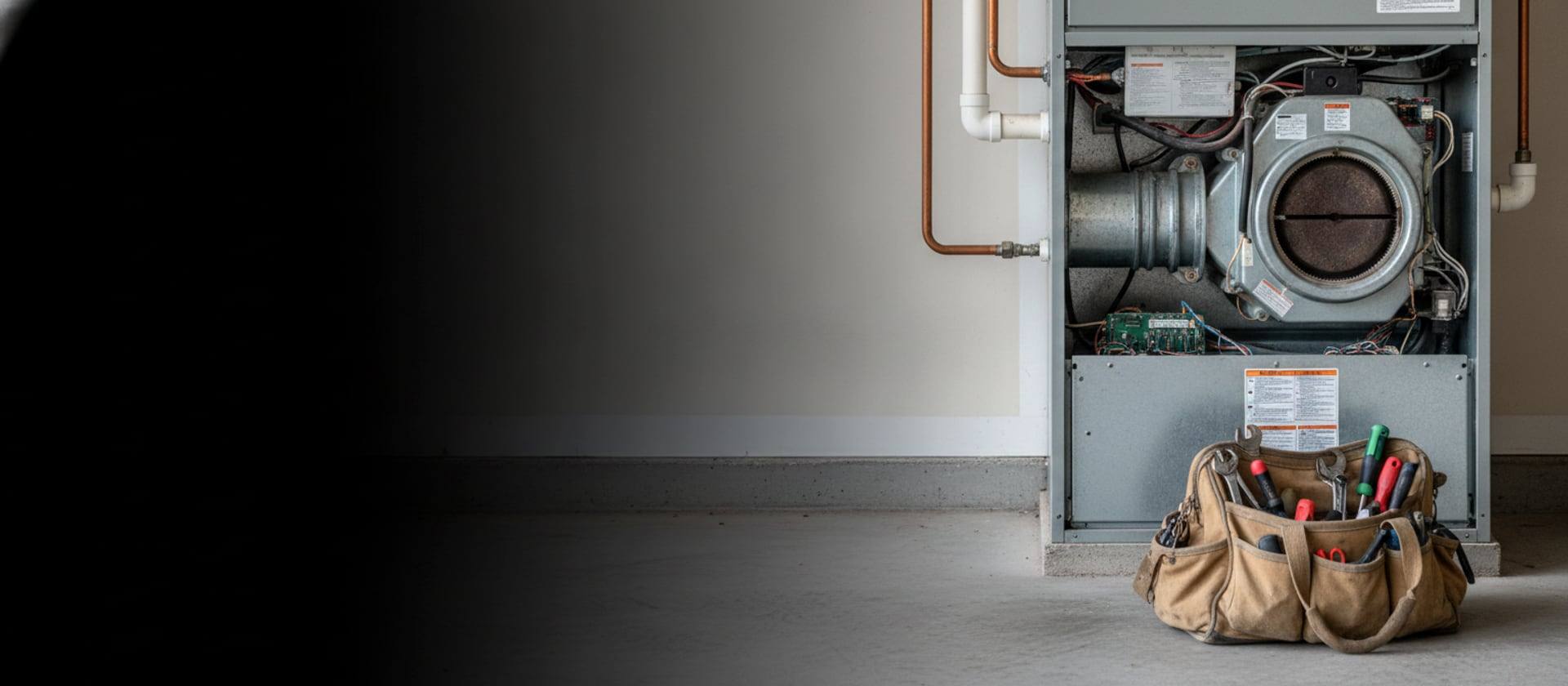
Hot surface ignitor (HSI) failure is the single most common reason a furnace stops igniting in SoCal homes — about 60–70% of our "furnace won't start" calls trace back to a failed ignitor. The good news: it's usually a $245–$385 fix that takes 45 minutes. The bad news: most DIY replacements fail within 60 days because of part selection mistakes and handling errors. This guide walks through symptoms, the silicon carbide vs silicon nitride decision, and when to call. Ready to book the fix? See our furnace ignitor replacement service, or the full furnace won’t ignite diagnostic tree. CSLB #1138898 (C-20).
What the hot surface ignitor does
The HSI is a small ceramic component (about the size of a fingertip) that glows red-hot when energized. Its job is to ignite the gas as it enters the burner chamber. Sequence:
- Thermostat calls for heat
- Inducer fan runs 30–60 seconds (purges combustion chamber)
- Pressure switch confirms vent is clear
- Control board energizes ignitor — heats to 1,800–2,500°F over 15–30 seconds
- Gas valve opens
- Gas ignites against ignitor
- Flame sensor confirms ignition, ignitor de-energizes
- Blower fan starts 30–60 seconds later, heat enters house
If the ignitor doesn’t reach temperature or fails entirely, step 6 doesn’t happen. Gas valve closes after 5–10 seconds (no flame detected), system retries 1–3 times, then locks out as safety.
Symptoms of HSI failure
- Furnace cycles through startup sequence but never produces heat — you hear inducer fan, then nothing
- No orange/red glow visible through inspection port (most furnaces have one)
- Control board LED flashes ignition fault code — typically 3 or 4 flashes (consult manual or sticker inside furnace cabinet)
- Furnace locks out after 1–3 retry attempts — won’t respond until power-cycled
- Smell of unburned gas briefly during startup attempts (not in operation — slight gas odor right when valve opens, before lockout)
Why HSIs fail in SoCal at 4–6 years (manufacturer rating: 5–7)
- Coastal moisture contamination — humid marine air carries salt and minerals that contaminate the ceramic surface, reducing efficiency
- Short-cycling damage — undersized vent, oversized furnace, or thermostat in poor location causes excessive ignition cycles. Each cycle thermal-shocks the ceramic from 70°F to 1,800°F+ in 30 seconds.
- Skin oil contamination during prior service — handling the ceramic with bare hands deposits oils that bake in and cause hot spots, leading to cracks
- Original silicon carbide (SiC) is brittle — most pre-2018 furnaces shipped with SiC ignitors that simply have shorter lifespans than the modern silicon nitride (Si3N4) replacement
Silicon carbide vs silicon nitride: the upgrade decision
| Type | Lifespan | Part Cost | Notes |
|---|---|---|---|
| Silicon Carbide (SiC) | 4–6 yrs | $35–$85 | Older, brittle, OEM in pre-2018 furnaces |
| Silicon Nitride (Si3N4) | 6–9 yrs | $85–$165 | Modern, more durable, default in post-2018 furnaces |
Our default: Si3N4 unless customer specifies otherwise. The $50–$120 upcharge for the part roughly doubles lifespan. On a 12-year-old furnace with 6–9 years of life left, you'd otherwise replace the ignitor again before the furnace dies.
5-minute homeowner check (before calling)
- Confirm thermostat set to "Heat" mode and above current room temperature
- Check thermostat batteries if applicable
- Check filter — heavily clogged filter can trigger limit switch shutoff
- Check breaker for furnace circuit (NOT the gas — the electrical circuit for control board and blower)
- Check gas supply — does your stove or water heater work? If gas is off completely (utility issue, valve closed), furnace won't start
- Try a power cycle — turn furnace breaker OFF for 60 seconds, then back ON. This clears lockout. If furnace ignites and runs normally after this, schedule diagnostic — you have an intermittent fault that will recur
If furnace still won’t ignite, schedule professional diagnostic. Don’t keep cycling power repeatedly — repeated gas valve actuation damages internals.
Real-world example
Sherman Oaks, January 2026:
- Customer: 9-year-old Carrier 59SC2 80% AFUE 80,000 BTU upflow furnace
- Symptoms: furnace ran fine through December, then stopped igniting first cold morning of January (overnight low 38°F)
- Diagnosis on site: original SiC ignitor showed visible cracks at base, multimeter read open circuit (failed)
- Customer options:
- Option A: SiC replacement (OEM equivalent), $245 (4–6 year expected life)
- Option B: Si3N4 upgrade, $325 (6–9 year expected life)
- Option C: full furnace replacement (9 years old — early for replacement, didn’t make sense)
- Customer chose Option B — Si3N4 upgrade
- Total cost: $325 (diagnostic waived with repair)
- Outcome: furnace running normally within 90 minutes of arrival, expected to outlast the rest of the system
When to call vs DIY
DIY appropriate for:
- 5-minute homeowner check items
- Filter replacement
- Visual inspection of ignitor (with furnace OFF, breaker OFF)
Professional required for:
- Actual ignitor replacement (handling requires gloves, part selection requires ID, voltage testing required to confirm root cause)
- Anything involving gas valve, control board, flame sensor, pressure switch
- Diagnosis when ignitor visually looks fine but furnace still won’t start
- Smell of gas during operation (not just at startup)
Service area & dispatch
Furnace service across all 5 SoCal counties:
- 📞 West LA / Westside: (424) 766-1020
- 📞 Pasadena & SGV: (626) 499-5530
- 📞 Thousand Oaks / Ventura: (805) 977-9940
- 📞 Irvine / Orange County: (949) 785-5535
- 📞 San Bernardino: (909) 757-6455
- 📞 Riverside: (951) 744-9188
Phones answered 24/7. Truck dispatch 8 AM–8 PM same-day. After-hours scheduled for first dispatch the following morning. Related: furnace repair, furnace blowing cold air, furnace short cycling, pilot light won't stay lit, heating maintenance, furnace installation.
CSLB License C-20 #1138898 | Roman HVAC 777 LLC dba Venta Heating and Cooling