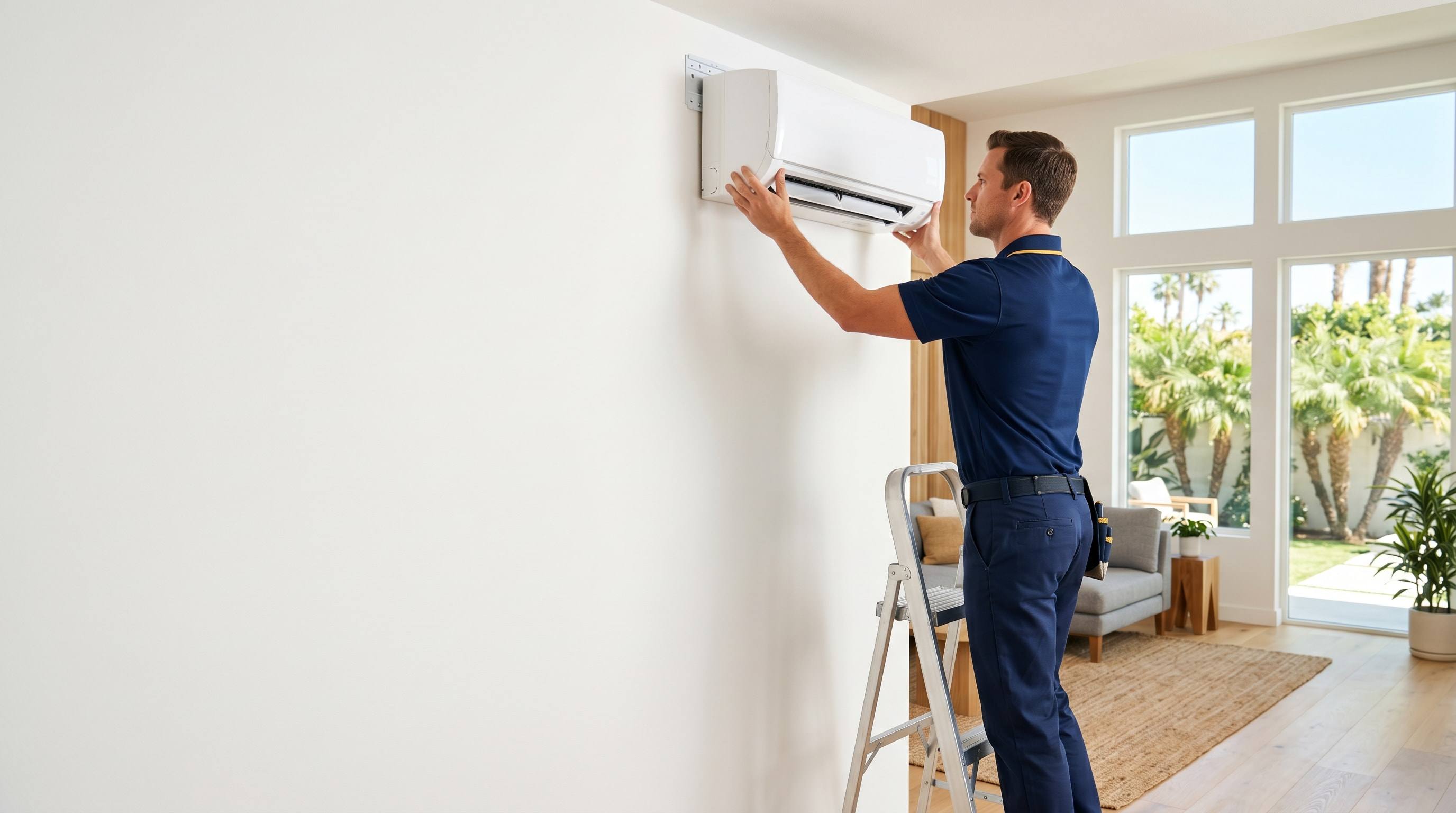
This is the failure-mode companion to our main ductless mini-split service, covering the two ductless calls that are not about heating or cooling output: water leaks and fault codes.
Why a mini-split head leaks water
- Clogged condensate drain line — the most common cause. The head’s gravity drain plugs with algae and dust, water backs up, and it drips from the head.
- Wrong slope — the drain line must fall continuously; a sag or a back-pitched run (often from a prior poor install) holds water that overflows.
- Failed condensate pump — on heads that must pump water uphill to a drain; a stuck or dead pump overflows.
- Frozen coil melting — a clogged filter or low charge ices the coil, which then drips as it melts.
- Loose drain connection behind the head from a prior install.
The freeze-then-drip path links to the cooling side — if your head is also weak on output, see mini-split not cooling or heating and refrigerant leak.
Start with the filter, then the drain
Two homeowner-reasonable checks before you call: clean the washable indoor-head filters (a clogged filter freezes the coil, which then drips as it melts), and gently clear the visible outdoor end of the condensate drain line. If the drip continues, the clog or slope problem is further up the line or behind the head — that, plus condensate-pump service, is a technician job. We clear and verify the full drain path under load so the leak does not return.
Reading blinking lights and error codes
Mini-splits signal faults two ways: a blinking-light pattern on the indoor head (the number and rhythm of flashes maps to a fault category) and, on units with a remote or app, an alphanumeric error code. The exact meanings are brand- and model-specific — the legend lives in the unit’s manual or service documentation — so we read the code against the correct brand reference rather than guess. We describe the categories here rather than print invented codes, because the wording varies by manufacturer. In general the codes point to a subsystem:
- Sensor out of range — a temperature or pressure sensor reading outside its window.
- Communication loss — the indoor head and outdoor unit are not talking (wiring or board).
- High / low pressure — a refrigerant or airflow problem tripping a safety.
- Compressor / inverter fault — the inverter-driven outdoor side reporting a problem.
- Fan or EEV fault — the indoor/outdoor fan or the electronic expansion valve.
Note the blink pattern or code before you call — it speeds the diagnosis. Power-cycle once; if it returns, stop and call rather than repeatedly resetting. For the Daikin lineup’s specific behavior, see Daikin mini-split repair.
Repair pricing
| Repair | Typical cost |
| Diagnostic (waived with repair) | $89 / $149 after-hours |
| Condensate drain clearing | low-cost, confirmed on diagnosis |
| Drain re-slope / condensate pump | quoted per unit |
| Sensor / board / communication (error code) | quoted per unit after diagnosis |
| Refrigerant recharge (R-410A / R-454B per lb) | $85–$145 / $125–$225 |
Inverter, communication, and compressor faults vary by brand and model, so we quote them per unit after reading the code rather than invent a flat rate.
Why these happen in SoCal
Humidity timing and dust. Coastal and late-summer humidity in Santa Monica, Long Beach, and across the basin loads the indoor coil with more condensate, which finds any weak point in a marginal drain. Dust — heavy inland and in pet homes — clogs both the head filters and the condensate line fast. On the coast, salt air corrodes the outdoor electronics that throw communication and sensor codes. Twice-yearly filter cleaning and an annual drain flush prevent most leaks. More on ductless upkeep in our ducted vs. ductless guide.
Mini-split and ductless resources
For output problems (not cooling, not heating, not turning on), see mini-split not cooling or heating. For the Daikin lineup, Daikin mini-split repair. Install scope and replacement: ductless mini-split and mini-split installation cost.
Frequently asked questions
Why is my mini-split leaking water from the indoor head? +
Almost always a condensate drainage problem. The indoor head pulls humidity out of the air, and that water drains by gravity through a small line that runs down and out through the wall. When that line clogs with algae or dust, or its slope is wrong, or the condensate pump (on heads that need to pump uphill) fails, water backs up and drips out of the head onto the wall or floor. Less often it is a frozen coil melting, a loose drain connection behind the head, or ice from a low refrigerant charge. The fix is usually clearing or re-sloping the drain; we confirm the cause on the diagnostic.
Why does my mini-split drip water only sometimes? +
Intermittent dripping usually means a partial drain clog or a marginal slope — the line drains when condensate is light but backs up and overflows when the head runs hard on a humid day. It can also be a condensate pump that works most of the time but sticks occasionally, or a frozen coil that only ices under certain conditions and then drips as it melts. Because it is intermittent, the fix is to clear and verify the full drain path and check the slope rather than just wiping it up. We test the drain under load so it does not come back.
What do the blinking lights or error codes on my mini-split mean? +
Mini-splits signal faults two ways: a blinking light pattern on the indoor head (the number and rhythm of blinks maps to a fault category) and, on units with a remote or app, an alphanumeric error code. The exact code meanings are brand- and model-specific, and the legend lives in the unit's manual or service documentation, so we read the code against the correct brand reference rather than guessing. In general the codes point to a subsystem — sensor out of range, communication loss between head and outdoor, high/low pressure, or compressor/inverter fault — and we confirm the actual part on the meter.
My mini-split light is blinking and it stopped working — what now? +
A blinking light with the unit not running is the head reporting a fault and often locking out for safety. Note the blink pattern (count the flashes and the rhythm) or the code on the remote — that is genuinely useful information for the technician and speeds the diagnosis. Then power-cycle the unit once at the breaker; if it comes back and runs normally, it may have been a transient. If the light blinks again or it will not restart, stop power-cycling and call — repeated resets can mask a real communication, pressure, or compressor fault. We read the code and confirm the cause.
How much does it cost to fix a leaking or error-code mini-split? +
The $89 diagnostic ($149 after-hours) credits to the repair. Clearing a clogged condensate drain is a low-cost fix; re-sloping a drain line or replacing a failed condensate pump is quoted per unit. For error-code faults, the price depends entirely on what the code points to — a sensor is inexpensive, while inverter-board, communication, or compressor faults are quoted per unit after diagnosis because they vary by brand and model. If a recharge is needed for an ice-then-leak cause, refrigerant is $85–$145 per pound for R-410A or $125–$225 for R-454B. We confirm the failed part before quoting.
Can I fix a mini-split water leak myself? +
A couple of things are homeowner-reasonable: cleaning the washable indoor-head filters (a clogged filter can cause the coil to freeze and then drip as it melts) and gently clearing the visible end of the condensate drain line outside. Beyond that — re-sloping a drain inside the wall, servicing a condensate pump, or anything behind the head or in the refrigerant circuit — is a technician job, and error-code faults need the brand-specific diagnostics. The head is also full of electronics that do not mix with water and DIY probing. We handle the drain path and the code on one visit.
Why do mini-splits leak and throw codes more in SoCal? +
Humidity timing and dust. Coastal and late-summer humidity in places like Santa Monica, Long Beach, and the basin loads the indoor coil with more condensate, which finds any weak point in a marginal drain. Dust — heavy inland and in pet homes — clogs both the head filters and the condensate line faster than people expect. On the coast, salt air also corrodes the outdoor electronics that throw communication and sensor codes. Twice-yearly filter cleaning and an annual drain flush prevent most leaks; reading codes early prevents a small fault from cascading.