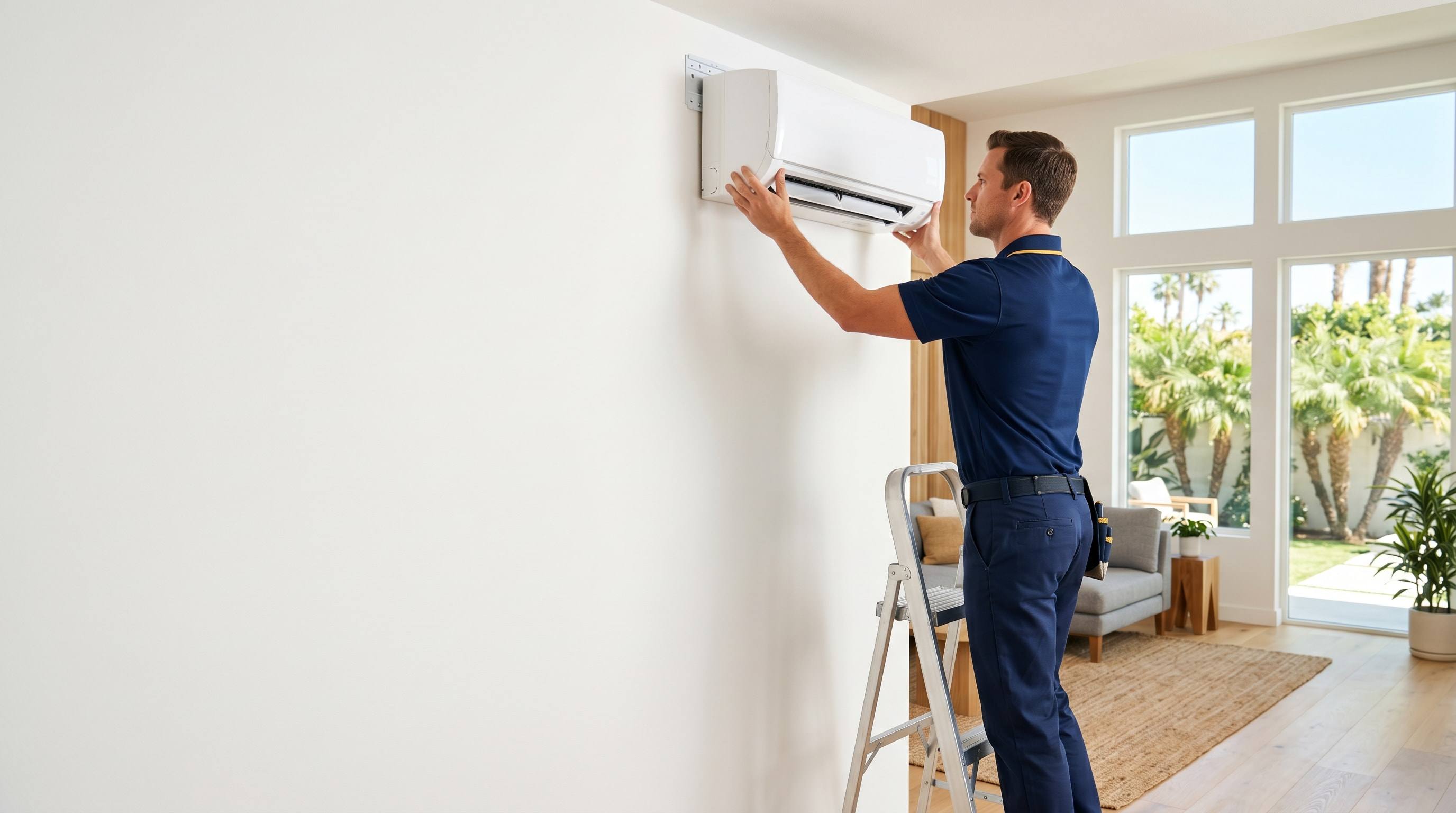
This is the failure-mode companion to our main ductless mini-split service. Ductless systems fail differently from ducted central systems, so the diagnosis starts in different places.
Why a mini-split stops cooling or heating
- Clogged indoor-head filter or coil — the most common and most overlooked. The head pulls room air across a small coil; washable filters load up fast and choke airflow. Often just a cleaning.
- Low refrigerant charge — usually a slow leak at a flare connection. Cuts capacity in both modes. See refrigerant leak.
- Communication fault between indoor head and outdoor unit — the wiring/signal that coordinates them.
- Inverter / control-board fault — the head runs but the compressor will not, or throws an error code.
- Failed outdoor fan or compressor — the outdoor side cannot move heat.
- Stuck mode on a heat-pump model — the reversing function locked in cooling or heating.
Start with the filter
Before anything else: pop the cover off the indoor head and check the filters. Mini-split heads draw room air directly across a compact coil, and the thin washable filters clog faster than people expect — especially in dusty inland homes or with pets. A choked filter starves airflow and the head blows weak, unconditioned air, which reads exactly like a refrigerant or compressor problem. Rinse the filters, let them dry, reinstall. If that does not restore it, the issue is deeper — charge, communication, or a board — and that is our diagnosis.
One zone down vs. the whole system
In a multi-zone setup, one outdoor condenser feeds several indoor heads. A single dead zone usually points at that head or its branch — a clogged filter or coil, that head’s control board or sensor, a communication fault on its wiring, or its EEV (the metering valve that doses refrigerant to each head). If every zone is down, the shared outdoor unit, its compressor, or the main charge is more likely the cause. We isolate the affected zone during the diagnostic rather than condemning the whole system.
Why mini-split pricing is quoted per unit
The cheap fixes are honest and predictable: a filter and coil cleaning, clearing a blocked outdoor unit, a flare-leak repair plus recharge (R-410A $85–$145/lb, R-454B $125–$225/lb). But the inverter-specific parts — control and inverter boards, the EEV, communication faults, and the compressor — vary so widely by brand and model that we quote them per unit after diagnosis rather than print a flat rate we would have to walk back. We read the brand-specific error code, confirm the failed part, and quote the real number. We will not invent a price sight-unseen.
Why mini-splits fail in SoCal
Two patterns. Filter and coil fouling is the big one — in dusty inland areas (Rancho Cucamonga, Fontana, Riverside) and pet homes the washable filters choke airflow fast, and many "not cooling" calls are really a cleaning. On the coast, in Santa Monica, Manhattan Beach, and Malibu, salt air corrodes the outdoor coil and electronics, so coastal units see earlier board and coil issues. Because mini-splits run year-round as heat pumps here, they accumulate hours quickly. Twice-yearly filter cleaning and an annual service prevent most of it; our ducted vs. ductless guide has more.
Repair or replace
A cleaning, a flare-leak repair, a sensor, or a single head’s board is worth fixing. The harder calls are an inverter board or compressor out of warranty, or a multi-head system aging all at once — there the repair can approach a new single-zone unit and we present the replace-versus-repair quote. Mini-splits often carry long compressor/parts warranties (frequently 10–12 years when registered), so we check coverage first — a warrantied part changes everything. See ductless mini-split for replacement scope and mini-split installation cost.
Brand-specific ductless
We service every ductless brand and read their fault codes — for the Daikin lineup specifically, see Daikin mini-split repair. The leaking-water and error-code side is on our mini-split leaking water & error codes page.
Frequently asked questions
Why is my mini-split not cooling or heating? +
On a ductless mini-split the common causes are: a dirty indoor-head filter or coil choking airflow (the single most common and most overlooked), a low refrigerant charge from a leak at a flare connection, a communication fault between the indoor head and the outdoor unit, an inverter or control-board issue, a failed outdoor fan or compressor, or a stuck mode on a heat-pump model. Mini-splits are inverter-driven, so many faults are board- and sensor-level rather than the simple capacitor-and-contactor swaps of a conventional system. We read the unit's error code and check the charge and airflow before quoting; the $89 diagnostic credits to the repair.
Why is my mini-split running but not blowing cold (or warm) air? +
If the indoor head runs and the fan blows but the air is not conditioned, start with the basics that cause most of these calls: a clogged head filter (pop the cover and check — they load up fast and are washable), a blocked outdoor unit, or a dirty indoor coil. Beyond that, a low refrigerant charge from a small flare-fitting leak is common on mini-splits and cuts capacity, and a communication or inverter-board fault can leave the compressor not running while the head still blows. On a heat-pump model stuck in the wrong mode, you would feel the opposite of what you set. We diagnose airflow, charge, and the error code.
How much does mini-split repair cost? +
The $89 diagnostic ($149 after-hours) credits to the repair. Simple items — cleaning a fouled indoor filter and coil, clearing a blocked outdoor unit — are low-cost. A refrigerant leak repair plus recharge is priced by leak location and refrigerant (R-410A $85–$145 per pound, R-454B $125–$225). The inverter-specific parts — control and inverter boards, the EEV (electronic expansion valve), communication faults, and the compressor — are quoted per unit after diagnosis rather than at a flat rate, because they vary widely by brand and model. We confirm the failed part before quoting and never invent a price sight-unseen.
Why does only one of my mini-split zones stop working? +
In a multi-zone system, one outdoor condenser feeds several indoor heads, so a single dead zone usually points at that head or its branch rather than the whole system. Likely causes: a clogged filter or coil on that head, a fault in that head's control board or sensor, a communication problem on that head's wiring, or an EEV (the metering valve that doses refrigerant to each head) issue for that zone. If every zone is down, the problem is more likely the shared outdoor unit, its compressor, or the main charge. We isolate the affected zone during the diagnostic.
Can a regular HVAC contractor fix a mini-split? +
Many can attempt it, but inverter-driven ductless systems use brand-specific control logic and error-code structures that a generalist often does not carry the tools or training for. Brands like Mitsubishi and Daikin use proprietary fault codes and diagnostic software, and a misread code leads to the wrong board or an unnecessary compressor recommendation. The flare-fitting connections, the EEV, and the communication wiring also behave differently from a conventional split system. We service ductless as a regular part of the work and read the brand-specific codes rather than guessing from outside.
Why do mini-splits fail the way they do in Southern California? +
Two patterns. Filter and coil fouling is the big one: mini-split heads pull room air directly across a small coil, and in dusty inland areas or homes with pets the washable filters load up fast and choke airflow — many "not cooling" calls are really a cleaning. On the coast, in Santa Monica, Manhattan Beach, and Malibu, salt air corrodes the outdoor unit's coil and electronics, so coastal mini-splits see earlier board and coil issues. Because mini-splits run year-round as heat pumps here, they also accumulate hours quickly. Twice-yearly filter cleaning and an annual service prevent most of it.
Should I repair or replace a mini-split that won’t cool or heat? +
A cleaning, a flare-leak repair, a sensor, or a single head's board is usually worth fixing. The harder calls are an inverter board or compressor failure out of warranty, or a multi-head system where several components are aging at once — there the repair can approach the cost of a new single-zone unit, and we present the replace-versus-repair quote. Mini-splits often carry long compressor and parts warranties (frequently 10–12 years registered), so we check coverage first, because a warrantied part changes the math entirely. We give you both numbers.