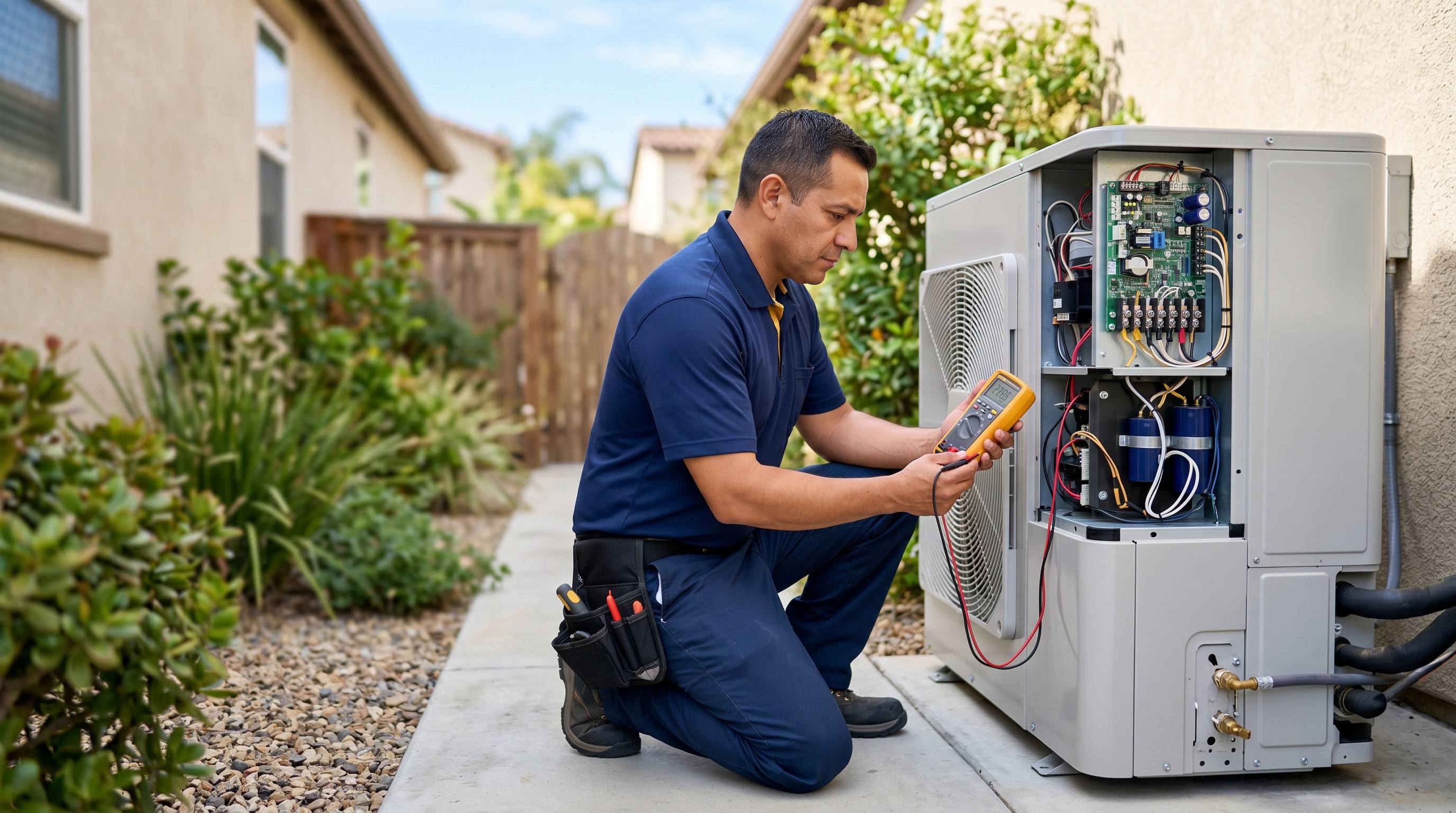
This is the failure-mode companion to our main heat pump repair service. A heat pump in cooling mode is an air conditioner, so most of this overlaps the AC side — with one heat-pump-only twist.
Why a heat pump stops cooling
- Reversing valve stuck in heating — the heat-pump-specific cause. The valve locks in heat mode and the system blows warm air on a cooling call. Reversing valve, $400–$1,500.
- Low refrigerant charge from a leak — reduced capacity, long run times, sometimes a frozen indoor coil. See refrigerant leak.
- Dirty outdoor (condenser) coil — cannot reject heat, so cooling fades on the hottest days. Coil cleaning $245–$485.
- Failed capacitor or contactor — the outdoor unit hums with the fan or compressor not running. See fan not spinning ($185–$295) and contactor ($165–$285).
- Weak or failed compressor — runs but never pulls down to pressure. See compressor replacement.
The one thing an AC can't do: get stuck in heat
The reversing valve is what makes a heat pump a heat pump, and it is the diagnosis that separates a heat-pump no-cool from an AC no-cool. If its solenoid coil fails or the valve body sticks, the system can lock in heating mode and push genuinely hot air at the vents on a day you asked for cooling. We meter the valve solenoid and verify which mode the refrigerant circuit is actually running. Everything else — coil, charge, capacitor, compressor — we diagnose exactly as we would on a straight AC, so our AC running but not cooling walkthrough applies to the shared causes.
Not-cooling repair pricing
Flat-rate from our SoCal tickets; diagnostic $89 ($149 after-hours), credited to the repair:
| Repair | Typical cost |
| Diagnostic (waived with repair) | $89 / $149 after-hours |
| Dual-run capacitor | $185–$295 |
| Contactor | $165–$285 |
| Condenser coil cleaning | $245–$485 |
| Condenser fan motor (PSC) | $485–$795 |
| Reversing valve (coil-only to full valve) | $400–$1,500 |
| Compressor (out of warranty — we quote replacement) | $2,400–$4,200 |
Why heat pumps lose cooling in SoCal
Inland, in Rancho Cucamonga, Fontana, and Riverside, a heat pump runs near maximum compressor amperage through 100°F-plus afternoons, which cooks capacitors (year 5–7) and stresses compressors. A dust- or cottonwood-clogged outdoor coil cannot reject heat, so cooling fades on the hottest days — exactly when you need it. On the coast, salt air corrodes the coil and electricals. A spring tune-up that cleans the coil and checks the capacitor and charge prevents most mid-summer no-cool calls.
Repair or replace
Under 10–12 years with a single electrical or coil fault, repair it. Past 12 years with a compressor or a full reversing-valve body, replacement usually wins, and R-22 is replacement-only. Heat pumps reach that threshold sooner than ACs because of the year-round hours. We model both — see heat pump vs. air conditioner and heat pump installation.
Every major brand
We diagnose no-cool on every heat pump line — Trane, Lennox, Rheem, Goodman, Daikin, and York heat pump repair, plus Daikin mini-split repair.
Frequently asked questions
Why is my heat pump not cooling? +
A heat pump cools exactly like an air conditioner, plus it has a reversing valve that can stick it in heating mode. So the causes are: a reversing valve stuck in heat (the heat-pump-specific one), a low refrigerant charge from a leak, a dirty outdoor coil that cannot reject heat, a failed capacitor or contactor leaving the compressor or fan not running, or a weak compressor. On a SoCal heat pump in summer the most common are a dirty coil, a low charge, and a failed capacitor — but the reversing valve is the cause unique to heat pumps. We confirm the mode and pressures before quoting; the $89 diagnostic credits to the repair.
Can a heat pump get stuck in heating mode? +
Yes, and it is the failure that separates a heat pump no-cool from an AC no-cool. The reversing valve flips refrigerant flow between cooling and heating; if its solenoid coil fails or the valve body sticks, the system can lock in heating mode and blow warm air no matter where you set the thermostat. You will often feel hot air at the vents on a day you asked for cooling. We meter the valve solenoid and verify which mode the refrigerant circuit is actually in. Repair runs $400–$1,500 depending on whether it is the coil only or the full valve.
How much does it cost to fix a heat pump that is not cooling? +
It depends on the cause, and the $89 diagnostic ($149 after-hours) credits to the repair. From our tickets: a dual-run capacitor $185–$295, a contactor $165–$285, a condenser fan motor $485–$795, a condenser coil cleaning $245–$485, a reversing valve $400–$1,500, refrigerant leak repair plus recharge (R-410A $85–$145/lb, R-454B $125–$225/lb) varying by leak location, and a compressor out of warranty $2,400–$4,200. We find the actual fault before quoting — the cheap capacitor and the expensive compressor cause the same "not cooling" symptom.
Is a heat pump not cooling the same as an AC not cooling? +
Mostly the same, with one extra suspect. Everything that stops an AC from cooling — dirty coil, low charge, dead capacitor, weak compressor — also stops a heat pump, and the diagnosis and pricing are identical for those. The difference is the reversing valve: a heat pump can be stuck in heating mode, which an AC cannot. So we run the same cooling-side checks as an AC plus a reversing-valve mode test. If you have a straight AC rather than a heat pump, our AC not-cooling resources apply directly.
Why is my heat pump blowing warm air in summer? +
Warm air when you want cooling points first at the reversing valve stuck in heating mode — the system is literally running in heat. If the air is room-temperature rather than hot, the more likely causes are a low refrigerant charge, a dirty outdoor coil that cannot dump heat, or a compressor that is not pulling down to pressure. A failed capacitor can leave the outdoor unit humming with the fan or compressor not running, which also reads as no cooling. We separate "actively heating" from "not cooling effectively" with a quick mode and pressure check.
Why do heat pumps lose cooling capacity in Southern California summers? +
Heat and the outdoor coil. Inland, in Rancho Cucamonga, Fontana, and Riverside, a heat pump runs near maximum compressor amperage through 100°F-plus afternoons, which is hard on capacitors and compressors — we see capacitors fail at year 5–7 inland. A dust- or cottonwood-clogged outdoor coil cannot reject heat, so cooling fades on the hottest days exactly when you need it. On the coast, salt air corrodes the coil and electricals. A spring tune-up that cleans the coil and checks the capacitor and charge prevents most mid-summer no-cool calls.
Should I repair or replace a heat pump that won’t cool? +
Under about 10–12 years with a capacitor, contactor, fan motor, coil cleaning, or reversing-valve coil, repair it. Past 12 years with a compressor failure or a full reversing-valve body replacement, replacement usually wins — the labor on those approaches a meaningful share of a new unit, and R-22 systems are replacement-only. Because a heat pump runs both seasons, it logs more hours than a cooling-only AC and reaches the replace threshold sooner. We give you the repair figure and a written replacement quote side by side.