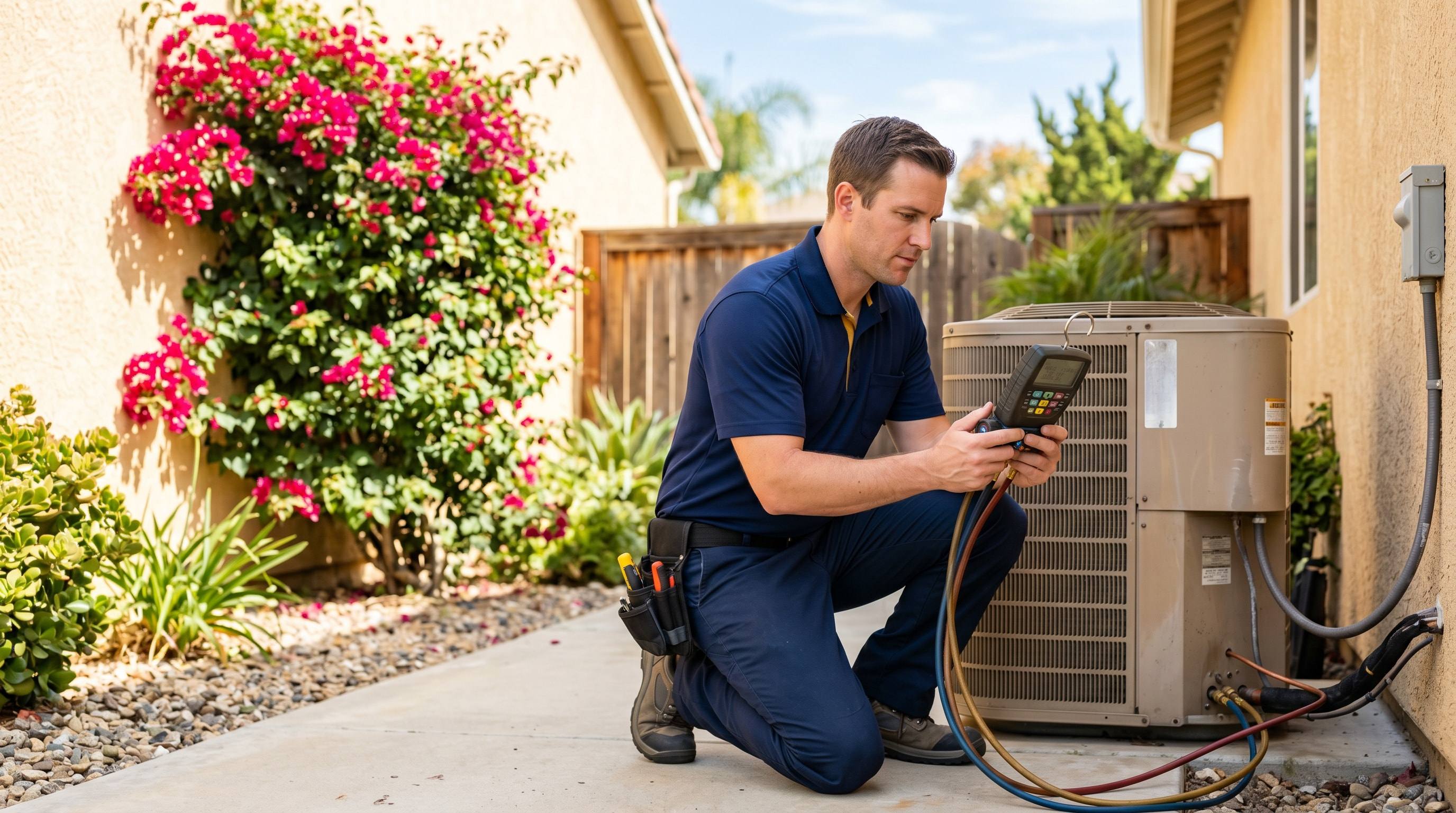
This is the failure-mode companion to our main AC repair service. A stalled condenser fan is one of the few AC faults where running the system another hour can turn a cheap repair into a compressor replacement.
Shut it off first
The outdoor fan pulls air across the condenser coil to dump the heat your AC removes from the house. When it stops but the compressor keeps running, head pressure and temperature spike and you can overheat the compressor — a $2,400-plus part — within the hour. The humming you hear is the compressor straining. Turn the system off at the thermostat or breaker and call. This protects the expensive component while you wait.
Why the fan stops — causes in order
- Failed dual-run capacitor — about 80% of cases. No starting torque, so the fan sits still and hums. $185–$295.
- Burned-out condenser fan motor — worn bearings (often noisy first) or a dead winding. $485–$795 PSC, $685–$1,085 ECM.
- Pitted contactor — not passing power to the fan and compressor. $165–$285.
- Lost power — tripped breaker, blown fuse at the disconnect.
- Physical obstruction — debris or a bent blade jamming the fan.
Capacitor vs. fan motor — the meter decides
The capacitor and the fan motor cause the identical symptom — a humming unit and a still fan — but one is a $185–$295 part and the other is $485–$795. We measure the capacitor’s microfarads against its rating and check the motor’s windings and amp draw before quoting. That single test is what keeps you from paying for a motor when a capacitor would have fixed it. The capacitor is also the most common cause, so it is always the first thing we check. More on the capacitor in our AC capacitor failure guide.
The push-start trick — clue, not cure
You may have read that nudging the fan blade with a stick (power off) gets it spinning. If the fan then runs on its own, that confirms a failed start capacitor — but it is a diagnosis, not a fix, and reaching into a live condenser is genuinely risky. A push-started fan will strand you again within days and can cook the compressor in the meantime. Treat it as confirmation to get the capacitor replaced, not as a repair.
Why these parts fail in SoCal — heat and salt
Capacitors are heat-sensitive, and an outdoor unit baking through 100°F-plus afternoons in Rancho Cucamonga, Fontana, and Riverside cooks them — we see them fail at year 8–12 inland. On the coast in Santa Monica, Manhattan Beach, and Malibu, salt air corrodes fan-motor bearings and electrical terminals, and failures show up earlier, year 5–8. Condenser fan bearings also wear from run-hours and from debris pulled through the unit. An annual spring tune-up that checks capacitor microfarads and motor amp draw catches a weak one before a heat-wave failure.
Fan repair pricing
| Repair | Typical cost |
| Diagnostic (waived with repair) | $89 / $149 after-hours |
| Dual-run capacitor | $185–$295 |
| Single-run capacitor | $145–$245 |
| Contactor | $165–$285 |
| Condenser fan motor (PSC) | $485–$795 |
| Condenser fan motor (ECM) | $685–$1,085 |
Every major brand
Fan and capacitor failures hit every brand — Carrier, Trane, Lennox, Rheem, Goodman, Daikin, and York AC not cooling cover the brand-specific diagnostics.
Frequently asked questions
Why is my AC fan not spinning? +
On an outdoor unit that hums but the fan will not spin, the cause is a failed dual-run capacitor about 80% of the time — the capacitor gives the fan motor its starting torque, and without it the motor cannot get moving. The next most common causes are a burned-out condenser fan motor, a tripped breaker or lost power, a pitted contactor not sending power, or debris physically jamming the blade. The fix ranges from a $185–$295 capacitor to a $485–$795 fan motor. Shut the unit off if it is humming — running it that way overheats the compressor fast.
Can I push-start my AC fan with a stick? +
It is a known trick — cut power, then nudge the fan blade with a long stick through the top grille — and if the fan then spins up on its own, it confirms a failed start capacitor. But it is a diagnostic clue, not a repair, and it is genuinely risky: the fan is electrically live work and the blade will start with force. We do not recommend reaching into a condenser. If push-starting makes it run, the capacitor is failing and will strand you again within days, often taking the compressor with it. Shut it down and have the capacitor replaced.
How much does it cost to fix an AC fan that won’t spin? +
It depends on which part failed, and our $89 diagnostic ($149 after-hours) credits to the repair. A dual-run capacitor — the most common cause — is $185–$295. A single-run capacitor is $145–$245. A contactor is $165–$285. A PSC condenser fan motor runs $485–$795, and an ECM fan motor $685–$1,085. We confirm the actual fault with a meter before quoting, because a $200 capacitor and a $700 motor present with the exact same symptom — a humming unit and a still fan.
Is it safe to run my AC if the outdoor fan isn’t spinning? +
No — shut it off at the thermostat or breaker right away. The condenser fan’s job is to pull air across the coil to reject the heat the system is removing from your home. When the fan stops but the compressor keeps running, head pressure and temperature climb fast, and you can overheat and damage the compressor — a $2,400-plus part — in under an hour. The humming you hear is the compressor straining. Turning it off protects the expensive component while you wait for us. This is one of the few AC faults where running it does real damage quickly.
What is the difference between the capacitor and the fan motor failing? +
They cause the same symptom — a humming unit with a fan that will not spin — but they are very different repairs. The capacitor is a cheap electrical component ($185–$295) that stores the jolt of starting torque; it is the most common cause and the first thing we test. The fan motor itself ($485–$795 PSC) fails less often, usually with worn bearings (often noisy first) or a burned winding. We measure the capacitor’s microfarads and check the motor windings and amp draw to tell them apart, rather than replacing the expensive part on a guess.
Why do AC fan motors and capacitors fail in Southern California? +
Heat and salt. Capacitors are heat-sensitive, and an outdoor unit baking through 100°F-plus Inland Empire afternoons cooks them — we see capacitors fail at year 8–12 inland. On the coast, in Santa Monica, Manhattan Beach, and Malibu, salt air corrodes motor bearings and electrical terminals, and we see failures earlier, year 5–8. Condenser fan motor bearings also wear from sheer run-hours and from debris pulled through the unit. An annual tune-up that checks capacitor microfarads and motor amp draw catches a weak one before it strands you in a heat wave.
My fan spins but the AC still isn’t cooling — is that the same problem? +
No, that is a different diagnosis. If the outdoor fan spins normally but the house is not getting cool, the issue is more likely a dirty condenser coil, low refrigerant from a leak, or a weak compressor — not the fan circuit. The fan-not-spinning problem is specifically the outdoor fan sitting still while the unit hums. If your fan runs and you still have warm air, start with our AC running but not cooling guide and the refrigerant-leak page instead. We sort out which path you are on during the diagnostic.