
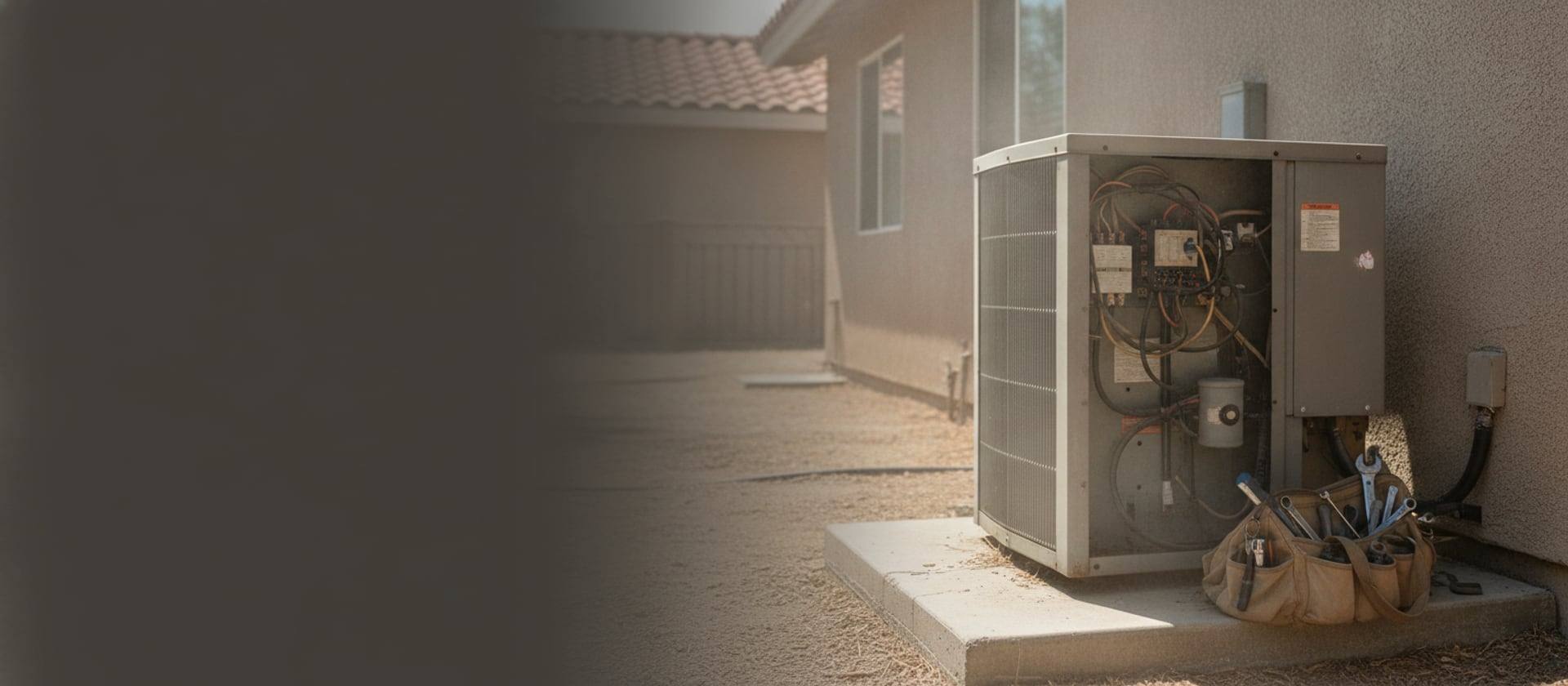
AC capacitor failure is the single most common AC emergency call we run in Southern California — typically 25–30% of summer service tickets. Symptoms are unmistakable once you know them: outdoor unit hums but the fan doesn’t spin, AC running but not cooling, or system attempting to start then immediately shutting down. Replacement cost in LA market: $185–$295 for typical residential system, 30–45 minutes on site. The frustrating part: capacitors rated for 10–15 years often fail in 4–7 years in SoCal because of our heat. This guide covers symptoms, diagnosis, replacement cost, and when to replace proactively vs reactively. CSLB #1138898 (C-20).
What an AC capacitor does
Plain-language explanation:
- Capacitor = electrical "battery" that stores energy and releases it as a burst
- Two roles: provides starting torque to compressor + provides running torque to fan motor
- Most residential ACs use one "dual-run" capacitor handling both roles
- Located inside outdoor condenser unit, typically 35/5 mfd (microfarads) for 3-ton residential, 40/5 for 4-ton, 45/5 for 5-ton
- When capacitor fails: motor can’t start (compressor) or can’t run (fan)
7 symptoms of a failing capacitor
- Outdoor unit humming but fan not spinning — most common. Capacitor too weak to provide starting torque. Quick test: nudge the fan blade with a stick (carefully) — if it spins after that, capacitor is the issue. Don’t keep operating like this — compressor strain.
- AC running but not cooling — fan spinning, compressor running, but no cold air. Could be capacitor weak enough to let compressor run but not at full capacity. See our AC running but not cooling guide for the full diagnostic tree.
- System hard-starts repeatedly — clicking sound followed by motor straining. Marginal capacitor.
- AC starts then shuts off after 30–60 seconds — short cycling caused by capacitor not maintaining proper run torque. Detail: AC short cycling guide.
- Higher than normal energy bills — weak capacitor forces motor to draw more amps, increases electricity consumption 8–15%.
- Visible bulging or leaking on the capacitor itself — DEFINITE failure. Cylindrical metal can develops "muffin top" shape from internal pressure. Sometimes oil-like leakage visible. Call professional immediately.
- Burning smell from outdoor unit — capacitor short-circuiting. Turn off AC immediately, breaker too. This is electrical safety, not just comfort.
Why SoCal capacitors fail faster than rated
Honest analysis:
- Capacitors rated for 10–15 year typical lifespan in moderate climates
- LA market reality: 4–7 years in coastal LA, 3–5 years in inland LA (Sherman Oaks, Pasadena, Glendale), 2–4 years in desert/Coachella Valley (Palm Springs, Palm Desert, Indio), 2–3 years in Inland Empire 110°F+ heat dome regions
Reasons:
- Heat exposure: capacitors rated for 158°F internal temperature. SoCal afternoons regularly push outdoor unit internal temps above this
- Run hours: SoCal AC runs 1,800–2,400 hours/year. Northern climates run 600–800 hours. 3–4x more wear per calendar year
- Dust and salt-air corrosion: coastal homes (Newport Beach, Manhattan Beach, Malibu) see corrosion on capacitor terminals, accelerates failure
- Voltage fluctuations: older LA neighborhoods with aging electrical infrastructure cause minor surges that cumulatively damage capacitors
How to diagnose capacitor failure (NOT for DIY — for understanding only)
What technicians do:
- Visual inspection: check for bulging, leaking, scorching
- Multimeter test on disconnected capacitor: measure microfarads (mfd) reading
- Specification check: rating printed on capacitor case (e.g., "35/5 MFD ±5%")
- Diagnosis: capacitor is failing if reading drops below 10% of rated value
- Example: 35 mfd rated capacitor reading 32 = 8% drift = borderline replacement; 30 = 14% drift = definite replacement
WARNING for homeowners: capacitors store HIGH-VOLTAGE charge even when AC is powered off. They can shock you severely (or fatally). DO NOT attempt DIY capacitor replacement unless you’re a trained technician with proper safety equipment.
AC capacitor replacement cost in Los Angeles 2026
Honest pricing breakdown for LA market:
| Cost component | Range |
|---|---|
| Diagnostic visit | $89 standard, $149 after-hours (waived with repair) |
| Capacitor part (residential 35-45 mfd dual-run) | $35–$95 (we use OEM-grade) |
| Labor (30-45 min on site) | $150–$200 |
| Total typical | $185–$295 |
Higher cost ranges in LA market:
- Premium variable-speed systems with multiple capacitors: $385–$685
- After-hours emergency call (8 PM–8 AM): add $50–$80 surcharge
- Holiday rate: $99 diagnostic + standard repair labor
We don’t surge-price during heat dome events. Period.
When to replace proactively vs wait for failure
Honest framework:
Replace proactively when:
- Capacitor reading 80–90% of rated value during scheduled tune-up
- System is 7+ years old without prior capacitor replacement
- Going into peak summer (May–September) with marginal readings
- During Comfort Club tune-up — preventive replacement is cheap insurance
Wait when:
- Capacitor reading 95%+ of rated value
- New system (under 5 years) with first-time inspection
- Reading is stable across multiple service visits
- Limited budget — capacitor is one of cheapest emergency repairs
The math: proactive replacement during tune-up = $295. Emergency replacement during heat dome = $295 + $149 emergency diagnostic + 4–6 hour wait without AC = roughly equivalent dollar cost but worse customer experience.
Real-world example
Newport Beach, July 2025 heat dome:
- Customer: 12-year-old Carrier 24ACC6 4-ton AC
- Symptoms: outdoor unit humming, fan not spinning
- Diagnosis (45 min): capacitor reading 28 mfd (rated 35/5 dual-run)
- Repair: dual-run capacitor replacement
- Total cost: $295 (diagnostic waived with repair)
- Compounding finding: refrigerant 9% low (slow leak, scheduled follow-up)
- Outcome: cooling restored within 1 hour of arrival
- Note: customer joined Silver Comfort Club ($349/year) at end of visit
Service area & dispatch
AC capacitor service across all 5 SoCal counties:
- 📞 West LA / Westside: (424) 766-1020
- 📞 Pasadena & SGV: (626) 499-5530
- 📞 Thousand Oaks / Ventura: (805) 977-9940
- 📞 Irvine / Orange County: (949) 785-5535
- 📞 San Bernardino: (909) 757-6455
- 📞 Riverside: (951) 744-9188
Phones answered 24/7. Truck dispatch 8 AM–8 PM same-day. After-hours scheduled for first dispatch the following morning. Related: AC repair, AC maintenance (catches capacitor drift), Comfort Club, emergency HVAC dispatch, AC replacement, AC running but not cooling, AC short cycling.
CSLB License C-20 #1138898 | Roman HVAC 777 LLC dba Venta Heating and Cooling