
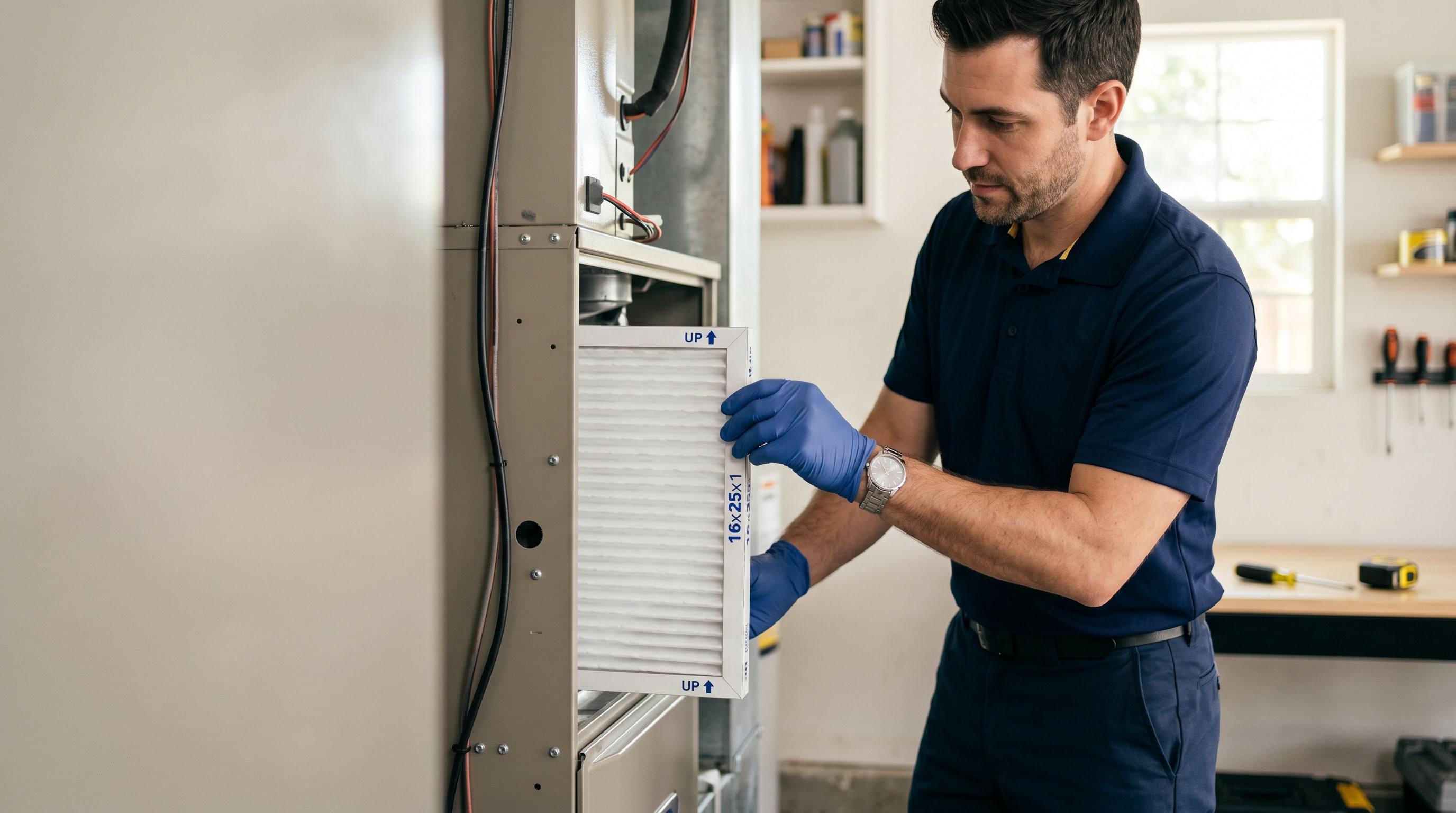
What an AC tune-up actually includes
A real AC tune-up is 60–90 minutes of measurement, cleaning, and documentation — not a 15-minute walk-around. Every item below gets done on a standard residential visit, and every reading goes on the written invoice. If your tech can’t show you the numbers, you didn’t get a tune-up.
- Condenser coil cleaning — visual debris removal, soft-brush of bent fins, and an optional chemical wash for heavily soiled coils in Sherman Oaks, the SGV, or coastal homes carrying salt deposits.
- Evaporator coil visual inspection — access through the cabinet panel; deeper clean if the coil is reachable and shows biological growth or matting.
- Capacitor microfarad reading — measured against nameplate spec. A 45 µF dual-run reading 39 µF is drifting; we document the number, flag the year-curve, and quote replacement if it’s outside 10% tolerance.
- Contactor inspection — pitting on the contact faces, voltage drop across the contacts under load, signs of buzzing or chattering. Pitted contactors run hot and weld themselves shut over a summer.
- Refrigerant pressures — manifold gauges on the high side and low side, plus superheat and subcool calculated from line temperatures. “Feels cold at the vent” is not a pressure reading.
- Amp draw on every motor — compressor, condenser fan motor, and blower motor each measured under load and compared to nameplate RLA / FLA. Anything pulling 10%+ over nameplate is a flag for bearings, capacitor drift, or refrigerant overcharge.
- Temperature differential (delta-T) — return air vs supply air at the closest register, target 18–22°F on a properly charged single-stage system. Reads below 16°F point to airflow, charge, or coil issues; above 24°F points to severe airflow restriction.
- Drain line clearing — nitrogen blow at the outdoor termination plus algae tablets in the P-trap. The evaporator generates 5–20 gallons of condensate on a hot day; a blocked line floods drywall before it floods the secondary pan.
- Air filter check and replacement — if you have the right filter on site we install it; if not, we measure the existing filter and document the install size on the invoice so you can buy the right one.
- Blower wheel inspection — this one matters. A dirty blower wheel chokes airflow long before the homeowner notices a temperature problem. We pull the access panel and check for caked dust on the squirrel-cage fins.
- Electrical connections tightening — every terminal screw on the contactor, capacitor, disconnect, and control board. Thermal cycling backs screws out over the years; a loose terminal arcs, then carbonizes, then fails.
- Outdoor disconnect inspection + voltage verification — line voltage at the disconnect with the unit running, fuses checked for resistance, pull-out visually inspected for burn marks.
- Thermostat calibration check — actual room temperature with a calibrated probe vs the displayed reading. A thermostat reading 3°F off the actual room temp runs the AC 15–20% longer than necessary all summer.
- Suction line insulation inspection — UV-degraded foam jacket on the larger refrigerant line is one of the most common findings in Pasadena and inland homes. Bare suction line costs you 5–8% of cooling capacity.
- Documentation — written report with every reading. Capacitor microfarad, all three amp draws, high/low pressures, superheat and subcool, supply/return delta, line voltage. If your tech leaves you with a checkmarked “all systems good” and no numbers, that’s the tell.
What a tune-up is NOT
The $49 tune-up advertised by the big LA chains is not what we’re describing above. Knowing the difference saves you from being upsold $3,400 in repairs at the end of what was supposed to be a maintenance visit.
- $49 tune-ups are sales calls. The format: 15 minutes of inspection plus a capacitor microfarad check, followed by a printed list of “findings” that conveniently total $1,200–$3,400. The tech is paid on commission against the upsell list. The $49 covers door-knock acquisition cost — the real revenue comes from what gets sold after.
- Real maintenance takes 60–90 minutes minimum on a standard residential system. 75–120 minutes on a heat pump. 90–150 minutes on a multi-stage or communicating system. If the tech is in and out in 20 minutes, you didn’t get a tune-up — you got an inspection.
- Coil cleaning means cleaning the coil. Not a 2-minute rinse with a garden hose at standard residential water pressure. Real condenser coil cleaning is debris removal first, fin straightening where needed, then a low-pressure rinse with a coil-safe alkaline cleaner. Garden-hose-only rinses push the gunk deeper into the coil, not out of it.
- Documented readings belong on the invoice. Compressor amps. Condenser fan amps. Blower amps. High side and low side pressures. Superheat and subcool. Supply and return temperatures with the delta-T calculated. Capacitor microfarad reading. If those numbers aren’t on the paperwork you sign, the tune-up wasn’t done — or it was done badly enough that nobody wants to write the numbers down.
- The honest line: if your AC is 12+ years old and hasn’t seen a tune-up in 3 years, the tune-up will find $400–$1,200 in actual maintenance work. That’s not upselling — that’s the equipment telling you what’s wrong. The $145 visit isn’t designed to be the only number on the invoice if you’ve been neglecting the system. The difference between us and the chains: we’ll show you the readings that justify each line item, and we’ll tell you which findings can wait until next year and which ones can’t.
Pricing
Honest, parts-and-labor pricing on tune-ups and the most common add-ons we find during maintenance visits. These are real ranges from our service tickets across all five counties:
| Service | Typical cost | Time |
|---|---|---|
| Standard residential AC tune-up | $145–$185 | 60–90 min |
| Heat pump tune-up (cooling + heating side) | $185–$245 | 75–120 min |
| Multi-stage / communicating system tune-up | $245–$385 | 90–150 min |
| Coil deep cleaning (chemical, in-place) | $245–$485 | 60–90 min |
| Coil deep cleaning (pull and clean) | $485–$885 | 2–4 hr |
| Comfort Club Silver (2 tune-ups) | $349/year | — |
| Comfort Club Gold (2 tune-ups + priority + 20% repair discount) | $599/year | — |
| Drain line treatment add-on | $45–$85 | 15 min |
| UV light installation | $385–$685 | 60–90 min |
| Capacitor preventative replacement (year 8+) | $185–$295 | 20–30 min |
| Adding R-410A refrigerant during maintenance | $85–$145/lb | varies |
| Diagnostic during maintenance | included | — |
A note on the coil deep cleaning ranges: the $245–$485 in-place chemical clean is for outdoor condenser coils with normal grime and pet hair. The $485–$885 pull-and-clean is for indoor evaporator coils so heavily fouled that they need to be removed from the cabinet, soaked, and reinstalled — usually only seen on neglected systems 10+ years old. The pull-and-clean is rare and we’ll show you the coil before quoting it. If it doesn’t need it, we don’t recommend it.
Adding refrigerant during a maintenance visit is fine if the system reads 1–2 lb low on a clearly identifiable seasonal slow leak and you’re in the middle of a heat dome. Adding refrigerant repeatedly without finding the leak is throwing money at a problem. A system that needs a top-off every year is a system with a leak — leak detection belongs on the schedule before the next refill.
When to schedule maintenance — timing matters in SoCal
The right time to call for a tune-up is the slow season for that system. The wrong time is during an active heat event. The difference between those two calls is roughly $40 in scheduling premium and a 5–7 day wait for an appointment.
- April–May is the window for AC tune-ups. Equipment has been mostly idle since October, components have drifted from spec over the winter, and you have 6–8 weeks of buffer before the first 100°F stretch arrives. Same-week scheduling is almost always available. Capacitor and refrigerant findings can be addressed before peak load.
- October–November for heat pumps. This covers the heating-side prep before the first cold snap of December. Reversing valve operation, defrost board cycling, supplemental heat strip continuity — all checked on the slow side of the year. Same logic on the timing: idle equipment, drifted readings, buffer time before load.
- Do not schedule during a heat wave. When the LA basin and inland areas pass 100°F for three consecutive days, call volume spikes 5–7x baseline. Every contractor in the region is running emergency-only at that point. Tune-ups get bumped, you wait a week, and the appointment you do eventually get pays the after-hours rate because the tech is on overtime.
- The reason for all of this: every AC contractor in SoCal is buried at the same moment when the temperatures pass 100°F for three days. The maintenance customers who scheduled in April are the ones cooling fine through the heat dome. The maintenance customers who scheduled in mid-July are the ones holding for callbacks. Plan accordingly.
If you’re reading this in June or July and you missed the spring window, schedule anyway — we’ll work you in on a non-emergency day. Better a late tune-up than no tune-up. Background reading: spring AC tune-up timing in Los Angeles.
A real example — Beverly Hills, 16-year-old Lennox
Composite from our service tickets, with rounded numbers. Beverly Hills homeowner, 2008 Lennox Elite 14ACX 3-ton condenser, 16 years old, last tune-up roughly 3 years prior. Customer scheduled spring maintenance in late April. Findings on the visit:
- Capacitor measured 28 µF against a 45/5 nameplate spec. 38% low. Compressor was still starting but pulling 18% over nameplate RLA on each startup cycle.
- Condenser fan motor pulling 12% over nameplate FLA. Bearings going. Audible whine at startup that the homeowner had been ignoring for “a few months.”
- R-410A charge reading 1.5 lb low based on superheat/subcool calculation. Slow leak suspected, scheduled follow-up for UV-dye injection and leak isolation later that month.
- Outdoor coil heavily soiled with palm-leaf debris and grit. Chemical clean done during the tune-up.
Total invoice that visit: tune-up $185 + capacitor replacement $245 + refrigerant top-off (1.5 lb) $128 = $558. What the customer avoided: a $895 condenser fan motor replacement that would have happened on a 105°F day in August once the bearings finished going, plus an after-hours diagnostic surcharge, plus an ice-up event when the refrigerant fully depleted. The fan motor still has another season or two in it now that the capacitor isn’t forcing it to overdraw on every startup.
The honest opinion behind that ticket: if your AC is 12+ years old and hasn’t seen a tune-up in 3 years, the tune-up will find $400–$1,200 in actual maintenance work. That’s not upselling — that’s the equipment telling you what’s wrong. The $145 visit isn’t designed to be the only number on the invoice if you’ve been neglecting the system.
Service area & response times
AC maintenance across all five Southern California counties. Each region runs from its own dispatch line so calls don’t bounce, and so the regional tech who knows your neighborhood’s common findings is the one on the truck:
| Region | Scheduling lead time (off-peak) | Phone |
|---|---|---|
| West LA, Westside | 2–5 days | (424) 766-1020 |
| Pasadena, San Gabriel Valley | 2–5 days | (626) 499-5530 |
| Thousand Oaks, Ventura County | 3–6 days | (805) 977-9940 |
| Irvine, Orange County | 2–5 days | (949) 785-5535 |
| San Bernardino, mountains | 3–7 days | (909) 757-6455 |
| Riverside, Inland Empire | 3–7 days | (951) 744-9188 |
Heat-wave caveat: during active 100°F+ events the scheduling table above goes out the window. Tune-ups get bumped behind no-cool emergencies and the lead times stretch to 5–10 days. Booking April–May for AC and October–November for heat pumps avoids that entirely.
Related services on site: Comfort Club annual plans, heating maintenance for furnaces, HVAC maintenance hub for full-system service, duct cleaning when the blower wheel inspection flags it, and AC repair if the tune-up turns up a real problem.
Why choose Venta for maintenance
CSLB licensed C-20 #1138898. California requires a C-20 license for residential HVAC work. License number appears on every invoice, in our website footer, and on the side of every truck. Verify any HVAC contractor at the CSLB License Check (cslb.ca.gov) before scheduling.
Documented readings, not checkmarked checklists. Every tune-up invoice we leave has actual numbers on it: capacitor microfarad, three amp draws, high/low pressures, superheat, subcool, supply/return delta, line voltage. That documentation is what makes a tune-up useful 12 months later when you’re trying to figure out whether a reading has drifted — you can compare year-over-year.
Flat-rate add-on pricing. If we find something during the tune-up that warrants attention, you get the part number, labor estimate, and total on a written quote before any work happens. No commission-driven upsells, no “trust me” pricing, no fear-selling.
No-show fee disclosure. We don’t charge cancellation fees on tune-ups rescheduled with 24+ hours notice. The big chains do — check the fine print on a $49 offer before booking.
Schedule an AC tune-up
Spring booking fills up fast in April and May. Call your regional dispatch number above or use our free estimate form. Single-visit tune-ups $145–$185 for standard residential. Comfort Club annual plans from $189/year. CSLB License C-20 #1138898. Licensed, bonded, insured. Serving Los Angeles, Orange, Riverside, San Bernardino, and Ventura counties.