
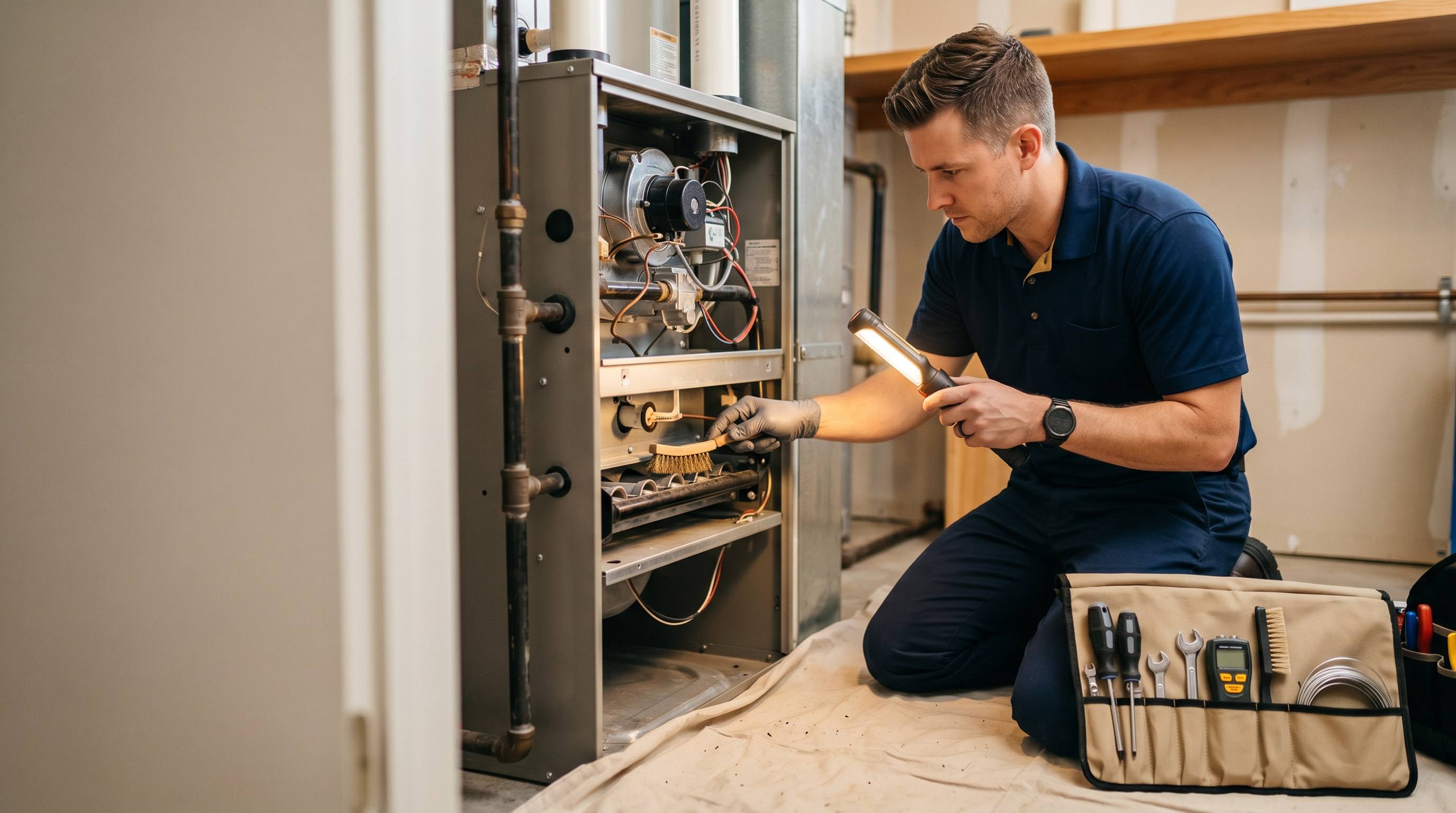
What a furnace tune-up actually includes
Most “$59 furnace tune-up” coupon visits in LA take 20 minutes and end with a $4,800 replacement quote. That’s not maintenance — that’s a sales call wrapped in a service shirt. A real tune-up takes 60–120 minutes on an 80% AFUE furnace and longer on a condensing unit or a communicating system, because there’s a list of measurements and checks that have to happen with instruments rather than eyeballs.
Our 15+ point checklist on every gas furnace tune-up:
- Heat exchanger visual inspection with mirror and flashlight (and a borescope camera on units 10+ years old). Cracks in the exchanger are the single CO risk that justifies the entire annual visit.
- Combustion analyzer reading — CO ppm air-free, O2%, stack temperature, combustion efficiency. Target: CO under 100 ppm, O2 between 6–9%, efficiency above 78% on an 80% AFUE unit.
- Flame sensor cleaning — emery cloth or fine steel wool to remove silica oxidation. This is the most common annual fix on LA furnaces, period. Dirty flame sensors are the reason your furnace ignites, runs five seconds, then locks out.
- Hot surface ignitor resistance check — 45–90 ohms typical (varies by manufacturer). Drift above the upper bound indicates end of life within months.
- Burner inspection — pilot tube or HSI assembly, looking for rust, dust, debris, spider webs in the orifice, and even flame pattern across all burners.
- Gas pressure verification — manifold pressure and inlet pressure measured in inches water column (W.C.). Typical natural gas manifold spec: 3.5 W.C. Pasadena and Glendale neighborhoods on older SoCalGas service lines run inlet pressures 5–7 W.C. and we adjust the regulator from there.
- High-limit switch test — verify the switch opens at its rated trip temperature (usually 160–200°F at the plenum).
- Pressure switch test — induced-draft pressure switch operates the burner safety circuit. Verify pickup and dropout points.
- Inducer motor amp draw — compared to nameplate FLA. High draw indicates bearing wear or impeller drag.
- Blower motor amp draw and RPM — verify static pressure and CFM are reasonable for the equipment size and duct system.
- Flue draft test — negative pressure verification at the draft hood (atmospheric units) or sealed venting pressure (induced and condensing).
- Condensate trap clearing on 90%+ AFUE furnaces — algae blocks the trap, water backs up, the pressure switch trips, the furnace locks out. The single most common 90%+ failure mode in LA.
- Air filter check + replacement if the owner provides a filter (or we sell from truck stock).
- Belt and bearings inspection on older PSC blowers. Newer ECM-blower furnaces have no belt — we still verify bearing noise and shaft play.
- Electrical connections tightening + capacitor reading — run-capacitor microfarad value measured against nameplate (5% tolerance).
- Thermostat calibration check — verify setpoint matches actual temperature at the stat, check for swing-on-time anomalies.
Written report goes to you at the end of the visit with combustion readings, amp draws, gas pressures, and a list of anything we recommend addressing before the next heating season. No verbal “everything looks fine” and a handshake — you get the numbers.
Heat pump heating-side tune-up
A heat pump shares the outdoor unit between cooling and heating, so the heating-mode tune-up overlaps with an AC tune-up but adds four checks that don’t apply to a straight gas furnace:
- Defrost cycle test. We force a manual defrost (jumper the defrost board, or use the test pins on a communicating system) and verify the reversing valve cycles, the outdoor fan stops, and the auxiliary heat engages if the unit has strip heat. A heat pump that won’t defrost ices up in the first cold-and-damp morning and blows cold air into the house.
- Reversing valve operation. Mode change from cooling to heating should be audible (a soft “thunk” as the slide shifts) and verifiable on the high-side gauge. Sticking valves don’t fully shift and trap the system in mixed-mode — symptom is poor heating capacity that the owner blames on the thermostat.
- Auxiliary heat strip amp draw if installed. A 5 kW strip pulls roughly 21 A at 240V; 10 kW pulls 42 A; verify the contactor sequences correctly and the strips reach full draw under load. Big Bear and mountain installs typically run 10–15 kW of strip heat and this check is non-optional.
- Refrigerant pressures in heating mode. Target values are different from cooling — suction pressure is lower, head pressure is higher, and superheat/subcool targets flip. A heat pump charged correctly for cooling can still under-perform in heating if the charge is off by half a pound.
Why SoCal furnaces need maintenance even with mild winters
The intuition that says “LA winters are mild so the furnace doesn’t need much” is exactly backwards. LA basin furnaces run 200–400 hours per heating season versus 1,500+ in Chicago or Minneapolis. That long idle period is what causes the problems we find every October.
The idle paradox plays out the same way every fall:
- Spider webs in the pilot tube and burner orifices. Eight months of summer dust and webs partially block the gas pathway. The furnace lights weak, runs rough, and the flame sensor doesn’t see a clean signal.
- Rodent damage to the wire harness. Mice and rats nest in attic and crawlspace furnace cabinets through summer. We pull control panels and find chewed thermostat wire, flame sensor wire, and gas valve wiring on roughly 5% of October tune-ups.
- Condensate trap dry-out on 90%+ units. The trap loses its water seal during long idle periods, and on first heating call the pressure switch sees positive instead of negative pressure and locks out. Pour a cup of water in the trap before first fire of the season.
- Control board voltage drift after long idle. Electrolytic capacitors on the control board age whether the board is energized or not, and the drift compounds after months of zero use. Late-October Santa Ana voltage events finish them off.
- Thermostat batteries flat. Smart thermostats running on battery backup drain over summer; replace before first heating call.
Mountain installations are the other extreme. Big Bear, Crestline, Lake Arrowhead, Wrightwood, Idyllwild — these properties actually run heating from October through May. The furnace logs 1,000–1,800 run hours per season and accumulates wear that LA basin units never see. Two tune-ups per year (October pre-season and March mid-season) is the standard for any property above 4,500 feet.
Pricing
Honest flat-rate pricing on heating maintenance. Parts replaced during the tune-up (filters, capacitors if drift detected) are quoted separately before any swap.
| Service | Typical cost | Time |
|---|---|---|
| Standard 80% AFUE furnace tune-up | $145–$185 | 60–90 min |
| High-efficiency 90%+ furnace tune-up | $185–$245 | 75–120 min |
| Heat pump heating-side tune-up | $185–$245 | 75–120 min |
| Multi-stage / communicating furnace tune-up | $245–$385 | 90–150 min |
| Combustion analyzer test (standalone) | $145–$185 | 30–45 min |
| Burner deep cleaning | $185–$285 | 60 min |
| Flame sensor preventative replacement | $145–$185 | 30 min |
| Heat exchanger camera inspection | $245–$385 | 45–60 min |
| Gas leak detection (electronic sniffer) | $145–$245 | 30–60 min |
| Comfort Club Silver (2 tune-ups) | $349/year | — |
Honest opinion on aging units: on a 12-year-old 80% AFUE furnace, the tune-up will find at least one borderline component every year. That’s not bad — that’s the furnace aging on schedule. Replace the flame sensor at $165 now or replace it at $245 emergency rate on the coldest night of the year. Your call.
Two services that frequently get bundled at a discount: combustion analyzer test + heat exchanger camera inspection together run $345–$485 instead of the standalone sum, and we recommend the pair on any furnace 12+ years old or any unit that has tripped a CO alarm even once.
A real Pasadena tune-up — what we actually found
Pasadena 1948 Spanish Colonial, 2,200 sq ft, original ductwork, 2012 Carrier 58STA 80,000 BTU gas furnace in the basement closet. Thirteen years old. Owner scheduled the October tune-up after reading our fall maintenance blog post. We were on-site for 95 minutes.
- Hot surface ignitor: cracked porcelain visible but the silicon-carbide element was still firing. Resistance read 78 ohms (Carrier spec for that part: 45–75). Above spec, intermittent ignition expected within 60–90 days.
- Flame sensor: pitted from 13 years of LA-basin dust, microamp signal reading 1.8 µA under flame (Carrier minimum: 2.0 µA). Cleaned with emery cloth, signal recovered to 4.2 µA.
- Combustion analyzer: CO reading at 78 ppm air-free. Acceptable (under 100 ppm threshold) but borderline; O2 was 9.2%, slightly lean. Adjusted manifold gas pressure from 3.7 W.C. down to 3.5 W.C., re-tested at 52 ppm CO and 7.8% O2 — clean.
- Heat exchanger: borescope inspection through the inducer port showed no cracks, no scaling.
- Recommendation: replace HSI proactively at $165 (part + labor) before the unit fails on a December cold night.
Total visit: $325 ignitor replacement + $185 tune-up = $510. Customer signed up for Comfort Club at end of visit, which credited the tune-up cost toward the annual fee. December came and went with no service call from that address.
The counter-scenario is what we see all winter: the same homeowner skips the October visit, the HSI fails at 6 PM on a Tuesday in December when overnight lows hit 39°F, after-hours diagnostic adds $149 to a $245 ignitor swap because we now stock fewer Carrier HSIs in evening dispatch trucks, and the family runs space heaters until morning. Same repair, $250 more, with a night of cold thrown in.
When to schedule heating maintenance — timing matters
October through early November is the right window. Here’s the operational reality:
- Don’t wait for the first cold snap. Santa Ana wind events drop nighttime temperatures fast in November. The same week the offshore winds pick up, every weak component on every furnace in the basin starts failing at the same moment.
- 5–7x normal call volume on the first cold night. Our dispatch board fills up with no-heat emergencies, and at that point we’re booking 1–2 days out for non-emergency tune-ups. Customers who scheduled in October are getting same-week service while their neighbors wait.
- Schedule a fall tune-up by mid-October and you skip the queue entirely. Our October dispatch is roomy, our techs aren’t rushed, and we have time to do the full 15-point inspection instead of triaging emergencies.
- For heat pumps, schedule the heating-side tune-up separate from the spring AC tune-up — once in March or April for cooling-mode prep, once in October for heating-mode prep. Comfort Club Silver bundles both into one annual price.
Mountain properties (Big Bear, Wrightwood, Lake Arrowhead, Idyllwild): book September pre-season and March mid-season. The heating system there does real work.
Carbon monoxide safety — the line we won’t cross
A cracked heat exchanger creates real CO risk. CO is colorless, odorless, and at sustained exposure above 70 ppm causes headaches, nausea, dizziness, and confusion; at 400 ppm it can be fatal within a few hours. Three rules on every gas furnace in our service area:
- Install CO alarms on every floor of any home with gas appliances. California Senate Bill 183 requires them. Battery models are $20–$40 each at any hardware store. Combination smoke/CO alarms cost slightly more.
- If a CO alarm sounds, leave the building and call 911. Do not troubleshoot. Do not open windows and wait. Get out, call from outside.
- If you smell gas at any time, leave and call SoCalGas (1-800-427-2200) or 911 from outside the house. Do not flip light switches, do not use phones inside, do not start vehicles in attached garages.
If we find a cracked heat exchanger during a tune-up, the furnace gets red-tagged and we shut off gas service to it before leaving the property. We don’t leave a CO-leaking furnace running because the homeowner “wants to think about it.” That’s the line.
Service area & response times
Heating maintenance across all five Southern California counties with regional dispatch:
| Region | Response time | Phone |
|---|---|---|
| West LA, Westside | Same week (October–November) | (424) 766-1020 |
| Pasadena, San Gabriel Valley | Same week (October–November) | (626) 499-5530 |
| Thousand Oaks, Ventura County | Same week, 2 days during peak | (805) 977-9940 |
| Irvine, Orange County | Same week (October–November) | (949) 785-5535 |
| San Bernardino, mountains | Same week, mountain routes by appointment | (909) 757-6455 |
| Riverside, Inland Empire | Same week (October–November) | (951) 744-9188 |
Each regional line goes to the dispatch board for that area. The number listed on every city page sidebar is the right one to call for that area — we’ve done the routing already so you don’t have to.
Related services and reading: Comfort Club maintenance plans, furnace repair, AC maintenance, heat pump repair, HVAC maintenance hub, fall furnace maintenance timing.
Schedule heating maintenance today
October bookings get same-week service. Call your regional dispatch number above, or use our free estimate form to request a tune-up. CSLB License C-20 #1138898. Licensed, bonded, insured. Serving Los Angeles, Orange, Riverside, San Bernardino, and Ventura counties.