
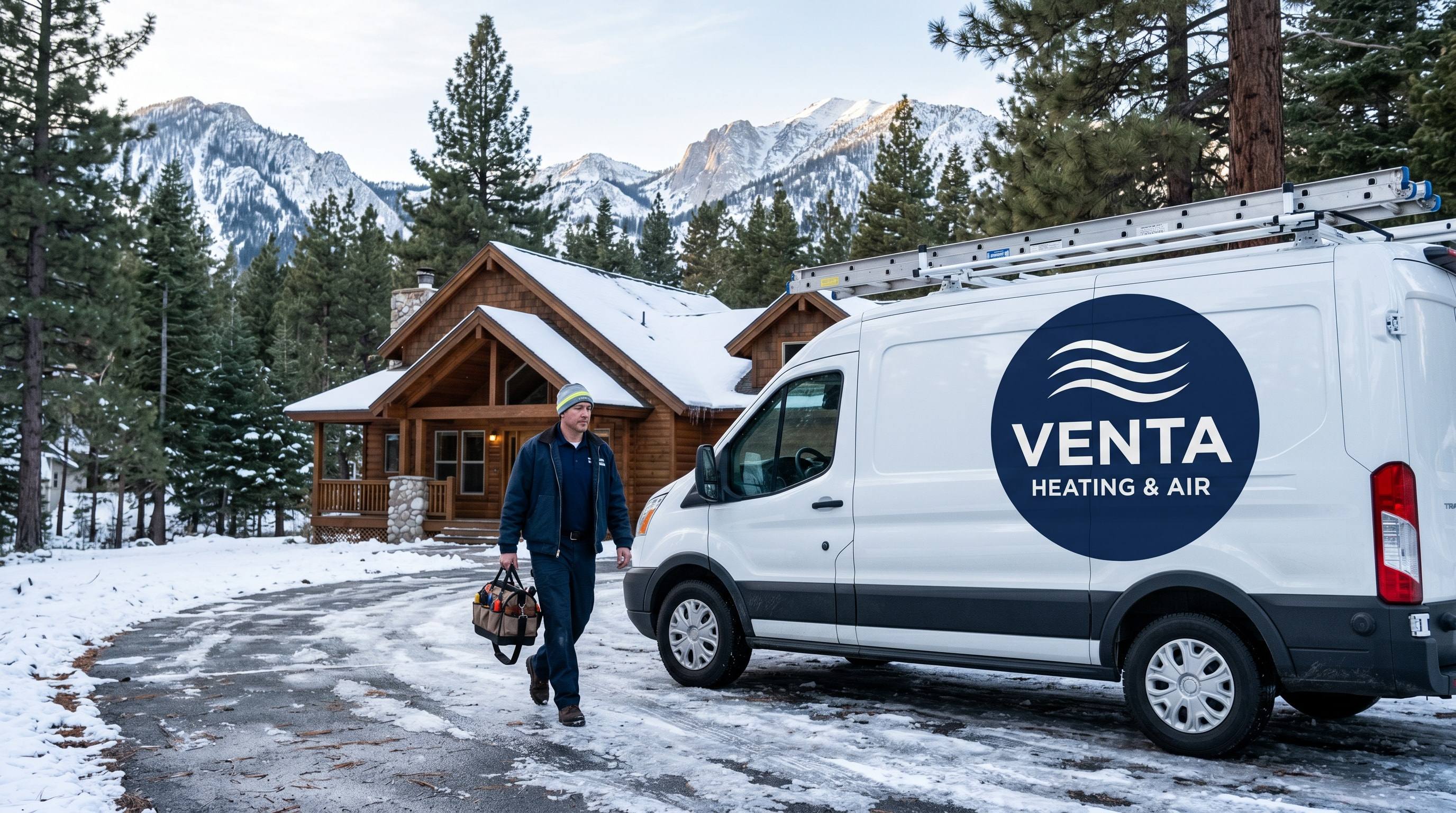
The HVAC failure that strands a family at 11 PM on a Saturday in January in Big Bear is not an AC failure. It's a furnace that won't light. A propane tank that ran dry overnight. A condensate line frozen solid that took the whole high-efficiency heating system into safety lockout. And the contractor down in San Bernardino Valley either doesn't make the drive or is booked three days out.
That gap is why we exist up here. At 6,750 feet elevation, with snow on the ground from December through March most years and overnight winter lows that regularly hit single digits, Big Bear is mountain HVAC, closer in service profile to Tahoe or Mammoth than to anything in the valley below. Heating is the primary concern, not cooling. Cooling matters in summer (the tourist season pushes daytime temperatures into the 80s and rental properties need it), but the calls we get at 11 PM in January are heating-side, every time.
Why most contractors won't drive to Big Bear (and we do)
The economics are simple: the round trip from Inland Empire dispatch to Big Bear is 3+ hours of windshield time, the route is weather-dependent November through April, and a single residential service call can absorb half a workday. Most San Bernardino Valley HVAC shops chase volume, they make their money on 4–6 valley calls per technician per day, and a Big Bear trip kills that ratio. We've structured our routing around mountain work specifically: scheduled batches when possible, weather-aware dispatch, snow-route familiarity, and pricing that reflects the trip without gouging on it. The result is reliable mountain coverage that valley-only contractors can't match. If you've been told "we don't go up there" by previous contractors, please call us.
Heating is the primary mountain HVAC concern
Big Bear's heating season runs October through May, eight months of regular furnace operation, with peak demand during December–February when overnight lows stay below freezing for weeks at a time. Most Big Bear properties heat with one of three fuel sources: natural gas in the more developed Big Bear Lake and Big Bear City cores where SoCalGas service exists, propane for cabins and homes in outlying areas (Sugarloaf, Fawnskin, Moonridge, Erwin Lake) where there's no gas main, or (increasingly) cold-climate heat pumps that maintain efficient operation down to 5–15°F. We service all three. Furnace work is most of our mountain service load: igniter replacement, gas valve service, inducer motor replacement, heat exchanger inspection (cracked exchangers are a real CO risk and we check every system we touch). For propane systems we coordinate with the major delivery suppliers (AmeriGas, Suburban, Eastern Propane) on tank fills and regulator service.
Mountain wildfire risk is also part of the conversation: Big Bear sits in CalFIRE’s Very High Fire Hazard Severity Zone, and seasonal smoke from regional fires (Bridge Fire 2024 and others) drives MERV 13 filter and HEPA preparedness work for cabin owners. See our Wildfire Smoke and HVAC pillar for full guidance.
Vacation rentals and absentee owners — priority dispatch
A meaningful share of Big Bear properties are vacation rentals on Airbnb, VRBO, and other platforms, owned by people who live in LA, Orange County, or further afield, and managed remotely. When a guest checks in to a freezing cabin on a Friday night because the furnace died Wednesday and nobody noticed, the owner has hours, not days, to fix it before bad reviews start. We provide priority dispatch for absentee owners: a phone call from you (the owner) or your property manager triggers same-day or next-day response based on weather, and we communicate directly with the guest if you'd prefer. Our 24/7 emergency line ((909) 757-6455) is monitored from October through April for exactly this scenario. Property managers running 5+ rental units get dedicated account routing with consolidated invoicing.
Frozen pipes, frozen condensate, frozen everything
Mountain HVAC failures often present as frozen something, frozen condensate line on the high-efficiency furnace blocking exhaust, frozen primary water line that's now leaking into the crawl space, frozen drain on the tankless water heater, or a heat pump's outdoor coil iced over. We service all of it: thawing protocols that don't damage equipment, freeze-trace heat cable installation on vulnerable runs, condensate line re-routing to keep them inside the conditioned envelope, and outdoor unit elevation off snowpack on heat pump installs. Pre-winter visits in October or November can prevent most of these failures before they happen, see our winterization FAQ above for the protocol.
Snow-resort tourism — Bear Mountain, Snow Summit, Big Bear Lake
Big Bear's economy runs on tourism, and the ski resorts (Bear Mountain, Snow Summit) bring 30,000+ weekend visitors during peak winter. That tourist load translates directly into HVAC demand, vacation rentals run at high occupancy, hotels and lodges run their commercial systems near capacity, restaurants and ski-rental shops need reliable rooftop HVAC. We service commercial accounts in the resort corridor: rooftop package units on hotels, restaurant kitchen exhaust and makeup-air, retail-shop split systems, and the bigger commercial heating systems that keep lodges habitable through January. Service contracts available; emergency dispatch 24/7 during ski season.
Summer cooling for tourist season
The other half of the year, Big Bear flips into summer-tourism mode, hiking, the lake, mountain biking, and daytime temperatures in the 80s. Vacation rentals need working AC during June, July, and August or guests complain. Most older Big Bear cabins were built without central air conditioning, the climate didn't demand it, and the construction era predated it. Mini-split systems are the common retrofit answer: a 2-zone Mitsubishi or Daikin Fit installs in about a day with two 3-inch wall penetrations, runs at 38–45 dB indoor noise, and provides both summer cooling and supplemental heating that pairs nicely with the existing furnace. Total install cost typically runs $4,800–$7,500 for a 2-zone configuration. We do enough of these in Big Bear to know which equipment configurations work best at altitude.
What we do in Big Bear
- Furnace Repair (natural gas, propane, and electric) same-day during fair weather
- Furnace Installation — high-efficiency replacement, altitude-adjusted
- Heat Pump Installation: cold-climate models for Big Bear winters
- Mini-Split Systems: summer AC retrofit for older cabins
- Emergency 24/7: mountain emergency response, October-April monitored line
- Pre-Winter Winterization: October/November scheduled visits
Call (909) 757-6455 or email sanbernardino@ventahvac.com. Mountain dispatch scheduled around weather and route conditions. Vacation-rental owners and property managers, please mention that when you call so we can route appropriately.