
80°F. That’s the typical annual temperature swing on a Victorville residential HVAC system: from a 105°F July afternoon when the condenser is pinned at maximum capacity, to a 25°F January morning when the same equipment (if it’s a heat pump) is pulling heat out of air that’s already below freezing. Almost no other city in our service area asks one piece of equipment to do both extremes.
2,700. That’s the elevation in feet. Air at 2,700′ is roughly 8% less dense than at sea level, which means combustion equipment shipped from a coastal supply house has to be reconfigured before it’ll fire correctly out here, and air-handler blowers configured for sea level move slightly less mass through the system per cycle. Most Inland Empire installers don’t make those adjustments. Some don’t even know they’re needed.
Then there’s 6. That’s the typical service life, in years, of a builder-grade capacitor on a Victorville condenser. The same part on a coastal install would last 10. The dust loading and the duty cycle are the difference, and they shape how we run service in this market.
The dust nobody warns you about
Every Victorville homeowner has watched a windstorm coat their patio in fine pink-tan grit. That same grit coats your condenser coils every single day. A coil that’s 30% fouled loses about 25% of its heat-rejection capacity, which means your compressor runs hotter, longer, and dies sooner. An annual coil rinse isn’t a maintenance upsell out here: it’s the difference between a 12-year system and a 6-year system. We include it on every pre-summer tune-up along with refrigerant pressure check, capacitor test, and contactor inspection.
Why we push heat pumps in this market
The dual-season demand (105°F summer cooling and 25°F winter heating) is exactly what a modern cold-climate heat pump is engineered to do. Mitsubishi Hyper-Heat, Daikin Aurora, Trane Hyperion: efficient heating output down to 5–15°F, efficient cooling all summer, one piece of equipment instead of two, one set of refrigerant lines, one maintenance schedule. Replacing a separate furnace plus AC pair with a single heat pump typically saves 30–40% on combined gas-and-electric bills annually.
The economics:
- Dual-fuel install (heat pump + backup furnace): $13,500–$19,500 before rebates.
- SCE: $300–$1,200.
- SoCalGas furnace-removal incentive: ~$300.
- TECH Clean California: $3,000–$8,000 (income-tier or CES tract dependent) when funded — currently waitlisted; submitted in case funding reopens.
- Federal IRA 25C: terminated December 31, 2025 under OBBBA. No longer available for 2026 installs.
- Active-stack net 2026: $11,000–$18,000.
- If TECH/HEEHRA reopens during the project window, qualifying low-income install nets $4,000–$6,000.
Detail: TECH Clean California rebates and the verified 2026 rebate guide.
Real numbers, not pressure pitches
Diagnostic $79 (waived on the repair). Capacitor $185–$295. Contactor $165–$285. Condenser fan motor $485–$795. Furnace igniter $220–$360. Gas valve $380–$620. Inducer motor $420–$680. AC replacement $7,500–$11,500. High-efficiency furnace replacement $4,800–$7,500.
Pre-1985 housing — the insulation conversation
Honest answer most contractors won’t give you: a new AC helps, but adding insulation helps more per dollar spent. Pre-1985 Victorville homes typically run R-11 attic insulation against a current Title 24 spec of R-30 to R-38, single-pane windows, and minimal wall cavity insulation. Closing that gap reduces summer cooling load 20–30%, which lets us size new equipment smaller and run it less. We’ll point you to insulation contractors we’ve worked with rather than upsell outside our trade. Sometimes the best HVAC quote is one that starts with the insulation work.
Wrightwood, Phelan, and the high-desert fringe
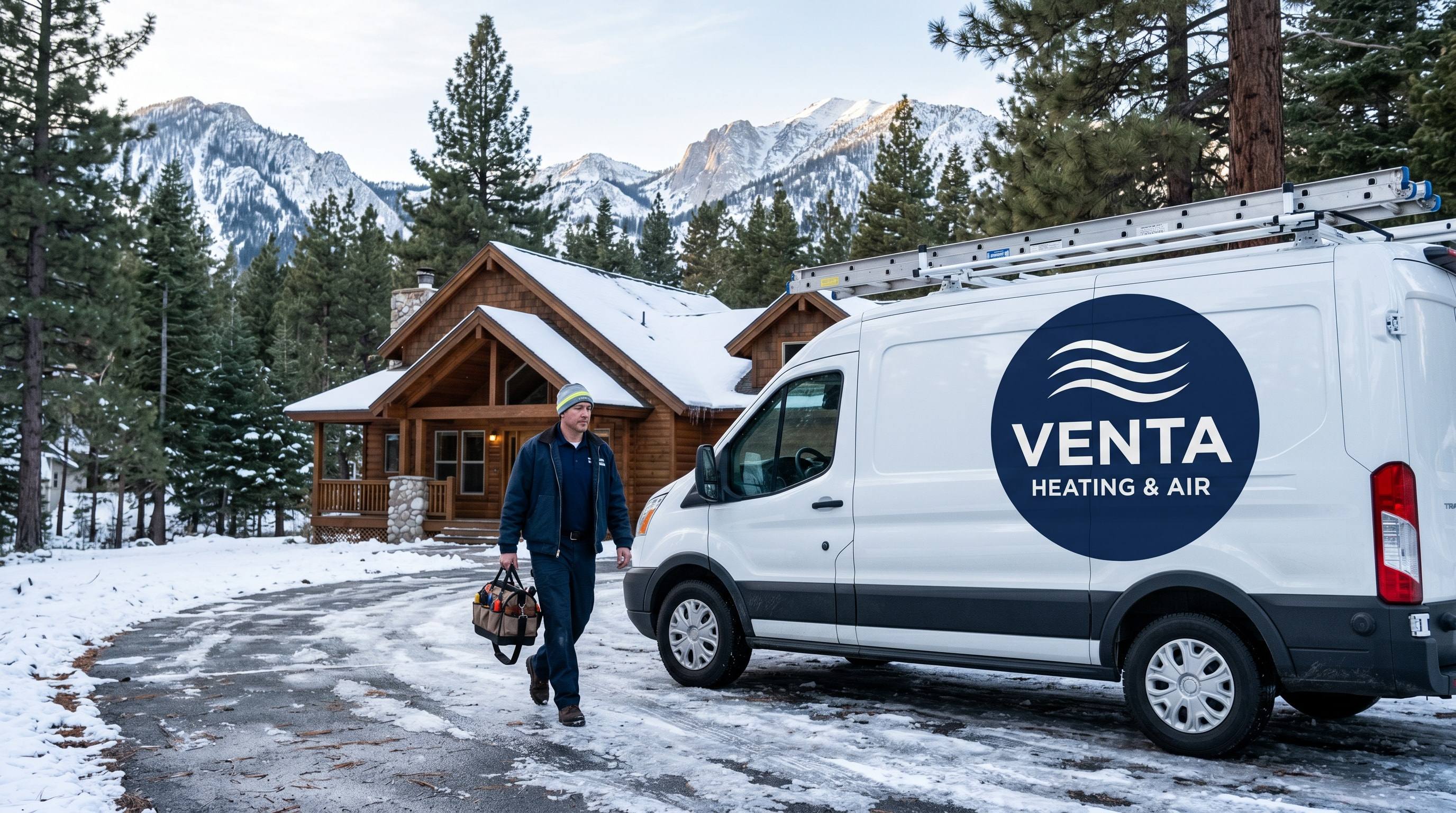
The smaller communities at higher elevation around Victorville (Wrightwood, Phelan, Pinon Hills, Oak Hills) sit in their own micro-zones. Wrightwood at 6,000′ sees real snow accumulation in winter and is closer in HVAC profile to Big Bear than to the rest of the high desert. Phelan and Pinon Hills are intermediate. We schedule these calls with weather-aware routing during winter and we’ll be honest about response times when conditions are bad, same-day in fair weather, sometimes 24–48 hours during active snow.
George AFB legacy and the veteran community
George Air Force Base operated in Victorville 1941–1992. Its legacy still anchors a meaningful share of the city’s residential stock and shapes the customer base. We offer a 10% labor discount on residential service for active-duty military, veterans, and Gold Star families, verified through standard military ID. We don’t market it loudly, we just apply it when it applies.
I-15 corridor commercial
The I-15 through Victorville is the natural staging point between Southern California and Las Vegas, and the corridor hosts substantial logistics, distribution, and trucking-industry capacity. We cover the commercial HVAC: rooftop package units on warehouse and distribution buildings, office cooling for trucking companies, supplemental cooling for cold-chain and pharmaceutical distribution. The I-15 commute pattern also means a meaningful share of Victorville residents work in Vegas casinos and resorts on weekly schedules, we offer flexible scheduling around the 4-on/3-off rotation common in gaming.
What we cover
- AC repair with same-day diagnosis and dust-rated maintenance.
- Furnace service: heating expertise on par with cooling.
- Heat-pump installation with cold-climate models.
- AC installation, desert-rated, properly sized.
- Pre-summer tune-ups: the highest-ROI service we offer in this market.
- 24/7 emergency dispatch.
Call (909) 757-6455 or email sanbernardino@ventahvac.com. Same-day Victorville dispatch is typical; mountain communities (Wrightwood, Phelan) scheduled with weather routing.