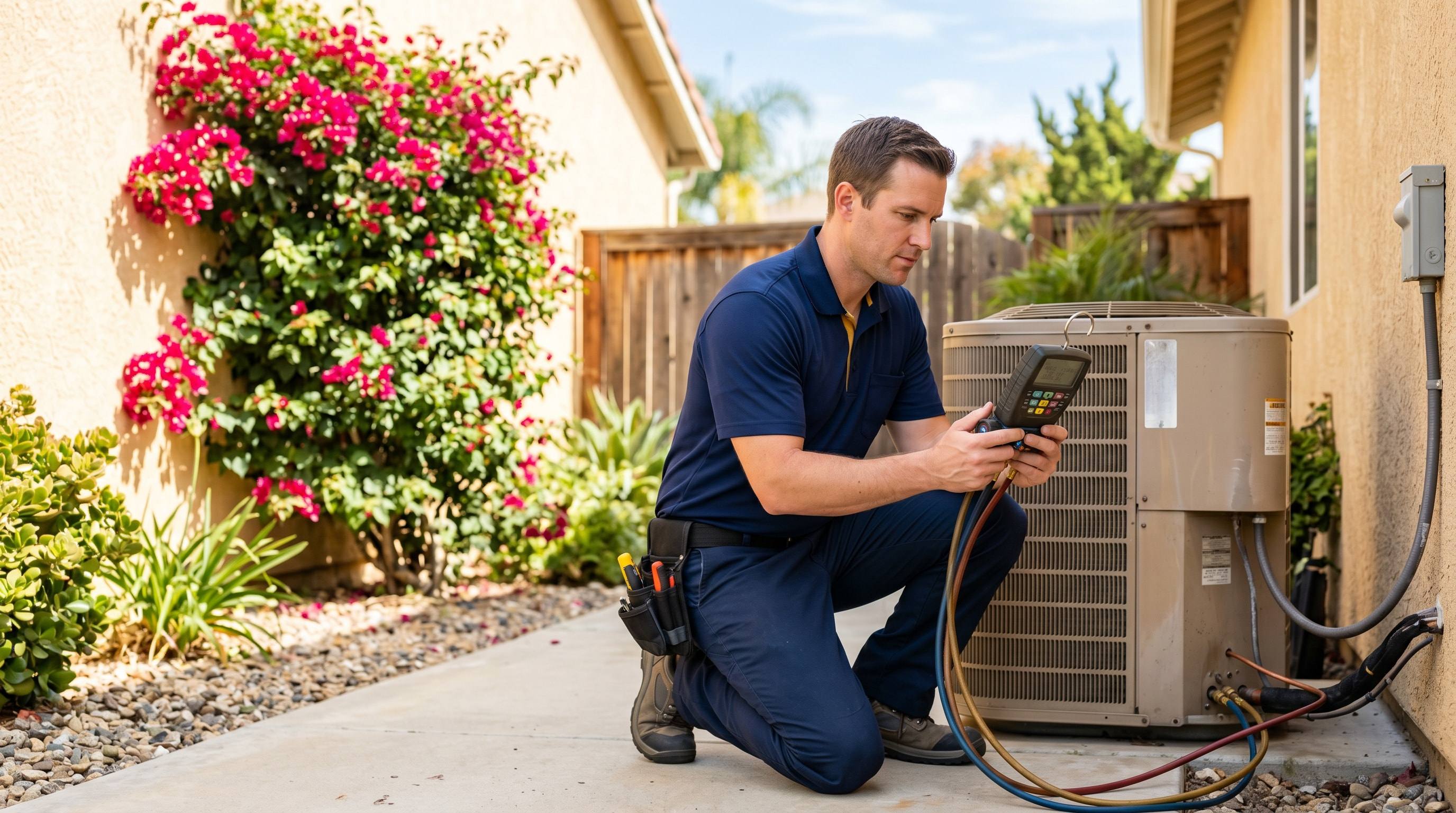
This is the failure-mode companion to our main AC repair service. The compressor is the heart of the system — the pump that circulates refrigerant — and its replacement is the one AC repair where the right answer is often “replace the whole unit instead.”
First: make sure it is actually the compressor
More than half the “dead compressor” calls we run are not the compressor at all. A failed dual-run capacitor leaves the compressor humming but unable to start; a pitted contactor never sends it power; a unit low on refrigerant trips on pressure. Each of those is a $185–$345 fix, not a $2,400–$4,200 one. We confirm a true compressor failure with amp-draw readings, a winding/continuity check, and refrigerant pressures before we ever quote one. Anyone quoting a compressor over the phone, or without those readings, is guessing with your money.
Out-of-warranty vs. warrantied — the cost split
The price hinges entirely on warranty status:
- Out of warranty: $2,400–$4,200 all-in (compressor, refrigerant, labor), varying with tonnage, refrigerant type, and access.
- Under warranty: most brands cover the compressor part for 10 years to the original registered owner — you pay labor plus refrigerant, the part ships free, a far smaller bill. Unregistered systems often drop to 5 years.
We look up your registration before quoting. If you are the second owner or never registered, that changes the math — and we will tell you honestly.
Repair or replace the whole system
Because the compressor is so costly, replacing it on an older unit often loses to replacing the whole system:
- Under ~10 years, warrantied compressor: replace the compressor (labor only). Easy call.
- 12–14 years, out of warranty: a $2,400–$4,200 compressor goes into a unit with degraded efficiency and other aging parts — replacement usually wins on five-year cost.
- R-22 system (pre-2010): we almost always recommend replacement; R-22 is expensive and phased out.
See AC repair vs. replace and AC replacement cost in LA, and our AC replacement service when replacement is the call.
Why compressors fail in SoCal — coast vs. inland
Two regional patterns drive the failures we see. On the coast — Santa Monica, Manhattan Beach, Malibu — salt air corrodes the contactor and electricals, and the strain of a degrading start circuit is what eventually takes the compressor. Inland, in Rancho Cucamonga, Fontana, Corona, and Riverside, units run wide-open through 100°F-plus afternoons, and the heat-load hours wear the compressor on a harder curve. In both cases the two avoidable killers are the same: chronic low refrigerant from an unrepaired leak, and repeated start strain from a failing capacitor. Fix those small things early — see AC capacitor failure — and the compressor lasts.
How the replacement is done right
A compressor swap is refrigerant work, not just a part swap. We recover the existing refrigerant (EPA Section 608 certification, with updated recovery equipment for R-454B on 2025-and-newer systems), replace the compressor, pull a deep vacuum to remove moisture, recharge to the factory weight, and verify the charge with superheat and subcool readings. Skipping the vacuum or eyeballing the charge is how a second compressor fails early. We document the readings before we leave.
AC compressor pricing
| Item | Typical cost |
| Diagnostic (waived with repair) | $89 / $149 after-hours |
| Compressor replacement (out of warranty) | $2,400–$4,200 |
| Compressor (under warranty — labor + refrigerant only) | quoted on coverage lookup |
| Hard-start kit (if marginal start, not failure) | $185–$345 |
| Dual-run capacitor (the common mimic) | $185–$295 |
Every major brand
We diagnose and replace compressors on every major brand, and check warranty coverage on each: Carrier, Trane, Lennox, Rheem, Goodman, Daikin, and York AC not cooling.
Frequently asked questions
How much does it cost to replace an AC compressor? +
On an out-of-warranty system, an AC compressor replacement runs $2,400–$4,200 in Southern California, parts and labor, and our $89 diagnostic ($149 after-hours) credits to the repair. The range depends on tonnage, refrigerant type, and access. If the compressor is still under the manufacturer’s parts warranty — most brands cover 10 years to the original registered owner — you pay labor only, since the part is supplied free, which is a much smaller bill. Because this is the single most expensive AC repair, we always run the numbers against a full system replacement before recommending it.
Is it worth replacing an AC compressor or should I replace the whole unit? +
This is the central question, and the honest answer turns on age and warranty. Under about 10 years with the compressor still under warranty, replacing it (labor only) usually makes sense. Past 12–14 years and out of warranty, a $2,400–$4,200 compressor on an aging single-stage unit rarely pencils out — you are putting a major repair into a system with degraded efficiency and other parts heading the same way, and replacement with a new high-efficiency unit often wins on five-year cost. On an R-22 system we almost always recommend replacement. We show you both numbers side by side.
What are the signs of a failing AC compressor? +
Common signs: the outdoor unit hums or clicks but the compressor will not start (often a capacitor or hard-start issue first, not the compressor itself), the system runs constantly but never cools, the compressor trips the breaker, abnormally high amp draw on our meter, or a hard mechanical knocking or grinding from the compressor. Warm air with normal airflow and a compressor that will not stay running points here. Because a dead capacitor or contactor mimics a failed compressor at a fraction of the cost, we confirm with electrical and pressure readings before condemning a compressor.
What causes an AC compressor to fail? +
The big ones: running the system low on refrigerant for a long time (the compressor overheats without enough cool gas returning), running it with a failed capacitor that strains the start windings, electrical issues, or simple age and hours. In Southern California two patterns stand out — coastal salt-air corrosion on the electricals and contactor in Santa Monica, Manhattan Beach, and Malibu, and heat-load stress on inland units in the Inland Empire that run wide-open through 105°F afternoons. Letting a humming unit run on a bad capacitor is the fastest way we see good compressors cooked needlessly.
How long does an AC compressor last in Southern California? +
A well-installed, properly charged, annually maintained compressor typically lasts 12–18 years in the SoCal climate. Coastal units corrode and tend toward the lower end; inland units that run heavy summer hours wear on a different curve. The two biggest lifespan-killers are chronic low refrigerant from an unrepaired leak and repeated starting strain from a failing capacitor — both are cheap to fix and both, left alone, take the compressor with them. That is the case for fixing small problems early and keeping up with maintenance rather than waiting for the big-ticket failure.
Does my AC compressor warranty cover the replacement cost? +
Most manufacturers warranty the compressor for 10 years to the original owner when the system was registered within 60–90 days of install. That warranty covers the part, not the labor — so a warrantied compressor failure means you pay the labor to swap it (plus refrigerant and any related parts), while the compressor itself ships free. Unregistered systems often drop to a 5-year part warranty. We look up your registration and confirm coverage before quoting, because it is the single biggest factor in whether replacing the compressor or the whole system is the smarter spend.
Can you replace just the compressor, or does the refrigerant matter? +
Yes, the compressor can be replaced as a component, but the refrigerant circuit has to be handled correctly: recover the existing refrigerant, replace the compressor, pull a deep vacuum, and recharge to the factory weight. That work requires EPA Section 608 certification, and on 2025-and-newer systems running R-454B it also requires updated recovery equipment. The refrigerant type matters for cost too — R-410A and R-454B are priced differently per pound, and R-22 on older units is expensive and another reason to replace rather than repair. We verify the charge with superheat and subcool readings before we leave.