
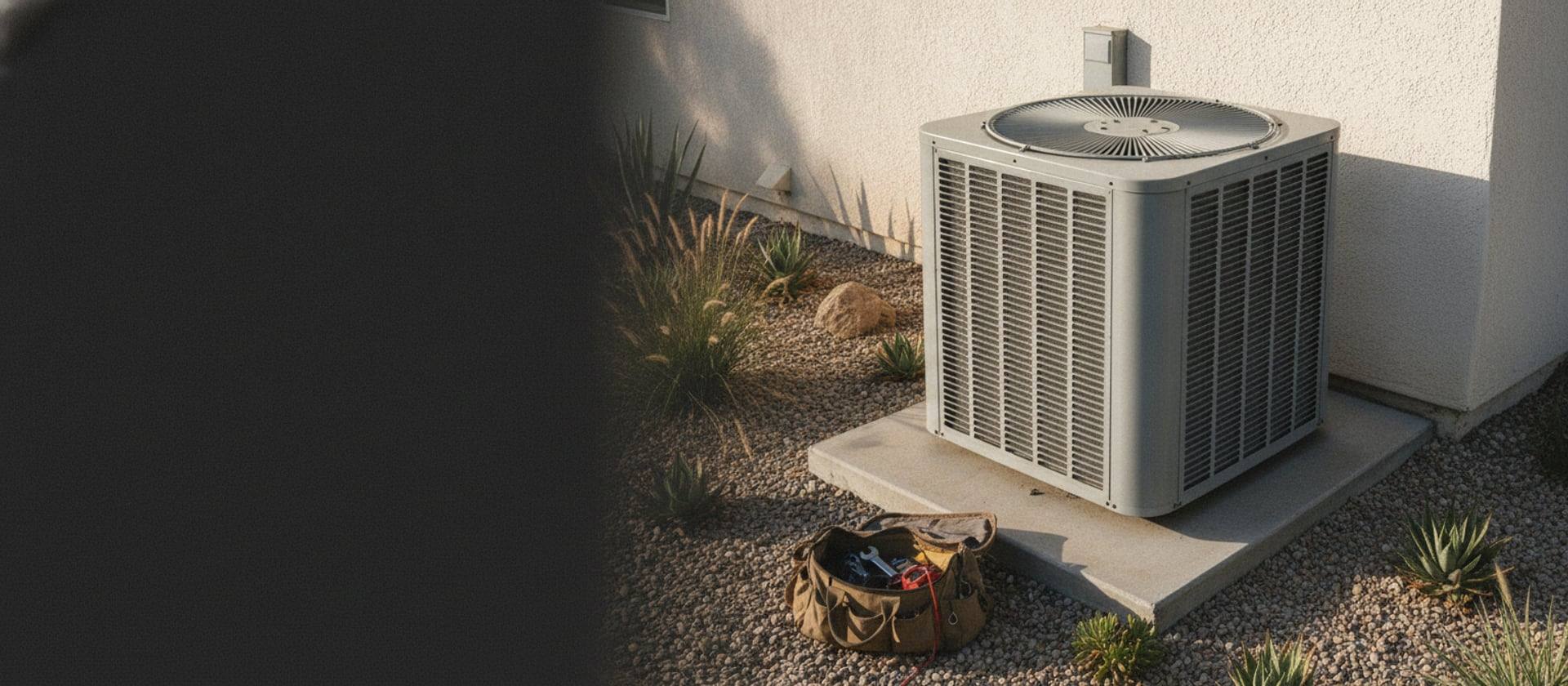
“It runs but it is not cold” is the most common AC complaint we hear during a SoCal heat wave, and it is also the one most often misdiagnosed as low refrigerant. A Carrier system that is genuinely low on refrigerant has a leak, and four other causes are more common than a charge problem. This page is the Carrier-specific companion to our general AC repair service and our Carrier AC repair page. Common failure modes have dedicated guides: compressor replacement, refrigerant leak, fan not spinning, leaking water, contactor replacement, and making noise.
Why a Carrier AC runs but will not cool
From thousands of no-cool calls across SoCal, the causes cluster like this:
- Dirty condenser coil — the single most common cause in a heat wave. The outdoor coil cannot reject heat, so the system loses ground as the day gets hotter. A coil cleaning plus a capacitor solves more no-cool calls in Pasadena and the Inland Empire than any other repair, often under $400 total.
- Refrigerant undercharge from a leak — not consumed, so low charge means a leak. Detection $245–$485; the fix depends on where the leak is.
- Weak compressor — high amp draw, cannot pull pressures down. Confirmed with gauges before we ever quote one.
- Frozen evaporator coil — ice from restricted airflow or low charge. Shut it off, thaw it, fix the restriction.
- Failed run capacitor — sometimes the unit is barely starting or the fan is struggling. Full detail on our Carrier capacitor replacement page.
The full diagnostic walkthroughs live in our AC running but not cooling, why is my AC not blowing cold air, and frozen evaporator coil guides.
Why we will not just “add a pound and see”
Topping off a leaking Carrier system is a $200 bill that lasts six weeks, and it is illegal to add refrigerant without EPA certification. More importantly, it leaves the actual problem in place. We find the leak with electronic detection and a gauge set, then quote the real repair: a leak at a service-port Schrader valve is inexpensive, while a leak inside the evaporator coil is a coil-replacement conversation. On a pre-2010 R-22 Carrier unit, a leak repair plus R-22 refill rarely makes sense against replacement, since R-22 alone runs $150–$300 per pound. Newer Carrier systems use R-454B (the 2025-and-later refrigerant); systems through 2024 are R-410A, and we carry the recovery gear and EPA Section 608 certification for both.
Why it fails when it does in SoCal
The microclimate sets the failure pattern. Inland in Pasadena, Burbank, the Inland Empire, and the Conejo Valley, a marginal system that cools fine at 80°F loses the fight at 104°F — dirty coils and weak capacitors show worst under peak load, which is exactly when you notice. On the coast in Santa Monica, Manhattan Beach, and Malibu, salt air corrodes the condenser coil fins and electricals, so heat rejection degrades earlier in the unit’s life. Either way, an annual coil cleaning before summer is the cheapest insurance against a peak-heat no-cool call, and a clogged condensate drain is its own common culprit — covered in our clogged AC drain line guide.
Carrier no-cool repair pricing
Flat-rate, parts and labor, from our SoCal service tickets. Diagnostic is $89 ($149 after-hours), credited to the repair if you proceed:
| Carrier AC repair | Typical cost |
|---|---|
| Diagnostic (waived with repair) | $89 / $149 after-hours |
| Dual-run capacitor | $185–$295 |
| Refrigerant leak detection | $245–$485 |
| R-410A recharge (per lb) | $85–$145 |
| R-454B recharge (per lb, 2025+ units) | $125–$225 |
| Condenser fan motor | $485–$795 |
| TXV (Infinity systems) | $585–$895 |
| Compressor (out of warranty — we quote replacement) | $2,400–$4,200 |
These are the same flat rates on our Carrier AC repair page. A registered Carrier system still carries labor on warranty parts; we confirm coverage before ordering.
Repair or replace your Carrier AC
A no-cool call on a newer Carrier system is almost always a straightforward repair — clean the coil, replace a capacitor, fix a leak. The replace conversation starts when the cause is a failed compressor or a major coil leak on an older unit: a $2,400–$4,200 compressor on a 14-plus-year R-22 system is throwing money at a degraded, end-of-life condenser. We model the repair against a written replacement quote so you decide on real numbers. See AC installation when replacement is the call.
Carrier and Bryant
Bryant and Carrier are the same corporation and largely the same equipment. A Bryant Preferred 127A is the Carrier 24ACC6, with the same compressors, coils, and parts distributors — the no-cool diagnosis and the parts are identical. We service both with the same manifold gauges and leak detection. For a condenser that hums and will not start at all, see our Carrier capacitor replacement page, and the full lineup on our Carrier brand page.