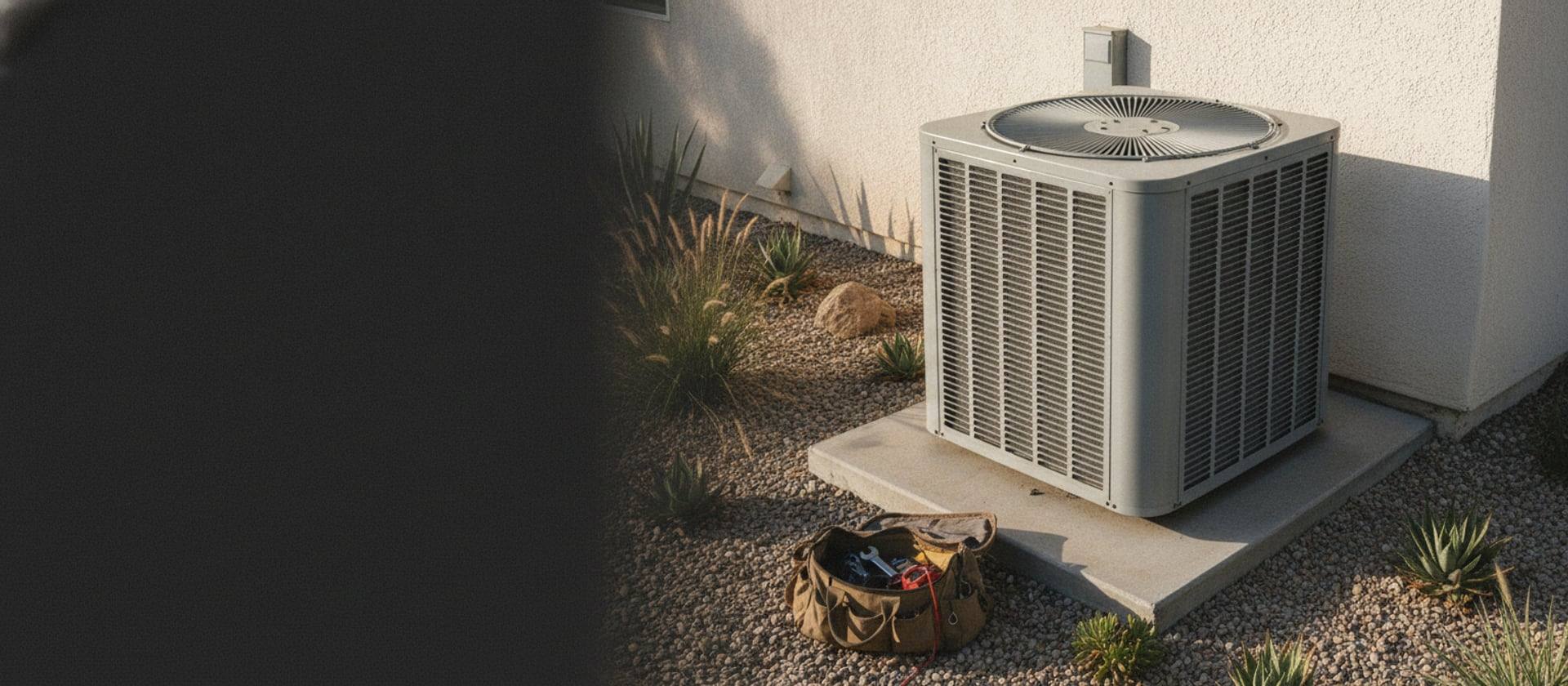
Carrier sells more residential split-system tonnage than any brand in California and runs the deepest parts pipeline in the state, which is why a Carrier capacitor, contactor, or fan motor is almost always a same-day repair here. This page is the Carrier-specific companion to our general AC repair service and our Carrier brand overview.
Common Carrier AC failures, by model
From thousands of Carrier service calls across SoCal, the cooling-side failures cluster predictably:
- Run-capacitor failure on Performance (24ACC6) and Comfort (24ABC6) condensers, especially after multi-day inland heat domes. Symptom: condenser hums, fan will not start. $185–$295.
- Contactor pitting from years of cycling under 100°F+ load. Symptom: outdoor unit buzzes but does not engage. $165–$285.
- Infinity Touch communication faults on the four-wire ABCD bus — nicked, corroded, or loose wiring between the 24VNA6 / 25VNA outdoor unit and the indoor section.
- Evaporator-coil leaks on 2008–2014-era N-coils from formicary corrosion. Carrier extended the warranty on affected serial numbers; we check before quoting.
- TXV failure on Infinity systems — warranty-covered if the system was registered within 90 days.
- Condenser fan motor wear, often signaled by a grinding bearing before it quits. $485–$795.
The hum-but-no-start call
The most common Carrier AC repair we run is a condenser that hums without the fan spinning. That is a run capacitor nine times out of ten — the part that gives the fan and compressor their starting torque. Shut the system off at the breaker if you hear it humming, because running a stalled compressor cooks the windings in under an hour. A pitted contactor produces a similar no-start with a chattering buzz instead. Both are inexpensive same-visit fixes; the walkthrough for the no-power version is in our AC not turning on guide, and the capacitor deep-dive is in AC capacitor failure.
Why Carrier AC fails when it does in SoCal
The microclimate decides the failure timeline. On the coast — Santa Monica, Manhattan Beach, Malibu — salt air corrodes the condenser electricals and capacitors tend to fail at year 5–8. Inland in Pasadena, Burbank, the Inland Empire, and the Conejo Valley, heat-cycling is the killer: capacitors run near their thermal limit through 100°F+ heat domes and usually fail at year 8–12, often at the worst possible moment during a heat wave. A unit that runs but blows warm is a different problem — dirty coil, low charge from a leak, weak compressor, or a frozen coil — walked through in AC running but not cooling, why is my AC not blowing cold air, and frozen evaporator coil.
Carrier AC repair pricing
Flat-rate, parts and labor, from our SoCal service tickets. Diagnostic is $89 ($149 after-hours), credited to the repair if you proceed:
| Carrier AC repair | Typical cost |
| Diagnostic (waived with repair) | $89 / $149 after-hours |
| Dual-run capacitor | $185–$295 |
| Contactor | $165–$285 |
| Condenser fan motor | $485–$795 |
| Refrigerant leak detection | $245–$485 |
| R-410A / R-454B recharge (per lb) | $85–$145 / $125–$225 |
| TXV (Infinity systems) | $585–$895 |
| Compressor (out of warranty — we quote replacement) | $2,400–$4,200 |
Newer Carrier systems use R-454B (the 2025-and-later refrigerant); systems through 2024 are R-410A. A registered Carrier system still carries labor on warranty parts; we confirm coverage before ordering.
Repair or replace your Carrier AC
Under 8 years and a sub-$400 fix, repair it without a second thought. Over 12 years with a compressor or coil failure, replacement usually wins — especially on a pre-2010 R-22 unit where refrigerant alone is $150–$300 per pound. The middle is judgment, and the variables are refrigerant type, compressor health, and whether the failed part is under the registered warranty. We model the repair against a written replacement quote so you decide on numbers. See AC installation when replacement is the call.
Bryant air conditioners
Bryant and Carrier are the same corporation. A Bryant Preferred 127A is the Carrier 24ACC6; a Bryant Evolution 189BNV is the Carrier 24VNA6 with the Evolution Connex bus. Same compressors, coils, and parts distributors — we service both identically. For the heating side of a Carrier system, see Carrier furnace repair, and the full lineup on our Carrier brand page.
Frequently asked questions
Is my Carrier AC worth repairing or should I replace it? +
In the SoCal climate: under 8 years old and under about 30% of replacement cost, repair it; over 12 years and over 30%, replace it. Two Carrier-specific tie-breakers. First, refrigerant: any pre-2010 R-22 condenser is end-of-life regardless of repair cost because R-22 runs $150–$300 per pound when it is available at all. Second, compressor health — Carrier compressors typically last 12–18 years here, so a failed compressor on a 14-year-old unit means replace, while a capacitor on the same unit is a cheap fix. We give you the repair number and a written replacement quote at the $89 diagnostic.
What are the most common Carrier AC failures you see? +
In order: run-capacitor failure on Performance and Comfort condensers, especially after a multi-day inland heat dome; contactor pitting from years of cycling under 100°F+ load; Infinity Touch communication faults on the four-wire ABCD bus; evaporator-coil leaks on 2008–2014-era N-coils from formicary corrosion; and TXV failures on Infinity systems. The capacitor and contactor failures are the bread-and-butter same-day fixes; the coil and TXV issues are where warranty status matters most.
My Carrier condenser hums but the fan will not start — what is that? +
Almost always a failed run capacitor, and it is the single most common Carrier AC repair in LA. The capacitor gives the fan motor and compressor their starting torque; when it weakens the fan cannot spin up and the unit just hums. Shut the system off at the breaker so you do not cook the compressor, then call. A pitted contactor causes a similar no-start with a chattering or buzzing sound instead. Both are quick, inexpensive repairs once a tech is on site.
My Carrier Infinity is not communicating with the thermostat — system or thermostat? +
Almost always the four-wire ABCD communication bus, not either end of it. Carrier Infinity uses a proprietary serial protocol over R, C, A, and B wires, and the common failures are a wire nicked during construction or by pests, a loosened attic splice, or a control board that lost its address after a power surge. We meter both ends of the bus and either re-terminate, replace the bad run, or re-pair the boards. The Infinity Touch control itself is solid hardware and is rarely the actual fault.
How much does Carrier AC repair cost in Los Angeles? +
Diagnostic is a flat $89 ($149 after-hours), credited to the repair if you proceed. Common Carrier AC repairs from our tickets: dual-run capacitor $185–$295, contactor $165–$285, condenser fan motor $485–$795, refrigerant leak detection $245–$485, TXV $585–$895. A compressor replacement out of warranty runs $2,400–$4,200, which is usually the point where replacement makes more sense on an older system. We quote the part before any work.
Why do Carrier capacitors fail faster in some parts of SoCal? +
Climate. On the coast (Santa Monica, Manhattan Beach, Malibu), salt air corrodes the condenser electricals and capacitors tend to go at year 5–8. Inland (Pasadena, Burbank, the Inland Empire, Conejo Valley), the killer is heat-cycling — capacitors run closer to their thermal limit through 100°F+ heat domes and typically fail at year 8–12, often right at the peak of a heat wave when the unit is working hardest. It is the same part either way; the SoCal microclimate just decides the timeline.
Does my Carrier 10-year warranty cover this AC repair? +
It covers the part, not the labor, and only if the system was registered within 90 days of install (unregistered drops to 5 years). One Carrier-specific note: the company extended the warranty on certain 2008–2014 N-coil evaporators affected by formicary corrosion — we check your serial number against that program before quoting a coil. Capacitors, contactors, refrigerant, and thermostats are not warranty parts. We look up registration and any extended-coverage campaigns before ordering anything.
My Carrier AC runs but the air is not cold — is that a refrigerant top-off? +
Probably not a simple top-off. A Carrier system low on refrigerant has a leak, and adding refrigerant without finding the leak just delays the next failure — and is illegal to do without EPA certification. A unit that runs but does not cool is usually a dirty condenser coil, a refrigerant undercharge from a leak, a weak compressor, or a frozen evaporator coil. We diagnose the actual cause rather than refill and leave. If the system is a pre-2010 R-22 unit, a leak repair plus R-22 refill rarely pencils out against replacement.
Do you service Bryant air conditioners too? +
Yes — Bryant and Carrier are the same corporation and largely the same equipment. A Bryant Preferred 127A is the Carrier 24ACC6; a Bryant Evolution 189BNV is the Carrier 24VNA6 with the Evolution Connex control bus. Same Copeland scroll compressors, same coils, same parts distributors. We service Bryant condensers with the same diagnostic tools and warranty channels as Carrier.