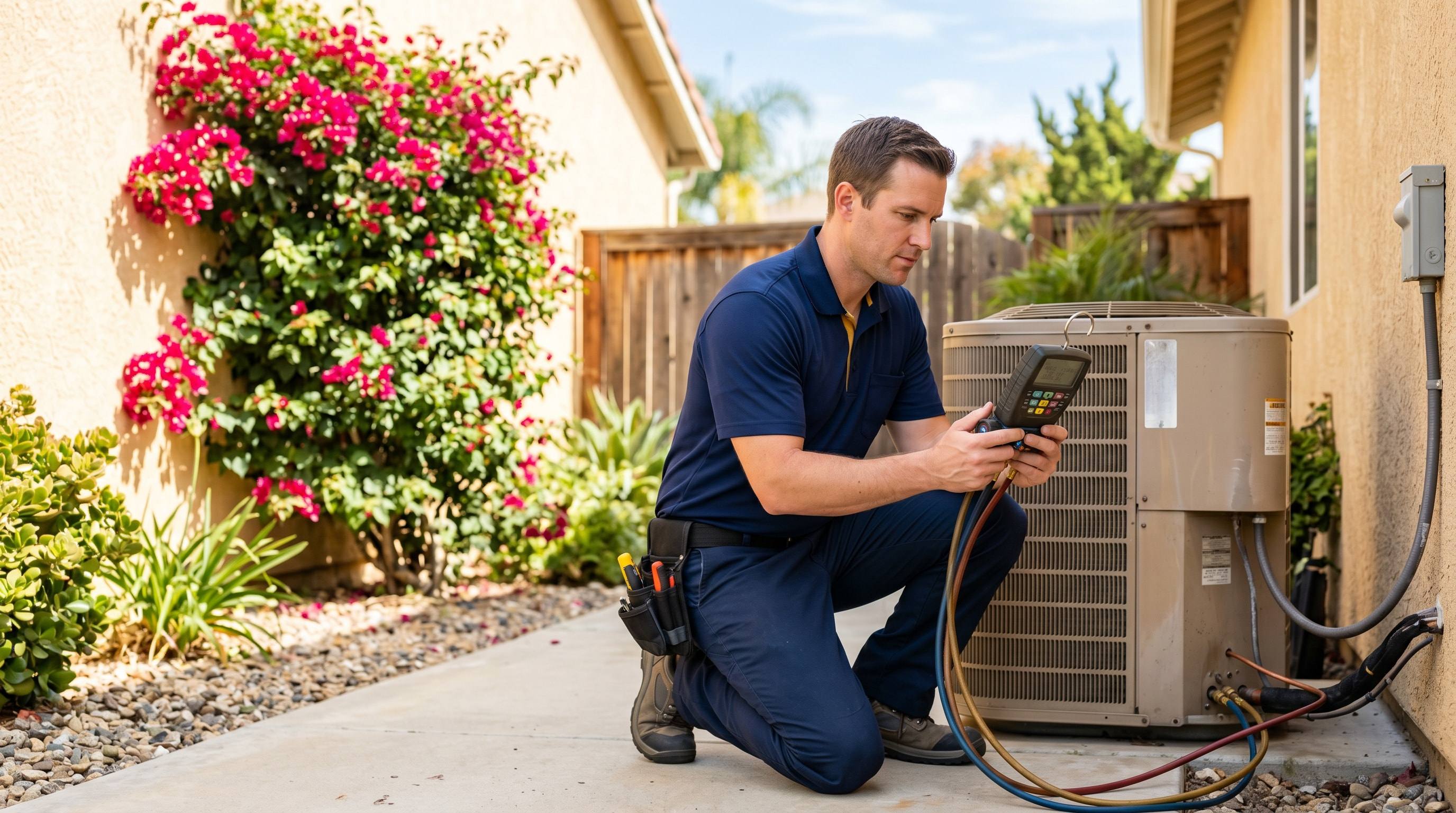
This is the failure-mode companion to our main AC repair service. The contactor is a cheap part that causes two opposite and very common failures — an AC that will not start, and an AC that will not stop.
What the contactor does
The contactor is an electrically operated switch in the outdoor unit. A 24-volt signal from the thermostat energizes its coil, which pulls in and closes the 240-volt circuit feeding the compressor and condenser fan; when the call for cooling ends, it opens and cuts the power. Because it switches the highest-current circuit in the system hundreds of times each season, the contacts arc every time and slowly pit, corrode, or weld. It is a classic wear part.
Two failure modes
- Pitted / stuck open — the contacts no longer pass power, so the outdoor unit will not start even though the thermostat is calling. Often paired with a buzzing or chattering coil.
- Welded closed — the contacts fuse together and power keeps flowing, so the AC will not shut off and the compressor runs nonstop. This one can overheat the system — shut it off at the breaker and call.
A no-start contactor looks like several other faults — a dead capacitor, lost power, or a thermostat issue — so we confirm with a meter. The broader no-start chain is in our AC not turning on guide.
Hard-start kits — when they help
A hard-start kit is a capacitor-and-relay device that gives the compressor a stronger jolt of starting torque. It is the right call when a compressor is healthy but slow or straining to start — common as units age — and it reduces start strain, which can extend an older compressor’s life. It runs $185–$345 installed. What it is not is a fix for a failing compressor; it can mask the early symptoms, so we diagnose the cause first and only add a hard-start kit where the compressor is sound. Used right, it is an inexpensive way to nurse a marginal-but-healthy compressor.
Why contactors fail in SoCal — cycling, salt, and ants
Three drivers here. Cycling: the contactor switches the compressor circuit hundreds of times a season and the contacts pit a little each time. Salt air: on the coast in Santa Monica, Manhattan Beach, and Malibu it corrodes the contacts and terminals, so coastal contactors fail earlier. And insects — a very SoCal cause — ants and bugs crawl into the contactor and get caught between the contacts, burning or sticking them. An annual spring tune-up that inspects and tests the contactor catches a pitted one before it strands you in a heat wave.
Why this is high-voltage work
The contactor is mechanically simple but switches 240 volts, and the run capacitor next to it can hold a lethal charge even after the power is off. The safe procedure — cut power at the disconnect, discharge the capacitor, match the correct pole count and coil voltage, verify clean operation — is licensed-technician work. Changing a filter is reasonable homeowner territory; reaching into the high-voltage side of a condenser is not.
Contactor & hard-start pricing
| Repair | Typical cost |
| Diagnostic (waived with repair) | $89 / $149 after-hours |
| Contactor (single or double pole) | $165–$285 |
| Hard-start kit installation | $185–$345 |
| Dual-run capacitor (often replaced together) | $185–$295 |
Every major brand
Contactors are universal across brands — Carrier, Trane, Lennox, Rheem, Goodman, Daikin, and York AC not cooling cover the brand-specific diagnostics.
Frequently asked questions
How much does it cost to replace an AC contactor? +
An AC contactor replacement runs $165–$285 in Southern California, parts and labor, and our $89 diagnostic ($149 after-hours) credits to the repair. The contactor is an inexpensive part; the cost is mostly the diagnostic confirmation, a quick swap, and verifying the unit starts and runs cleanly afterward. If a hard-start kit is the better fix for a compressor that is slow to start, that runs $185–$345. We carry contactors on every truck, so it is almost always a same-day, single-visit repair.
What does an AC contactor do? +
The contactor is an electrically operated switch inside the outdoor unit. When the thermostat calls for cooling, it sends 24 volts to the contactor coil, which pulls in and closes the high-voltage circuit feeding the compressor and condenser fan. When the call ends, it opens and cuts power. Because it switches the highest-current circuit in the system hundreds of times a season, its contacts arc and wear — they pit, corrode, or weld. A failed contactor is one of the most common reasons an AC will not start, or will not shut off.
What are the signs of a bad AC contactor? +
Common signs: the outdoor unit will not start even though the thermostat is calling (contacts pitted open), a chattering or buzzing sound at the contactor on startup, or — the dangerous one — the AC will not shut off because the contacts have welded closed. You may also see visible pitting, melting, or insect damage on the contactor (ants are a classic cause in SoCal). Because a stuck-closed contactor runs the compressor continuously, it can overheat the system, so we treat a welded contactor as a prompt fix.
What is a hard-start kit and do I need one? +
A hard-start kit is a capacitor-and-relay device that gives the compressor a stronger jolt of starting torque. It is the right fix when a compressor is healthy but slow or struggling to start — common as units age — and it can extend the life of an older compressor by reducing start strain. It is $185–$345 installed. What a hard-start kit is not is a cure for a failing compressor; it can mask the early symptoms, which is why we diagnose the cause first. Used correctly on a marginal-but-sound compressor, it is a smart, inexpensive add.
Why do AC contactors fail in Southern California? +
Three reasons stand out here. First, sheer cycling: a contactor switches the compressor circuit hundreds of times each cooling season, and the contacts arc and pit a little each time. Second, coastal salt air — in Santa Monica, Manhattan Beach, and Malibu it corrodes the contacts and terminals, so we see contactors fail earlier near the coast. Third, and very SoCal, insects: ants and other bugs crawl into the contactor and get caught between the contacts, causing a stuck or burned contactor. An annual tune-up that inspects and tests the contactor catches a pitted one before it strands you.
Can I replace an AC contactor myself? +
It is mechanically simple, but it is high-voltage work and we steer most homeowners away from it. The contactor switches 240 volts, and the capacitor nearby can hold a lethal charge even with the power off. A wrong wiring connection or an unmatched contactor causes immediate failure or a hazard. Cutting power at the disconnect, discharging the capacitor safely, matching the correct contactor (pole count and coil voltage), and verifying clean operation is licensed-technician work. Changing your filter is fine; reaching into the high-voltage side of a live condenser is not.
My AC won’t shut off — is that the contactor? +
Often, yes. If the AC runs continuously and ignores the thermostat turning it off, the most common cause is a contactor whose contacts have welded shut — power keeps flowing to the compressor and fan even with no call for cooling. A stuck thermostat or a wiring fault can also do it. Because a welded contactor runs the compressor nonstop and can overheat it, shut the system off at the breaker and call. We confirm the contactor with a meter and replace it; if it is the thermostat instead, that is a different fix and we will tell you.