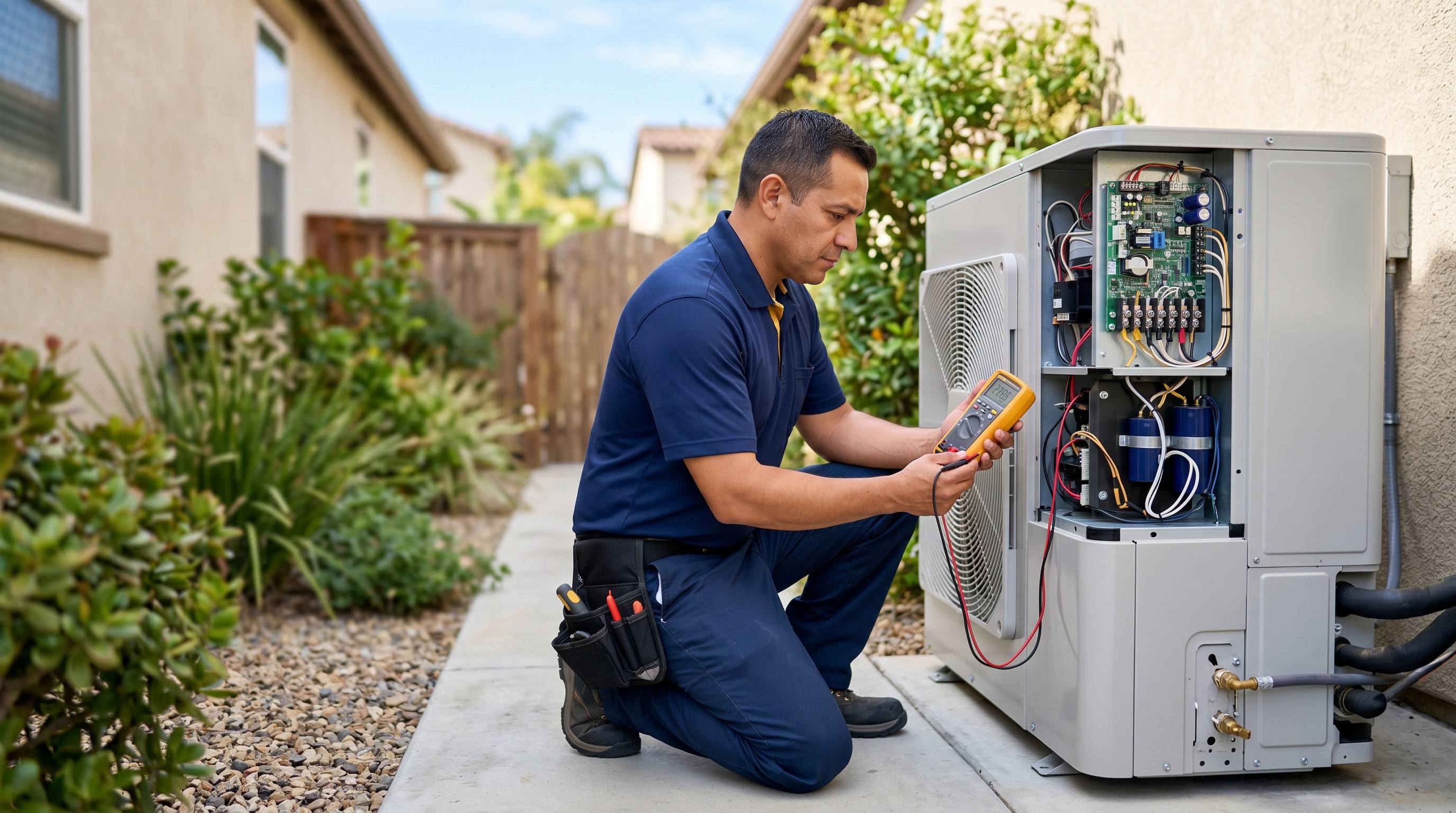
This is the failure-mode companion to our main heat pump repair service. The reversing valve is the part that defines a heat pump — and the one repair that has no counterpart on an AC or a furnace.
What the reversing valve is
A heat pump is an air conditioner that can run in reverse. The reversing valve is what reverses it: it changes the direction of refrigerant flow so the same equipment either dumps heat outdoors (cooling) or pulls heat indoors (heating). A small electric solenoid coil shifts the valve’s internal slide when the thermostat switches mode, and the valve also flips briefly during every defrost cycle. Because it cycles on every season change and every defrost, it racks up wear an AC’s components never see.
Signs the reversing valve has failed
- Stuck in one mode — only heats, or only cools, regardless of the thermostat. The signature symptom.
- Won’t change modes at all when you switch heat/cool.
- Loud hiss or clunk from the outdoor unit on changeover.
- Lukewarm in both modes — a valve leaking internally between the two sides.
- Buzzing solenoid coil — the electrical half trying and failing to shift the valve.
A stuck valve drives both the not heating and not cooling calls, and a valve that can’t reverse also blocks the defrost cycle — see not defrosting.
Coil vs. valve body — why the price varies so much
The $400–$1,500 range comes down to which half failed:
- Solenoid coil only ($400 end) — the electrical coil unbolts and swaps without opening the refrigerant circuit. Quick, inexpensive, any age worth doing.
- Valve body ($1,500 end) — the valve is brazed into the line set, so replacement means recovering the refrigerant, unbrazing and rebrazing the new valve without cooking nearby components, pulling a deep vacuum, and recharging to factory weight. Several hours of skilled refrigerant work.
We confirm coil-versus-body on the meter and gauges before quoting, so you know which job it is.
Why this is experienced refrigerant work
A coil swap is simple, but a valve-body replacement is one of the more demanding residential refrigerant jobs: refrigerant recovery under EPA Section 608 rules, careful brazing that does not overheat the new valve’s internal seals, a deep vacuum to remove moisture, and a verified recharge with superheat and subcool readings. Done poorly it introduces leaks or contamination that fail again within a season. On inverter and communicating heat pumps, the brand-specific diagnostics matter too. This is licensed work, not DIY.
Reversing valve pricing
| Repair | Typical cost |
| Diagnostic (waived with repair) | $89 / $149 after-hours |
| Solenoid coil replacement | $400 end of range |
| Full reversing valve body replacement | up to $1,500 |
| Refrigerant recharge (R-410A / R-454B per lb) | $85–$145 / $125–$225 |
Why reversing valves fail in SoCal
Mostly hours and cycling. A SoCal heat pump runs year-round and switches the valve on every season change plus during every defrost, so it accumulates cycles far faster than a cooling-only system would put on any comparable part. On the coast — Santa Monica, Manhattan Beach, Malibu — salt air corrodes the solenoid coil and its connections. The valve body can stick from internal wear or debris in the refrigerant circuit. It is not the most frequent heat pump failure, but it is one of the most distinctly heat-pump ones.
Repair or replace
A solenoid coil is worth fixing at almost any age. A full valve-body replacement on a heat pump past about 12 years is where the labor starts to rival a new outdoor unit, so we present the replace-versus-repair quote there; R-22 systems are replacement-only. We give you both numbers — see heat pump vs. air conditioner and heat pump installation.
Every major brand
We diagnose reversing-valve faults on every heat pump line — Trane, Lennox, Rheem, Goodman, Daikin, and York heat pump repair, plus Daikin mini-split repair.
Frequently asked questions
What does the reversing valve do on a heat pump? +
The reversing valve is the component that makes a heat pump a heat pump. It reverses the direction of refrigerant flow to switch the system between cooling and heating — in cooling it sends hot refrigerant outdoors, in heating it sends it indoors. A small electric solenoid coil shifts the valve when the thermostat changes mode. Because it cycles on every season change and during every defrost, it is a wear point an air conditioner and gas furnace simply do not have. When it fails, the system gets stuck in one mode regardless of the thermostat.
What are the signs of a bad reversing valve? +
The classic sign is the system stuck in one mode: it only cools when you want heat, or only heats when you want cooling, no matter the thermostat setting. Other signs: the system will not switch modes at all, a loud hiss or clunk from the outdoor unit when it tries to changeover, lukewarm output in both modes (a valve leaking internally between the two sides), or a buzzing solenoid coil. Because a stuck valve can be either an electrical (coil) failure or a mechanical (valve body) one, we meter the solenoid and verify refrigerant flow direction before deciding which.
How much does it cost to replace a heat pump reversing valve? +
A reversing valve repair runs $400–$1,500 in Southern California, and the spread is real: if only the solenoid coil failed, it is at the low end — the coil unbolts and swaps without opening the refrigerant circuit. If the valve body itself stuck and must be replaced, the high end applies, because it means recovering the refrigerant, unbrazing and rebrazing the valve into the line set, pulling a vacuum, and recharging — several hours of skilled refrigerant work. Our $89 diagnostic ($149 after-hours) credits to the repair, and we confirm coil-vs-body before quoting so you know which job it is.
Is it worth replacing a reversing valve or should I replace the heat pump? +
It depends on which part failed and the age of the system. A failed solenoid coil is cheap and worth fixing at almost any age. A full valve-body replacement is labor-intensive, and on a heat pump past about 12 years that labor approaches a meaningful share of a new outdoor unit — at that point we usually present the replace-versus-repair quote, because you may be better off with a new system and warranty. On an R-22 system, replacement is the only sensible path. We give you the repair figure and a written replacement quote side by side.
Why is my heat pump stuck in cooling (or heating) mode? +
A heat pump stuck in one mode is the textbook reversing-valve symptom. If it only blows cold air when you call for heat, the valve is stuck in (or stuck toward) cooling; if it only blows warm when you call for cooling, it is stuck in heating. The cause is either the solenoid coil not energizing to shift the valve, or the valve body mechanically stuck or slid part-way. A thermostat or control fault can occasionally mimic it, which is why we verify the valve is actually getting its signal and check the refrigerant flow direction rather than assuming.
Why do reversing valves fail in Southern California? +
Mostly hours and cycling. A SoCal heat pump runs year-round and switches the reversing valve every season change plus during every defrost, so the valve and its solenoid accumulate cycles fast — far more than a cooling-only system would ever put on a comparable part. On the coast, in Santa Monica, Manhattan Beach, and Malibu, salt air also corrodes the solenoid coil and connections. The valve body can stick from internal wear or debris in the refrigerant circuit. It is not the most common heat pump failure, but it is one of the most distinctly heat-pump ones.
Can a regular HVAC tech replace a reversing valve? +
A solenoid coil swap is straightforward for any competent tech — it is an electrical part that bolts on. Replacing the valve body is a different level of work: it requires recovering the refrigerant under EPA Section 608 rules, unbrazing the old valve and brazing in the new one without overheating nearby components, pulling a deep vacuum, and recharging to factory weight with verified superheat and subcool. Done poorly it introduces leaks or contamination that fail again. It is licensed, experienced refrigerant work, and on inverter and communicating systems the brand-specific diagnostics matter too.