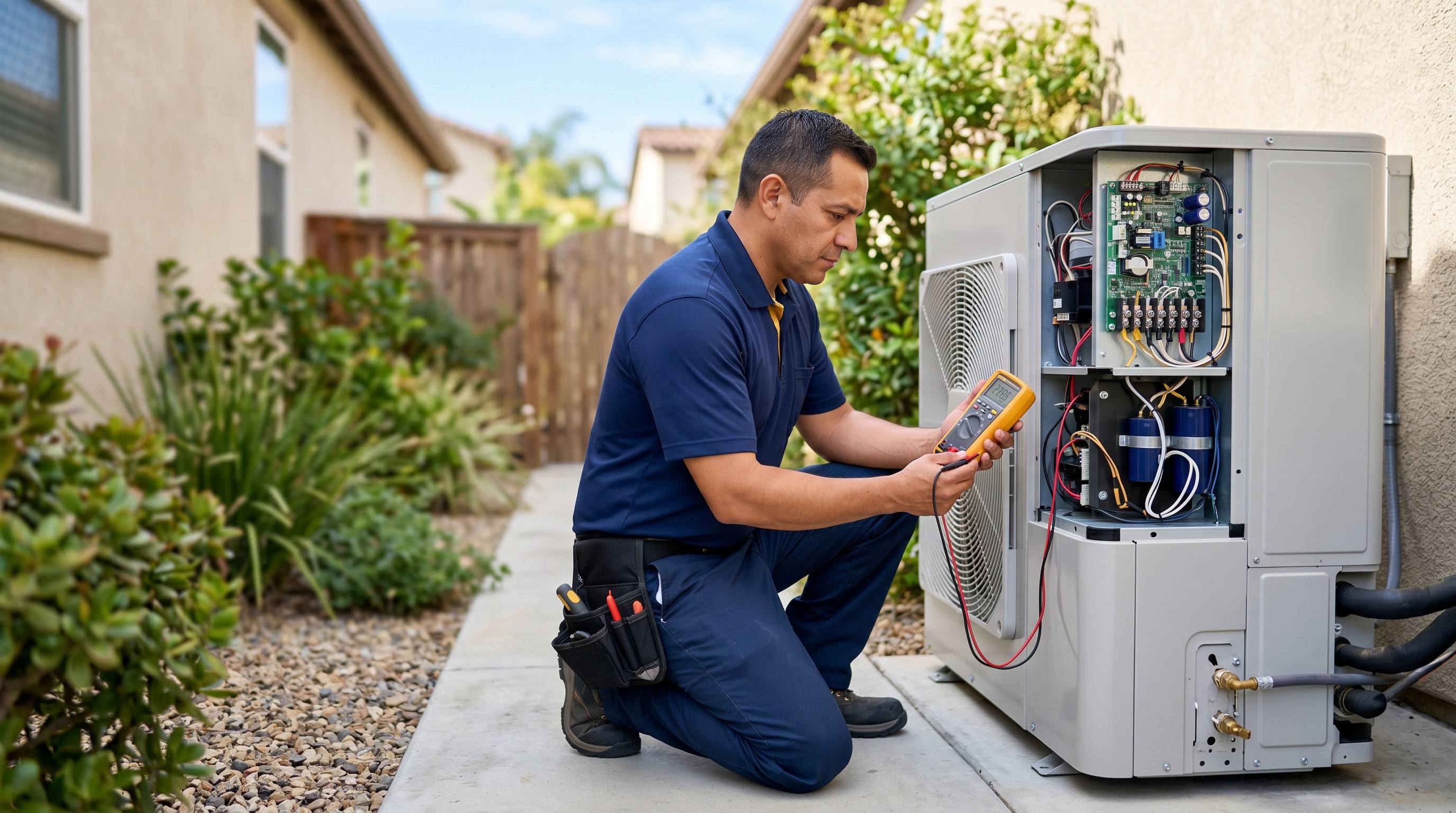
This is the failure-mode companion to our main heat pump repair service. No-heat is the call that defines a SoCal cold snap, and on a heat pump the diagnosis is genuinely different from a gas furnace.
Why a heat pump stops heating
- Reversing valve stuck in cooling — the most common cause. The valve that flips the system between heating and cooling fails or sticks, so it blows cool air regardless of setpoint. Reversing valve repair, $400–$1,500.
- Low refrigerant charge from a leak — less refrigerant means less heat moved, so the system runs long and never reaches setpoint. See refrigerant leak.
- Iced outdoor coil / failing defrost — a thick ice block means the defrost cycle is not clearing the coil. See not defrosting, $300–$800.
- Failed auxiliary heat — the backup electric strips (or dual-fuel furnace) that supplement the heat pump on cold mornings are not engaging.
- Thermostat / control fault — especially on communicating systems where the thermostat and outdoor unit talk over a serial bus.
Blowing cold air in heat mode — defrost vs. fault
This is the symptom that confuses people most. During a normal defrost cycle, the heat pump briefly reverses to melt frost off the outdoor coil, and for a few minutes it blows cooler air indoors while the aux heat offsets it — completely normal, happens every 30–90 minutes in cold, damp weather. But if the system blows cool air continuously in heat mode, that is a real fault: a reversing valve stuck in cooling, a low charge, or aux heat that never engages. Brief and occasional means defrost; constant means it is not heating and needs a look.
Auxiliary and emergency heat, explained
Auxiliary heat is a backup — usually electric resistance strips in the air handler, or a gas furnace on a dual-fuel setup — that supplements the heat pump on cold mornings and during defrost, engaging automatically. Emergency heat (EM heat) is a manual mode that runs only the backup, for when the heat pump itself has failed. The trap: electric-strip aux heat is expensive to run, so a heat pump leaning on aux heat constantly spikes your bill. That is a signal the heat pump side is underperforming — a charge, defrost, or capacity issue — not a reason to just live on EM heat. In the cold-climate corridor (Big Bear, Wrightwood, Apple Valley), a non-cold-climate-rated unit loses capacity below ~30°F and leans on strips by design; our cold-climate heat pump guide covers that.
No-heat repair pricing
Flat-rate from our SoCal tickets; diagnostic $89 ($149 after-hours), credited to the repair:
| Repair | Typical cost |
| Diagnostic (waived with repair) | $89 / $149 after-hours |
| Reversing valve (coil-only to full valve) | $400–$1,500 |
| Defrost-system repair (board / sensor) | $300–$800 |
| Refrigerant recharge (R-410A / R-454B per lb) | $85–$145 / $125–$225 |
| Capacitor / contactor (no-start side) | $185–$295 / $165–$285 |
| Compressor (out of warranty — we quote replacement) | $2,400–$4,200 |
Why heat pumps fail in SoCal
A heat pump here runs year-round — far more annual hours than a cooling-only AC — and the reversing valve cycles on every season change, so it wears on a curve gas systems do not have. On the coast, in Santa Monica, Manhattan Beach, and Malibu, salt air corrodes the outdoor coil and electricals. In the cold-climate corridor the defrost cycle actually gets exercised through winter, so defrost-board and reversing-valve faults show up more there than in the warm inland valleys. The frozen-coil mechanics carry over from cooling season too — see frozen evaporator coil.
Repair or replace
Under 10–12 years with one fault, repair it. Past 12 years — especially a full reversing-valve body or a compressor — replacement usually wins, and R-22 systems are replacement-only. Heat pumps hit that threshold sooner than ACs because of the hours. We model both with a written quote; see heat pump vs. air conditioner and heat pump installation.
Every major brand
We diagnose no-heat on every heat pump line — Trane, Lennox, Rheem, Goodman, Daikin, and York heat pump repair, plus Daikin mini-split repair for ductless.
Frequently asked questions
Why is my heat pump not heating? +
In order of how often we see it: the reversing valve is stuck in cooling mode (so the system blows cool air no matter the setpoint), a low refrigerant charge from a leak has cut heating capacity, the outdoor coil is iced over because the defrost cycle is not running, the auxiliary heat strips have failed or were never wired, or a thermostat/control fault. On a SoCal heat pump the most common single cause is a stuck or failing reversing valve, because that part cycles every season change. We confirm with a mode test, refrigerant pressures, and a defrost-cycle check before quoting — the $89 diagnostic credits to the repair.
Why is my heat pump blowing cold air in heat mode? +
Two cases, and they are very different. The normal one: during a defrost cycle the heat pump briefly reverses to melt frost off the outdoor coil, and for a few minutes it blows cooler air indoors — this is expected and the auxiliary heat usually kicks in to offset it. The not-normal one: the system blows cool air continuously in heat mode, which points at a reversing valve stuck in cooling, a low refrigerant charge, or the aux heat never engaging. If it is brief and occasional, it is defrost. If it is constant, the system is not actually heating and needs diagnosis.
What is auxiliary heat (aux heat / emergency heat) on a heat pump? +
Auxiliary heat is a backup heating source — usually electric resistance strips in the air handler, or a gas furnace on a dual-fuel system — that supplements the heat pump when it cannot keep up. It engages automatically on cold mornings or during defrost. "Emergency heat" (EM heat) is a manual setting that runs only the backup, used when the heat pump itself has failed. The catch: aux/EM heat on electric strips is expensive to run, so if your aux heat is running constantly your electric bill spikes — usually a sign the heat pump side is underperforming and needs a look, not a reason to just leave it on EM heat.
How much does it cost to fix a heat pump that is not heating? +
It depends on the cause, and the $89 diagnostic ($149 after-hours) credits to the repair. From our SoCal tickets: a reversing valve runs $400–$1,500 (coil-only versus full valve), a defrost-system repair $300–$800, a refrigerant leak repair plus recharge varies by leak location with R-410A at $85–$145 per pound and R-454B at $125–$225, and a capacitor or contactor on the no-start side is $185–$295 or $165–$285. We diagnose the actual fault before quoting rather than guessing — on a heat pump the same "no heat" symptom has five very different price tags.
Why does my heat pump run constantly but the house stays cold? +
Long run times with weak heat usually mean reduced capacity, and the three causes are a refrigerant leak (less refrigerant means less heat moved), a partially iced outdoor coil from a failing defrost cycle, or the heat pump simply being below its capacity envelope on a cold morning so the aux heat is carrying the load. In the cold-climate corridor — Big Bear, Wrightwood, Apple Valley — a non-cold-climate-rated heat pump loses capacity below about 30°F and the strips run hard. We check charge, defrost, and the balance point to tell which it is.
Is it normal for the outdoor unit to steam or have frost in winter? +
Light frost on the outdoor coil on a cold, damp morning is normal — the coil runs colder than ambient and moisture condenses and freezes. The heat pump clears it with a periodic defrost cycle, and you may see steam rising off the coil during defrost, which is also normal. What is not normal is a thick block of ice covering the whole coil that never clears: that means the defrost cycle is failing and the unit is losing heating capacity. Do not chip the ice off — you will bend the fins. Switch to emergency heat and call. See our heat pump not defrosting page.
Should I repair or replace a heat pump that won’t heat? +
Under about 10–12 years with a single fault — a reversing valve coil, a defrost board, a fixable leak — repair it. Past 12 years, especially with a full reversing-valve body replacement (labor approaches half of a new unit) or a compressor failure, replacement usually wins, and R-22 systems are replacement-only. Because heat pumps run far more annual hours than a cooling-only AC, they reach that threshold sooner. We give you the repair figure and a written replacement quote side by side, and current LADWP rebates ($1,250–$2,500 per ton) narrow the gap more than most expect.