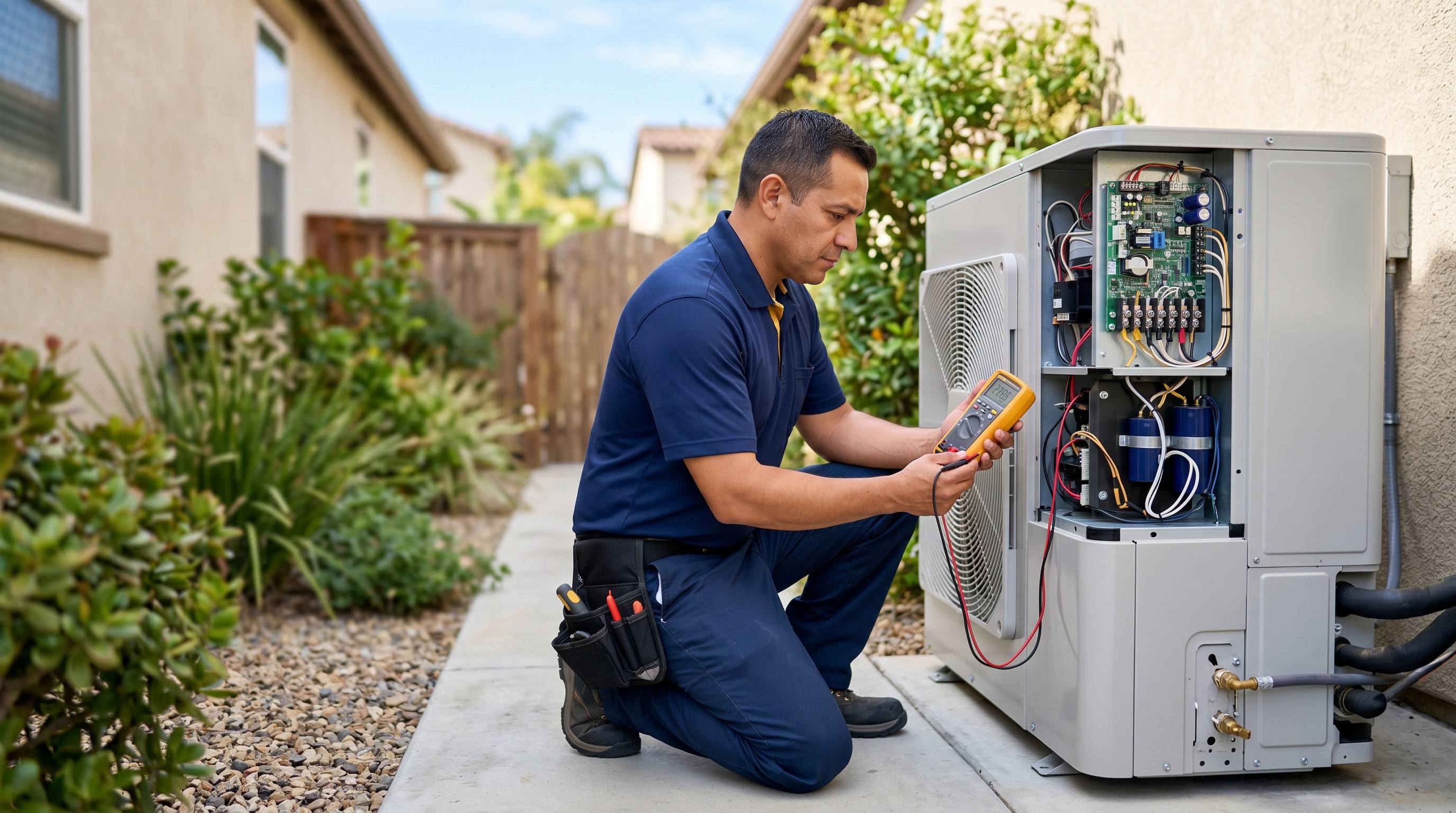
This is the failure-mode companion to our main heat pump repair service. It covers three related symptoms — won’t start, short cycles, and makes noise — because they often share the same parts.
Why a heat pump won't turn on
- Tripped breaker / blown disconnect fuse — reset once; if it trips again instantly, stop and call (real electrical fault).
- Dead thermostat or thermostat fault — flat batteries, lost programming, or a failed unit. Roughly 1 in 5 no-starts clears here.
- Failed low-voltage transformer — no 24V control power reaches the unit.
- Pitted or welded contactor — not passing power to compressor and fan. $165–$285.
- Failed capacitor — the unit hums but the fan or compressor will not start. See fan not spinning. $185–$295.
- Safety lockout — a high/low pressure switch tripped on a charge or airflow problem; or a communication/board fault on inverter systems.
Short cycling — and why it's urgent
Short cycling is starting, running a few minutes, shutting off, and repeating — and it is hard on the compressor, so it is worth fixing quickly. Causes: a low refrigerant charge tripping the low-pressure switch, a dirty coil or filter overheating the system into a safety trip, an oversized system that satisfies the thermostat too fast, a failing capacitor, or a thermostat in direct sun or near a supply register. On a heat pump, a defrost or reversing-valve fault can also cause odd cycling. We find the trigger rather than resetting and hoping — the broader pattern is in our short cycling guide.
Loud noise — match the sound to the cause
- Loud hum, won’t start → failed capacitor.
- Clicking / chattering → contactor.
- Grinding / squealing → worn condenser fan-motor bearing. $485–$795.
- Hard knocking from the compressor → possible internal wear; see compressor replacement.
- Hiss / clunk on mode change → reversing valve.
- Rattle → loose hardware or debris in the unit.
The deeper sound-by-sound reference is in our HVAC strange noises guide.
Don't keep resetting it
Reset a tripped breaker once. If it trips again the instant you reset it, stop — that is a real electrical fault (a shorted or grounded compressor, a seized motor), and forcing it can cause damage or a fire risk. The same goes for a unit that keeps locking out on a pressure switch: repeated resets mask a refrigerant or airflow problem. Note the behavior, leave it off, and call.
No-start & noise repair pricing
| Repair | Typical cost |
| Diagnostic (waived with repair) | $89 / $149 after-hours |
| Dual-run capacitor | $185–$295 |
| Contactor | $165–$285 |
| Hard-start kit (slow-to-start compressor) | $185–$345 |
| Condenser fan motor (PSC) | $485–$795 |
| Compressor (out of warranty — we quote replacement) | $2,400–$4,200 |
Why these faults cluster in SoCal
Heat and hours. A heat pump runs year-round, so capacitors and contactors accumulate cycles fast, and inland heat (Rancho Cucamonga, Fontana, Riverside) cooks capacitors to failure at year 5–7 — a weak capacitor is a leading cause of both no-start and short-cycle calls. Dust- and cottonwood-clogged coils trip safeties and drive short cycling on the hottest afternoons. On the coast, salt air pits contactors early. A spring tune-up that tests the capacitor and contactor and cleans the coil heads off most of these before peak season.
Repair or replace
Most no-start and short-cycle causes are cheap, worthwhile repairs at any reasonable age. The exception is a no-start that is really a failed compressor — a breaker that trips instantly on a grounded compressor — on a unit past 10–12 years, or any R-22 system; those tip toward replacement. We confirm whether it is a cheap electrical part or a major component first. See heat pump vs. air conditioner and heat pump installation.
Every major brand
We diagnose no-start, short-cycle, and noise on every heat pump line — Trane, Lennox, Rheem, Goodman, Daikin, and York heat pump repair, plus Daikin mini-split repair.
Frequently asked questions
Why won’t my heat pump turn on at all? +
In order: a tripped breaker or blown disconnect fuse, dead thermostat batteries or a thermostat fault, a failed low-voltage transformer, a pitted or welded contactor not passing power, a failed capacitor leaving the unit humming but not starting, or a safety lockout from a high/low pressure switch. On communicating and inverter systems, a control-board or communication-bus fault can also leave it dark. About one in five no-start calls clears at the thermostat or breaker before we open the cabinet. We start with the free checks, then meter the contactor, capacitor, and transformer. The $89 diagnostic credits to the repair.
Why is my heat pump short cycling (turning on and off rapidly)? +
Short cycling — starting, running a few minutes, shutting off, repeating — burns out compressors fast, so it is worth addressing quickly. Common causes: a low refrigerant charge tripping the low-pressure switch, a dirty coil or filter overheating the system and tripping a safety, an oversized system that satisfies the thermostat too quickly, a failing capacitor, or a thermostat placed in direct sun or near a supply register. On heat pumps a defrost or reversing-valve fault can also cause odd cycling. We find the actual trigger rather than just resetting it, because continued short cycling is hard on the compressor.
Why is my heat pump making a loud noise? +
The sound points to the cause. A loud hum with the fan or compressor not starting is usually a failed capacitor. A rhythmic clicking or chattering on startup is often the contactor. A grinding or squealing from the outdoor unit is typically a worn fan-motor bearing. A hard knocking or banging from the compressor can mean internal wear. A loud hiss or clunk on mode changeover is often the reversing valve. A rattle is usually loose hardware or debris. Some are cheap fixes; a compressor knock or a refrigerant hiss is a stop-using-it call. We identify the noise and confirm on the meter.
How much does it cost to fix a heat pump that won’t start? +
It depends on the part, and the $89 diagnostic ($149 after-hours) credits to the repair. From our tickets: a dual-run capacitor $185–$295, a contactor $165–$285, a low-voltage transformer in a similar range, a hard-start kit (for a compressor slow to start) $185–$345, and a condenser fan motor $485–$795. A control board on a communicating system is more. Many no-start calls are an inexpensive single-visit fix — we carry common capacitors and contactors on the truck — but we confirm the fault on the meter first.
Is it safe to keep resetting my heat pump breaker? +
Reset it once. If the breaker trips again immediately, stop — a breaker that trips the moment you reset it is reporting a real electrical fault (a shorted compressor, a grounded wire, a seized motor), and repeatedly forcing it can cause damage or a fire risk. The same goes for a unit that locks out on a pressure switch: repeated resets mask a refrigerant or airflow problem. Note what it is doing, leave it off, and call. We find the cause rather than nursing it through reset cycles that can turn a small repair into a compressor.
Why do heat pumps short cycle or fail to start more in SoCal? +
Heat and hours. A SoCal heat pump runs year-round, so its capacitors and contactors accumulate cycles fast, and inland heat (Rancho Cucamonga, Fontana, Riverside) cooks capacitors to failure at year 5–7 — a weak capacitor is a leading cause of both no-start and short-cycle calls. Dirty coils from desert dust and cottonwood trip safeties and drive short cycling on the hottest afternoons. On the coast, salt air pits contactors early. A spring tune-up that tests the capacitor and contactor and cleans the coil heads off most of these before peak season.
Should I repair or replace a heat pump with starting problems? +
Most no-start and short-cycle causes are inexpensive, worthwhile repairs at any reasonable age — a capacitor, contactor, transformer, or hard-start kit restores the system for a few hundred dollars. The picture changes if the no-start is a failed compressor (a breaker that trips instantly on a grounded compressor), especially on a unit past 10–12 years, or on an R-22 system — those tip toward replacement. We confirm whether it is a cheap electrical part or a major component first, then give you the repair figure and a replacement quote side by side.