
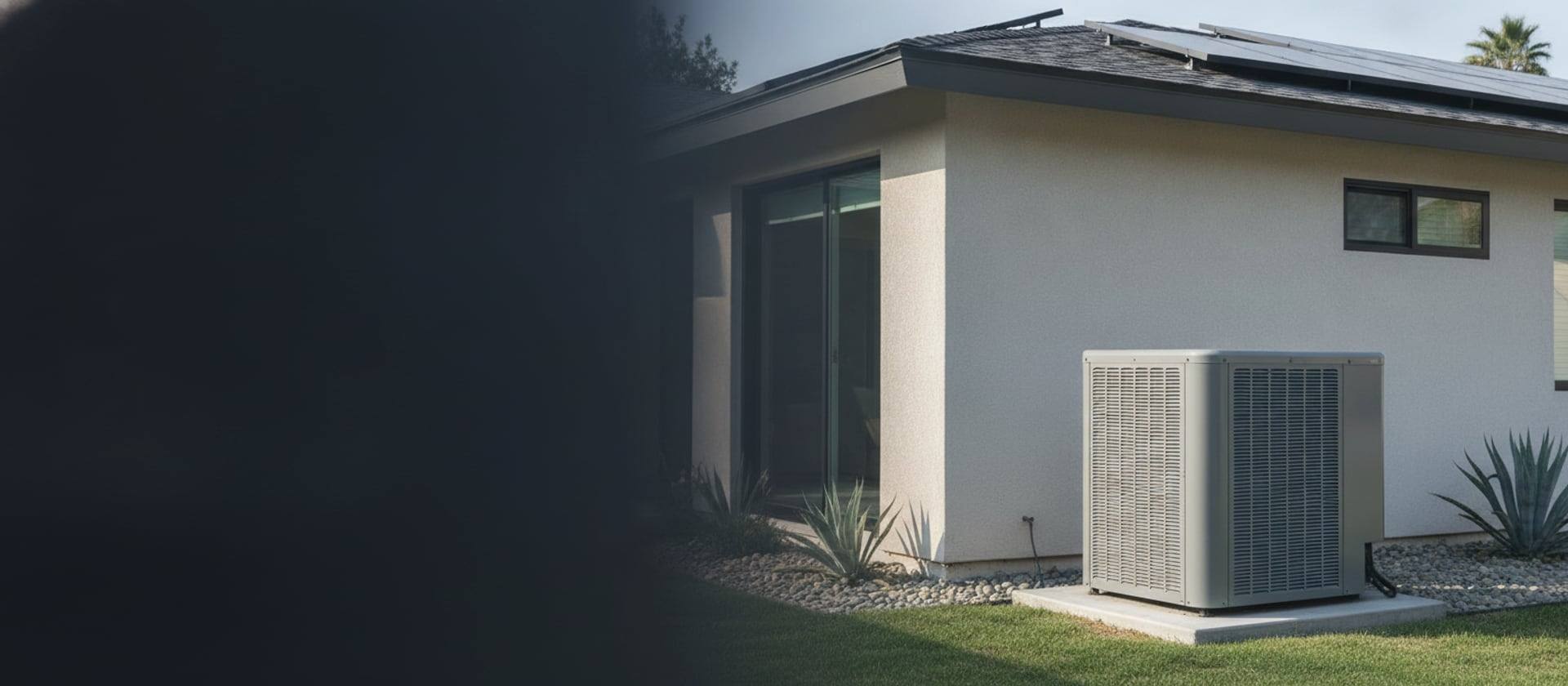
Standard residential heat pumps lose capacity below 30°F — a problem in Apple Valley, Big Bear, Wrightwood, and other SoCal mountain/desert areas where winter nights drop into the 20s. Cold-climate heat pumps (Mitsubishi Hyper-Heat, Carrier Infinity Greenspeed) maintain full capacity to -13°F. This guide covers when you need one and which models we install.
Most LA HVAC contractors install standard-tier heat pumps everywhere — Sherman Oaks, Apple Valley, Big Bear, doesn’t matter. That works fine in Sherman Oaks. In Apple Valley winter, when nights drop to 25°F, a standard heat pump loses 40% of its rated heating capacity right when you need it most. Owners blame “the heat pump” when really it’s installer error — wrong equipment for the climate. We install cold-climate heat pumps in mountain and high-desert SoCal because that’s the right tool for that climate. CSLB #1138898 (C-20). TECH Clean California certified.
Why standard heat pumps fail in cold weather
Residential heat pumps are rated by AHRI at 47°F outdoor air. The published BTU and SEER2/HSPF2 numbers reflect performance at that test condition. Real-world performance drops as outdoor temperature drops, and at the entry tier the curve gets steep fast.
Typical capacity retention for a standard residential heat pump:
- 47°F outdoor: 100% rated capacity
- 30°F outdoor: 70–75% capacity
- 17°F outdoor: 50–60% capacity
- 5°F outdoor: 35–45% capacity
When outdoor capacity drops below indoor heat-loss demand, the system either runs continuously without reaching setpoint (cold house) or pulls electric resistance backup heat (high bill). Most installs default to resistance backup — 10–15 kW heat strips integrated into the air handler. At LADWP rates around $0.21/kWh, that backup running 4–6 hours per cold night adds $50–$120 to the bill per cold week. In Apple Valley with 60–90 cold nights per winter, that compounds to $300–$700 of unnecessary backup-heat cost per season.
This is not a flaw in the technology — it is how entry-tier heat pumps work. The fix is cold-climate models with vapor-injection or flash-injection compressors that maintain capacity well below freezing.
Where this matters in SoCal
Cold-climate heat pump territory in our service area:
- High desert: Apple Valley, Hesperia, Victorville. Winter nights regularly 25–35°F, occasional sub-20°F dips, occasional snow. Sustained 25–40 mph wind events with sand exposure that wears outdoor units faster than coastal installs.
- Mountain: Big Bear, Lake Arrowhead, Crestline, Running Springs. Winter days 30–45°F, nights often below 20°F, snow common. Some neighborhoods see -5°F in extreme winters.
- Mountain communities outside SB County: Wrightwood, Idyllwild, Pine Mountain Club. Similar profile to Big Bear, slightly less extreme.
- Hillside fire-zone: Pacific Palisades hills, Calabasas, Topanga, parts of Malibu canyon. Coastal influence helps, but elevation matters — Topanga gets 30°F nights occasionally, and the wind exposure compounds the load.
Where you do not need cold-climate: LA basin proper, the Westside, the San Fernando Valley floor, OC, Riverside basin, San Bernardino city, Ontario, Rancho Cucamonga. These all see overnight lows in the 35–45°F range, well within standard residential heat pump capacity. Honest take: if you are in West LA, Sherman Oaks, Irvine, or Riverside basin, do not pay for cold-climate. A standard mid-tier heat pump (Carrier Infinity 25VNA8, Daikin Fit DZ20VC, Bosch IDS 2.0) is fine and saves you $2,000–$3,000 of equipment premium that will not pay back in your climate.
Cold-climate heat pump options we install
Mitsubishi Hyper-Heating H2i — the gold standard
Models: M-Series MUZ-FH single-zone (outdoor) + MSZ-FH wall heads (indoor). Multi-zone: MXZ-3C30NAHZ2 (3-zone), MXZ-4C36NAHZ2 (4-zone), MXZ-5C42NAHZ2 (5-zone). Ducted air handler: M-PVA-A30AA7 for partial-ducted installs.
Performance: full rated capacity to -13°F, useful heat down to -22°F, COP 2.2 at 5°F. Flash Injection compressor with intermediate-pressure refrigerant injection at the scroll.
Warranty: 12-year compressor (best in class), 5-year parts.
Best for: Apple Valley homes wanting all-electric, Big Bear cabins wanting reliable heat without resistance backup, Wrightwood/Idyllwild ductless retrofits. Also our default recommendation for hillside fire-zone homes (Calabasas, Topanga) where ductless preserves architecture.
Carrier Infinity Greenspeed (ducted alternative)
Model: Carrier Infinity 25VNA8 with Greenspeed Intelligence variable-speed inverter compressor.
Performance: operates to -15°F, maintains capacity at 5°F, SEER2 24, HSPF2 11+. 25–100% modulation.
Warranty: 10-year compressor, 10-year parts on registered systems.
Best for: Apple Valley homes with existing ductwork that want to keep ducts, multi-story homes where multi-zone ductless would require too many indoor heads, customers who prefer Carrier’s dealer network depth. Pairs cleanly with Carrier 59MN7A 97% AFUE furnace for dual-fuel installs.
Lennox dual-fuel hybrid (gas backup approach)
Models: Lennox SL18XP1 heat pump + Lennox SLP99V variable-capacity gas furnace (99% AFUE) as backup.
How it works: heat pump runs above 35–40°F (handles cooling and shoulder-season heating). Gas furnace takes over below the crossover setpoint — the coldest nights run on gas, not on resistance backup.
Best for: Big Bear cabins with existing gas service, customers who want absolute reliability on coldest nights without electric resistance heat, SCE-territory homes where the LADWP heat pump rebate does not apply.
Rebate stacking: SoCalGas $25/kBtuh top-tier rebate on the 99% AFUE furnace = $2,000 on an 80 kBtuh unit. That rebate is unavailable on pure-electric heat pump conversions because there is no qualifying gas appliance.
Cold-climate vs standard performance — real numbers
Side-by-side at 5°F outdoor, 3-ton nominal heat pump (36,000 BTU rated at 47°F):
- Standard mid-tier (Bosch IDS 2.0, Daikin Fit DZ20VC entry config, base-tier Carrier Infinity without Greenspeed): roughly 14,400–16,000 BTU at 5°F (40–45% capacity). Resistance backup heat strips engage to make up the gap.
- Cold-climate (Mitsubishi Hyper-Heat MXZ-3C30NAHZ2, Carrier Greenspeed 25VNA8): 32,000–34,000 BTU at 5°F (90%+ capacity). No backup heat needed.
In Apple Valley with overnight lows of 25°F and ASHRAE 1% design temperature around 22°F, the cold-climate system handles the full heating load at design conditions without backup. The standard system would either fall short on capacity (cold house) or fire up resistance heat for 4–6 hours per night, costing roughly $200–$400 per month in winter premium.
When dual-fuel makes more sense than all-electric cold-climate
Both approaches work. Picking between them:
Dual-fuel scenarios:
- Existing gas line and gas service in place, no plans to remove
- Customer wants insurance on absolute coldest nights (3–5 nights per year below 15°F in Big Bear)
- SCE-territory homeowner without LADWP rebate to soften electric heat costs
- Larger homes (over 3,000 sq ft) where ducted system is mandatory
- Existing gas water heater + gas range + gas dryer — gas line stays anyway, so dual-fuel adds backup capability without removing infrastructure
All-electric cold-climate scenarios:
- New construction, no existing gas service (avoids gas connection cost entirely)
- LADWP territory (rebate stack offsets the cold-climate equipment premium)
- Customer prioritizing all-electric / no fossil fuel
- Smaller homes (under 2,500 sq ft) where Mitsubishi Hyper-Heat handles full load
- Wood stove or pellet stove already installed for occasional supplemental backup
Composite real-world example
4-zone Mitsubishi Hyper-Heat install, Apple Valley, 2,400 sq ft 1990s tract home:
- Replacing: 18-year-old gas furnace + 12-year-old AC, both end of life
- New: Mitsubishi MXZ-4C36NAHZ2 4-zone outdoor + 4 wall-mount indoor heads
- Existing gas line capped at the furnace (kept available for water heater + range)
- Total install cost: $19,800
- SoCalGas furnace-removal incentive: −$300
- AVCE / Liberty Utilities CalPeco rebate: variable (verify with provider on bill)
- Net out-of-pocket: ~$17,500–$19,500 active stack
Federal IRA Section 25C ($2,000) is no longer in this math — it expired December 31, 2025 under OBBBA.
Operating cost vs. previous gas + AC: comparable in winter (heat pump efficiency offsets the electric vs. gas rate spread), 30% lower in summer (variable-speed inverter efficiency). On 25°F nights the Hyper-Heat handles full load without resistance backup — no electric-bill spike. Complete 2026 rebate breakdown by territory.
Sizing matters more in cold climate
Manual J load calculation is non-negotiable on cold-climate installs. Oversized heat pump in Apple Valley short-cycles, defrosts excessively, and fails 3–5 years early on compressor wear. Undersized heat pump cannot keep up on the coldest nights, owner blames “the heat pump,” and the install becomes a warranty headache.
Cold-climate calculations have to account for the actual ASHRAE 1% design temperature for your specific microclimate (Apple Valley is roughly 22°F, Big Bear is 14°F, Wrightwood is 10°F), infiltration rate driven by elevation and wind exposure, window orientation (southern exposures help in winter), and ceiling height (mountain cabins frequently have vaulted ceilings that load differently than tract construction).
We use ACCA Manual J on every cold-climate install. No exceptions, no rule-of-thumb sizing. If your installer is not asking about your insulation, your windows, or running an actual load calculation, you are getting a guess — and a guess in Apple Valley is the difference between a system that works and a system that pulls $400/month of resistance backup heat.
How we install cold-climate heat pumps
Heat pump electrification is what we built this business around. Cold-climate work is concentrated in Apple Valley, Big Bear, Wrightwood, and the hillside fire-zone communities. Our San Bernardino dispatch covers Apple Valley, Hesperia, Victorville, Big Bear, Lake Arrowhead, and Crestline at (909) 757-6455. CSLB #1138898 (C-20). TECH Clean California certified.
For installation pricing, equipment, and the rebate stack worked through territory by territory: our heat pump installation page. For brand-by-brand fit: heat pump brand comparison. For service after install: heat pump repair. Cluster hub: heat pump services. Wider county view: San Bernardino County HVAC.
Free in-home estimate with Manual J on site: (909) 757-6455 or sanbernardino@ventahvac.com.