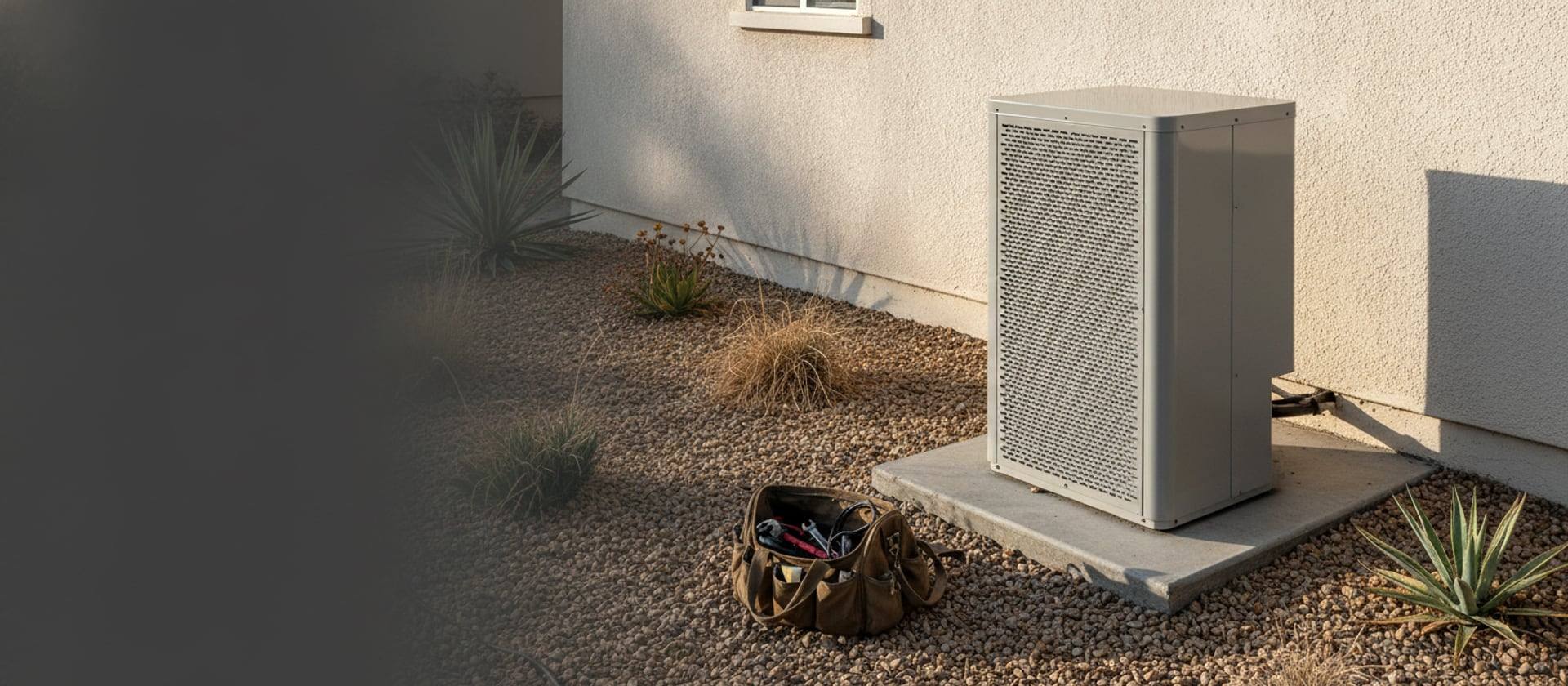
Daikin is the world’s largest HVAC manufacturer and the company that brought inverter-driven variable capacity to mass-market residential equipment. That heritage means a Daikin repair is rarely a generic split-system repair — the diagnosis depends heavily on whether you have a conventional condenser or an inverter platform. This page is the Daikin-specific companion to our general AC repair service and our Daikin brand overview. For ductless systems, see our Daikin mini-split repair page.
Conventional ducted Daikin failures
On a conventional single- or two-stage ducted Daikin, the cooling-side failures are the familiar ones, and they carry our standard flat-rate pricing:
- Run-capacitor failure — condenser hums, fan will not start. $185–$295. Shut the breaker if it is humming.
- Contactor pitting from years of cycling under 100°F-plus inland load. $165–$285.
- Condenser fan motor wear, often a grinding bearing first. $485–$795.
- TXV failure — poor cooling with otherwise normal pressures. $585–$895, warranty-covered if registered.
The no-power version of a no-start is in our AC not turning on guide, and the capacitor deep-dive is in AC capacitor failure.
Inverter Daikin Fit and One+ failures
The inverter platforms are where Daikin is different — and where the repair is board-and-code driven, not part-swap driven:
- U4 communication faults between indoor and outdoor units — almost always a wiring or terminal-block issue, occasionally a board needing re-pairing.
- Inverter PCB failures — the drive board that runs the variable-speed compressor. Warranty-covered on registered units; we quote per unit after diagnosis rather than flat-rate.
- F3 discharge-temperature trips — usually low refrigerant or restricted piping rather than a board.
- E5 compressor overload — a protection trip we trace to refrigerant charge or airflow.
Because inverter units do not use a conventional run capacitor, a Daikin Fit no-start is never “just a capacitor.” We read the code on the controller, confirm on the meter, and quote the actual board or component. The full code reference is on our Daikin error codes page.
Why Daikin fails when it does in SoCal
On conventional units the microclimate sets the clock: coastal salt air (Santa Monica, Manhattan Beach, Malibu) corrodes condenser electricals and capacitors fail at year 5–8, while inland heat-cycling (Pasadena, Burbank, the Inland Empire, the Conejo Valley) pushes them to year 8–12. On the inverter platforms, coastal corrosion attacks the PCB and outdoor electronics, so a beach-adjacent Daikin Fit benefits from coastal-rated equipment and annual electronics cleaning. A unit that runs but blows warm is a different problem — dirty coil, low charge, weak compressor, or a frozen coil — covered on our Daikin AC not cooling page and in AC running but not cooling.
Daikin AC repair pricing (conventional units)
Flat-rate, parts and labor, from our SoCal service tickets. Diagnostic is $89 ($149 after-hours), credited to the repair. Inverter-specific boards and electronic expansion valves are quoted per unit after diagnosis:
| Daikin AC repair | Typical cost |
| Diagnostic (waived with repair) | $89 / $149 after-hours |
| Dual-run capacitor (conventional units) | $185–$295 |
| Single-run capacitor (conventional units) | $145–$245 |
| Contactor | $165–$285 |
| Condenser fan motor | $485–$795 |
| TXV | $585–$895 |
| Compressor (out of warranty — we quote replacement) | $2,400–$4,200 |
| Inverter PCB / EXV (Daikin Fit, One+, mini-split) | quoted per unit after diagnosis |
Daikin’s standard warranty carries a 12-year compressor and 12-year parts term when registered within 60 days — labor is separate. We confirm coverage before ordering. Capacitor detail (and the inverter caveat) is on our Daikin capacitor replacement page.
Repair or replace your Daikin AC
A capacitor, contactor, or fan motor on a conventional Daikin is always worth fixing. The judgment call is an inverter PCB or compressor failure on an older Daikin Fit or mini-split — those repairs run higher, but Daikin’s 12-year compressor warranty (if registered) and the premium-tier longevity of the equipment usually justify keeping a well-maintained unit. We look up registration, quote the real number, and model it against a written replacement quote so you decide on figures.
Daikin and Goodman
Daikin acquired Goodman in 2012 and builds U.S. equipment at the Daikin Texas Technology Park, but the two are distinct brands — Daikin positions as premium inverter, Goodman as value-tier. For the ductless side of Daikin, see Daikin mini-split repair; the full lineup is on our Daikin brand page.
Frequently asked questions
What are the most common Daikin AC failures you see in SoCal? +
It depends on whether the system is a conventional ducted unit or one of Daikin’s inverter platforms. On a conventional ducted Daikin, the usual suspects are the same as any split system: run capacitor, contactor, condenser fan motor, and TXV. On the inverter Daikin Fit and Daikin One+ systems, the failures shift to the inverter PCB, communication faults between indoor and outdoor units (the U4 code), and refrigerant-side protection trips (F3 discharge-temperature, E5 compressor overload). The capacitor and contactor failures are quick same-day fixes; the inverter-board and communication issues are board-level work where we diagnose with the controller code first. Most Daikin parts come through SoCal distributors, though some inverter boards are order-ahead.
My Daikin condenser hums but the fan will not start — is that a capacitor? +
On a conventional ducted Daikin, yes — that is the classic failed run capacitor, the part that gives the fan and compressor their starting torque. Shut the system off at the breaker so you do not cook the compressor, then call; it is a 20–30 minute fix. But here is the Daikin-specific catch: the inverter Daikin Fit and most Daikin mini-splits do not use a conventional run capacitor at all — the inverter drive board handles motor starting electronically. So on an inverter unit a no-start is a board or communication issue, not a capacitor. We confirm which platform you have before quoting. Detail on our Daikin capacitor replacement page.
How much does Daikin AC repair cost in Los Angeles? +
Diagnostic is a flat $89 ($149 after-hours), credited to the repair if you proceed. On a conventional ducted Daikin, common repairs from our tickets: dual-run capacitor $185–$295, single-run capacitor $145–$245, contactor $165–$285, condenser fan motor $485–$795, TXV $585–$895. A compressor replacement out of warranty runs $2,400–$4,200. Inverter-specific parts (inverter PCB, electronic expansion valves, communicating boards) are not flat-rate swaps — we quote those per unit after diagnosis rather than guessing a price. We tell you the part cost before any work.
My Daikin One+ shows a communication or U4 code — what is it? +
U4 is a communication failure between the indoor and outdoor units — the most common Daikin system code we see. The cause is almost always the wiring rather than a failed board: a damaged or nicked communication wire, a loose terminal-block connection, or occasionally a board that needs re-pairing. On a Daikin One+ the fault also surfaces on the Daikin One thermostat. We meter the communication line at both ends and re-terminate or replace the bad run before condemning any board. The full code reference is on our Daikin error codes page.
Does Daikin still make conventional (non-inverter) air conditioners? +
Yes — alongside the inverter Daikin Fit and One+, Daikin offers conventional single- and two-stage ducted condensers that use the same standard components as any split system: a run capacitor, a contactor, a PSC or ECM condenser fan motor, and a TXV. Those repair like a Carrier or Trane and carry our standard flat-rate pricing. The inverter platforms are where Daikin’s engineering lead shows, and where the repair approach is board-and-code driven instead of part-swap driven. We service both, and we tell you which one you have on the first visit.
Why do Daikin capacitors and parts fail faster in some parts of SoCal? +
On the conventional units, climate decides the timeline like any brand: coastal salt air (Santa Monica, Manhattan Beach, Malibu) corrodes condenser electricals and capacitors fail at year 5–8, while inland heat-cycling (Pasadena, Burbank, the Inland Empire, the Conejo Valley) pushes them to year 8–12. On the inverter platforms, coastal corrosion is still the enemy — salt attacks the PCB and the outdoor electronics — which is why we recommend coastal-rated Daikin equipment and annual coil-and-electronics cleaning for any beach-adjacent install.
Is my Daikin worth repairing or should I replace it? +
For a capacitor, contactor, or fan motor on a conventional Daikin, repair without hesitation. The harder call is an inverter PCB or compressor failure on an older mini-split or Daikin Fit: those repairs can run high, and Daikin’s 12-year compressor warranty (if registered) changes the math significantly. We look up registration, quote the real number, and model it against a written replacement quote — and because Daikin’s ductless and inverter equipment is premium-tier, a well-maintained unit is usually worth keeping well past the point where a budget system would be replaced.