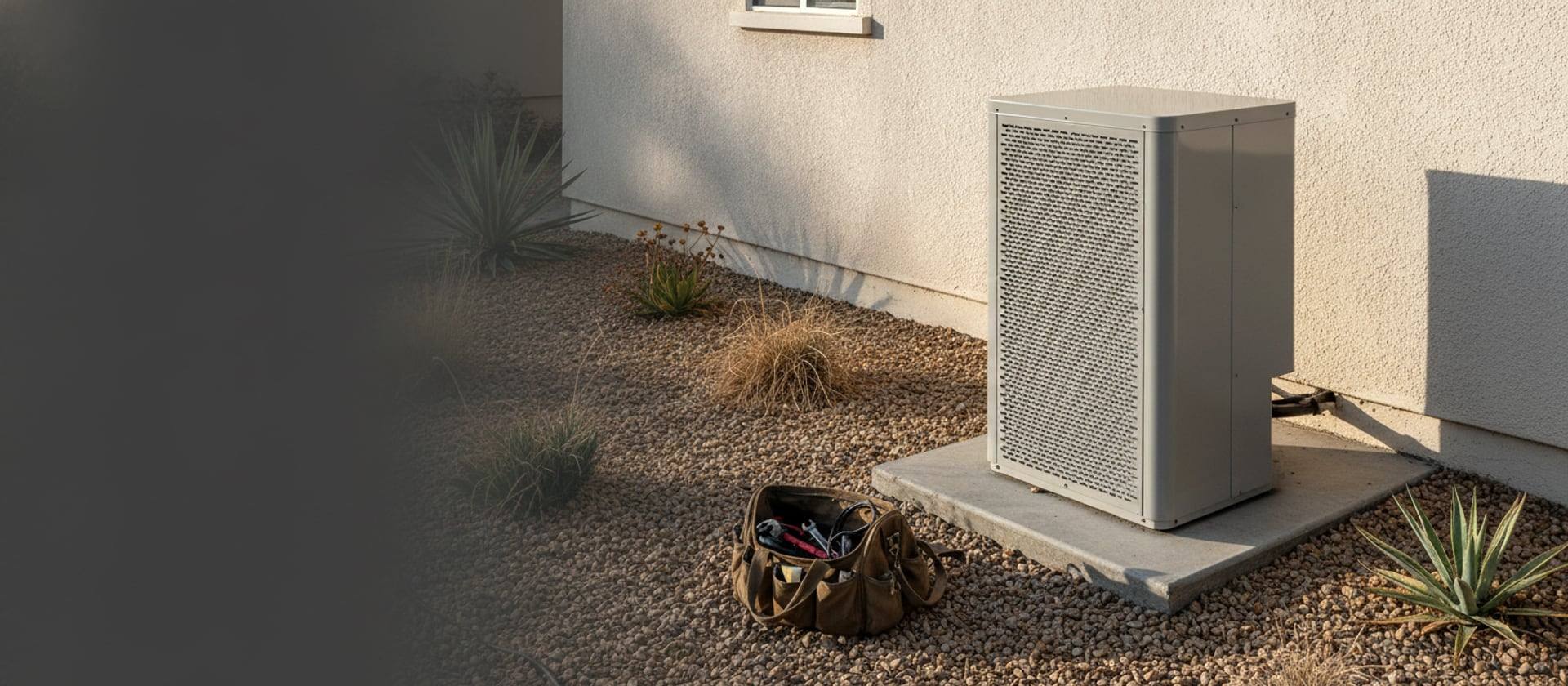
The run capacitor is the cheapest electrical part in a conventional condenser and the one most likely to strand you on a hot afternoon — but Daikin is unusual because so much of its lineup is inverter-driven and has no such part. This page is the Daikin-specific companion to our general AC repair service and our Daikin AC repair page, and it is honest about which Daikins this repair even applies to.
Conventional Daikin: the capacitor story
On a conventional single- or two-stage ducted Daikin, a single-phase motor cannot start itself from a dead stop — it needs a phase-shifted jolt to break free, and that is the capacitor’s job. Most use one dual-run capacitor serving both the compressor and the condenser fan motor; the two ratings stamped on it (for example 45/5 µF) are the compressor side and the fan side. When it weakens below its rated microfarads, the motor will not start and you get the classic hum-without-spin. Heat kills it: every 100°F-plus afternoon pushes it closer to its thermal limit, which is why they die mid-heat-wave.
Symptoms of a failed conventional Daikin capacitor
- Condenser hums, fan does not spin. The signature failure. Shut the breaker off so you do not cook the compressor.
- Slow or laboring fan startup, or a fan you can nudge into spinning (do not — the part still needs replacing).
- Outdoor unit silent while the thermostat clicks on and the indoor blower runs.
- Clicking contactor with no fan response — sometimes a capacitor, sometimes a pitted contactor, which is why we meter.
The no-power version is in our AC not turning on guide, and the capacitor deep-dive is in AC capacitor failure.
The inverter Daikin caveat — no run capacitor
This is the part most homeowners (and some contractors) get wrong. The inverter Daikin Fit, Daikin One+, and the entire Daikin mini-split lineup do not use a conventional run capacitor. The inverter drive board converts incoming power and starts the variable-speed compressor and fan electronically, so there is no field-replaceable run cap to swap. A hum-no-start or a no-cool on an inverter Daikin points at the inverter PCB, a communication fault (U4), or a protection trip (F3, E5) — which we read on the controller and quote per unit, not at a flat capacitor rate. There are high-voltage DC bus capacitors inside the inverter board, but those are not a homeowner-serviceable run-capacitor swap and hold a dangerous charge. If someone quotes you a flat “capacitor” on a Daikin Fit or mini-split, get a second opinion.
Daikin capacitor replacement pricing (conventional units only)
Flat-rate from our SoCal tickets, including the $89 diagnostic ($149 after-hours) credited to the repair:
| Daikin capacitor repair | Typical cost | Time |
| Diagnostic (waived with repair) | $89 / $149 after-hours | — |
| Dual-run capacitor (35–50 µF) | $185–$295 | 20–30 min |
| Single-run capacitor | $145–$245 | 20 min |
| Inverter board (Daikin Fit, One+, mini-split) | not a capacitor — quoted per unit |
These conventional-unit rates are the same ones on our Daikin AC repair and AC repair pages, and they match the residential capacitor figure in our AC capacitor failure guide. We quote the part before any work.
When a dead capacitor is hiding a bigger problem
On a conventional Daikin, a capacitor that fails at year 8–12 inland is normal wear — replace it and move on. A capacitor that fails at year 3 or 4, or again within a season, is usually a symptom of something else: a fan motor or compressor drawing high amps, a pitted contactor, or a dirty coil that never sheds heat. We measure amp draw and inspect the contactor on any early or repeat failure, because swapping the capacitor alone resets the same countdown.
Capacitor or board — replace vs. repair
A conventional capacitor is never a reason to replace a system — it is a $185–$295 fix. An inverter board on an older Daikin Fit or mini-split is a different conversation: the board runs higher, but Daikin’s 12-year compressor/parts warranty (if registered) often covers it on the part, so you pay labor only. We look up registration and model the repair against a written replacement quote. For ductless specifics, see Daikin mini-split repair; the full lineup is on our Daikin brand page.
Frequently asked questions
Does my Daikin even have a run capacitor? +
It depends on the model, and this is the most important thing to know before assuming a capacitor is the problem. Conventional single- and two-stage ducted Daikin condensers use a standard run capacitor like any split system. But the inverter Daikin Fit, Daikin One+, and the entire Daikin mini-split lineup do not use a conventional run capacitor at all — the inverter drive board handles compressor and fan starting electronically. So on an inverter Daikin, a no-start is a board, communication, or protection issue, never a capacitor swap. We confirm which platform you have on the first visit before quoting anything.
How do I know my conventional Daikin needs a new capacitor? +
On a conventional ducted Daikin, the classic sign is a condenser that hums but the fan will not spin. The run capacitor stores the charge that gives the fan motor and compressor their starting torque; when it weakens, the motor cannot break free and the unit just hums. Shut the system off at the breaker if you hear humming — running a stalled compressor cooks the windings in under an hour — and call. A meter reading against the rated microfarads confirms it in seconds. If your unit is an inverter Daikin Fit or mini-split, the same hum-no-start symptom points at the inverter board instead, not a capacitor.
How much does Daikin capacitor replacement cost? +
On a conventional ducted Daikin, from our SoCal service tickets, a dual-run capacitor runs $185–$295 installed and a single-run capacitor runs $145–$245, about a 20–30 minute job. That price includes the flat $89 diagnostic ($149 after-hours), credited to the repair. We carry the four most common sizes on every truck. On an inverter Daikin Fit or mini-split there is no equivalent capacitor swap — if the inverter board is the fault, that is quoted per unit after diagnosis, not at a flat capacitor rate. We will not sell you a capacitor a Daikin Fit does not have.
What size capacitor does my conventional Daikin take? +
It is printed on the side of the old capacitor and on the unit’s rating plate, in microfarads (µF) and volts. The four most common dual-run sizes we stock are 35/5, 40/5, 45/5, and 50/5 µF, rated at 370 or 440 volts. The two numbers on a dual-run are the compressor side and the fan side. Matching both the capacitance and the voltage rating matters — an undersized or wrong-voltage capacitor fails early or will not start the motor. We confirm the rating against the motor and compressor specs rather than trusting a sun-faded label. Again, this applies only to conventional units — inverter Daikins do not use this part.
Can I just replace the Daikin capacitor myself? +
On a conventional unit it is physically a small part, but a capacitor stores a live charge even with the power off and can deliver a serious shock if it is not discharged correctly, and a wrong-size or wrong-polarity install damages the motor it protects. There is also the why-it-failed question: a capacitor that died early often points at an overheating motor or a failing contactor. We discharge it safely, install the matched part, and check the contactor and amp draw. On an inverter Daikin, there is no DIY capacitor swap at all — opening an inverter outdoor unit exposes high-voltage DC bus capacitors that hold a dangerous charge and are not field-replaceable like a run capacitor.
My conventional Daikin capacitor keeps failing — what is really wrong? +
A capacitor that fails repeatedly is a symptom, not the disease. The usual culprits: a condenser fan motor or compressor pulling high amps as its bearings wear, which overheats and cooks the capacitor; a pitted contactor causing voltage chatter; or chronic overheating from a dirty condenser coil. We measure amp draw on the fan and compressor and inspect the contactor on any early or repeat failure, because swapping the capacitor alone just resets the same countdown. If the motor is the root cause, that is a separate condenser fan motor repair we quote.
Does this apply to Daikin mini-splits? +
No — and that is the key point. Daikin mini-splits are inverter-driven and do not use a conventional run capacitor. A mini-split that hums and will not start, or trips on a code, is a board, communication, or protection issue, not a capacitor. The most common mini-split no-cool call is actually a clogged condensate drain. Full ductless detail is on our Daikin mini-split repair page. We service single-zone, multi-zone, and VRV/VRF systems.