
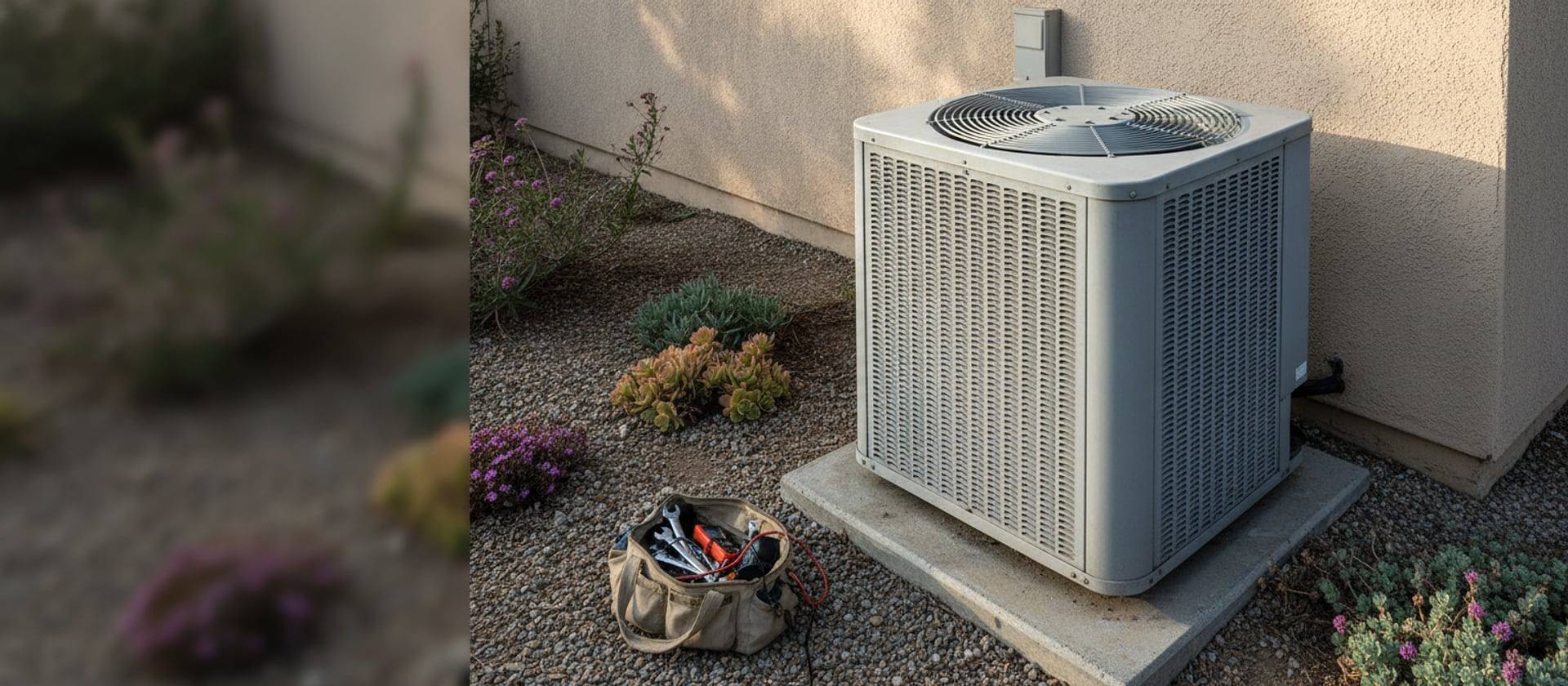
If there is one repair that defines a SoCal cooling season, it is the run capacitor — the cheapest electrical part in the condenser and the one most likely to strand you on the hottest afternoon of the year. This page is the Lennox-specific companion to our general AC repair service and our Lennox AC repair page.
What the capacitor does and how it fails
A single-phase motor cannot start itself from a dead stop — it needs a phase-shifted jolt to break free and spin up. That is the capacitor’s job. Most single-stage and two-stage Lennox split systems use one dual-run capacitor that serves both the compressor and the condenser fan motor; the two ratings stamped on it (for example 45/5 µF) are the compressor side and the fan side. When the capacitor weakens below its rated microfarads, the motor it serves cannot start, and you get the classic hum-without-spin. Heat is what kills it: every 100°F-plus afternoon pushes the capacitor closer to its thermal limit, which is why they so often die mid-heat-wave.
Symptoms of a failed Lennox capacitor
- Condenser hums, fan does not spin. The signature failure. Shut the breaker off so you do not cook the compressor.
- Slow or laboring fan startup, or a fan you can nudge into spinning (do not do this — it confirms the diagnosis but the part still needs replacing).
- Outdoor unit silent while the thermostat clicks the system on and the indoor blower runs.
- Clicking contactor with no fan response — sometimes a capacitor, sometimes a pitted contactor, which is why we meter rather than guess.
The no-power version of this is walked through in our AC not turning on guide, and the full capacitor deep-dive lives in AC capacitor failure.
Lennox capacitor sizes we stock
We carry the four most common dual-run sizes on every truck — 35/5, 40/5, 45/5, and 50/5 µF, in both 370V and 440V ratings — which covers the overwhelming majority of single-stage and two-stage Lennox condensers in SoCal. Matching both the capacitance and the voltage rating matters: an undersized or wrong-voltage capacitor either fails to start the motor or burns out early. We confirm the rating against the motor and compressor specs rather than trusting a sun-faded label.
Lennox capacitor replacement pricing
Flat-rate from our SoCal service tickets, including the $89 diagnostic ($149 after-hours) credited to the repair:
| Lennox capacitor repair | Typical cost | Time |
|---|---|---|
| Diagnostic (waived with repair) | $89 / $149 after-hours | — |
| Dual-run capacitor (35–50 µF) | $185–$295 | 20–30 min |
| Single-run capacitor | $145–$245 | 20 min |
These are the same flat rates published on our Lennox AC repair and AC repair pages, and they match the residential capacitor figure in our AC capacitor failure guide. We quote the part before any work, and we do not mark up an emergency just because it is 104°F in Woodland Hills.
When a dead capacitor is hiding a bigger problem
Here is the honest part most companies skip. A capacitor that fails at year 8–12 in inland SoCal is normal wear — replace it and move on. A capacitor that fails at year 3 or 4, or one that fails again within a season of being replaced, is usually a symptom of something else: a condenser fan motor or compressor drawing high amps as its bearings wear and overheating the capacitor, a pitted contactor causing voltage chatter, or a dirty condenser coil that never sheds heat. We measure amp draw on the fan and compressor and inspect the contactor on any early or repeat failure, because swapping the capacitor alone just resets the same countdown.
A note on Signature variable-capacity units
The standard dual-run capacitor story applies to single-stage Merit and most Elite condensers. The Signature variable-capacity units (SL28XCV, XC25) run an inverter-driven compressor with a different control architecture, so a no-start on those is more often a control-board or inverter fault than a simple capacitor, and the parts are Lennox-specific. We meter the system to confirm which it is before quoting — on a variable-capacity unit we never assume it is just a capacitor and quote blind.
Capacitor replacement vs. system replacement
A capacitor is almost never a reason to replace a system — it is a $185–$295 fix on a part that costs a fraction of that. The exception is the older unit where the capacitor is the third repair in two years on a 14-plus-year R-22 condenser: at that point you are spending money to keep a degraded, end-of-life system limping, and R-22 alone runs $150–$300 a pound. We will replace the capacitor and tell you the unit has years left, or show you the five-year math against a new system if it does not. For a Lennox that runs but blows warm, see our Lennox AC not cooling page, and the full lineup on our Lennox brand page.