
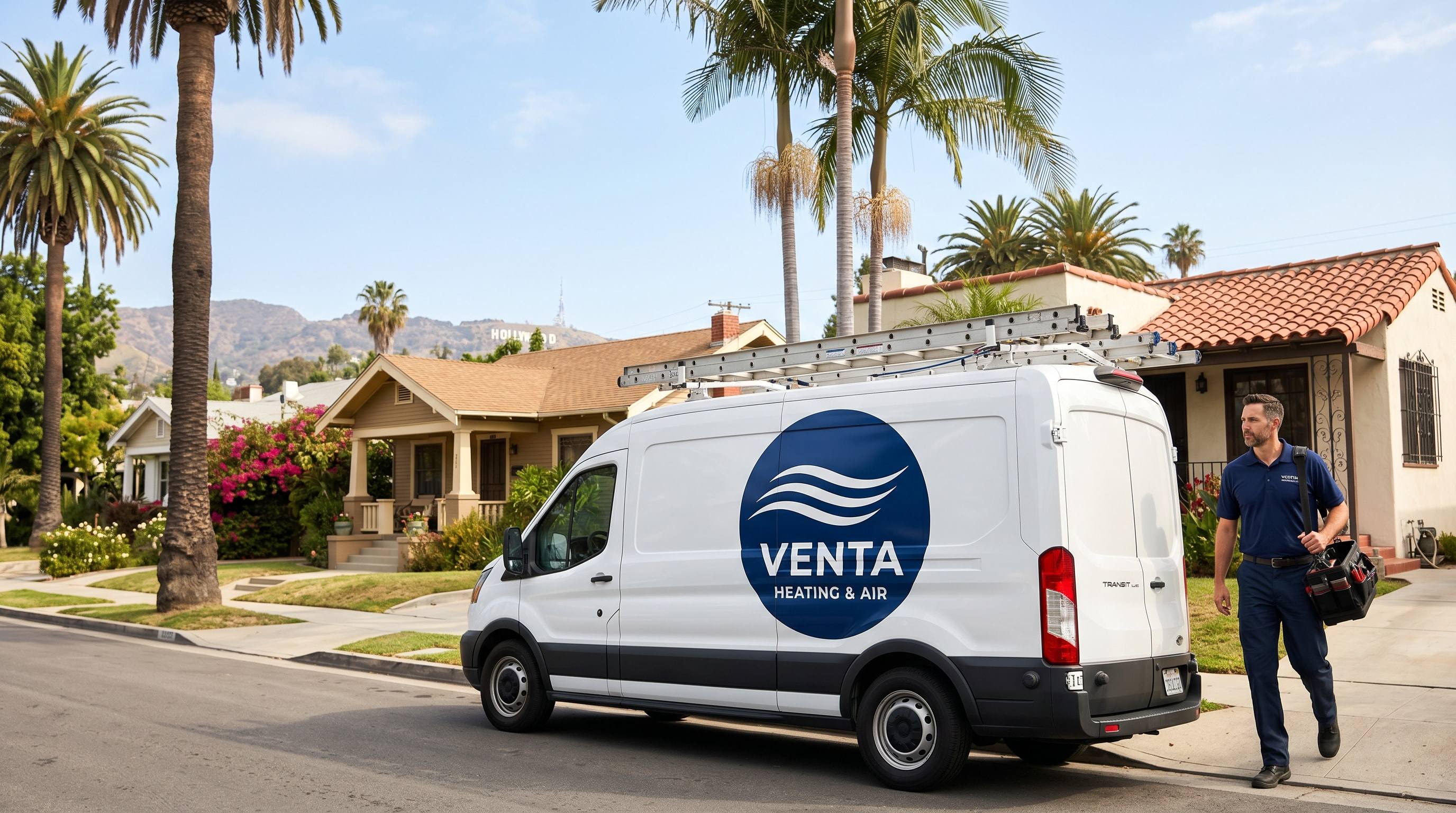
A 3-bedroom 1962 beach cottage off Vista del Mar called us last spring on a 10-year-old Goodman GSX130421 3-ton AC. The owner described a gradual cooling decline over two summers — the system was still running, still kicking on when the thermostat called, but the back bedrooms ran 4°F warm by mid-afternoon. We pulled the side panel on the condenser and the outdoor coil told the whole story: visible corrosion across the lower third of the fin pack, aluminum that was already flaking when you touched it, and a contactor whose terminals had a dusting of green oxide. Ten years on a standard-tier coil within a few hundred yards of the open beach with LAX wind hitting it daily. The unit hadn’t failed yet. It was about to.
Replacement at this age given the location-driven equipment stress: Carrier Infinity 25VNA8 3-ton with corrosion-resistant coil, $13,800 installed. SCE territory, no LADWP rebates available here. TECH Clean California waitlisted as of November 14, 2025. Federal IRA 25C terminated December 31, 2025. The customer asked about the standard-tier alternative we’d quote in a non-coastal city — we told them honestly: $4,000 cheaper today, half the service life on this lot, and the same conversation again in seven years. They went with the variable-speed.
Playa del Rey shares Venice’s salt-air challenges — with extra wind
Playa del Rey shares Venice’s salt-air challenges with added wind stress from open beach exposure and LAX runway-end turbulence. Standard-tier galvanic-coil outdoor units typically last 5–7 years here. We recommend variable-speed equipment — Trane XV20i, Carrier Infinity 25VNA8 — for both corrosion resistance and quieter operation given LAX adjacency. The 15-dB drop from variable-speed equipment matters more for residents already living under approach paths to runways 24L and 24R.
The three things that make HVAC different in PDR
Most of what we do in Playa del Rey is shaped by three things that don’t apply two miles inland:
- Salt + wind compounding. Salt-laden marine air alone is rough on coils; salt with afternoon wind loading drives the salt deeper into the fin pack and accelerates fan-bearing wear. Coated coils and quarterly fresh-water rinses are baseline maintenance, not optional.
- LAX noise sensitivity. Customers under flight paths have already accepted overhead noise they can’t control. Equipment they can control should be the quietest available — variable-speed compressors run at 55–62 dB outdoor versus 72–76 dB on standard single-stage units.
- 1950s–1970s beach cottages with original ductwork. The housing stock skews older here, and the original trunk lines were often sized small, insulated minimally, and routed through unconditioned attics where decades of heat have crisped the insulation. Duct retrofit is on the table for most installs in this housing stock.
Equipment we install here, and why
The default replacement quote for a Playa del Rey single-family home is variable-speed with a coastal-rated coil:
- Carrier Infinity 25VNA8 — modulating compressor, factory corrosion-resistant coil treatment, 24 SEER2. Our most-installed unit in the 90293/90296 ZIP area.
- Trane XV20i with spine-fin coil — spine-fin geometry has less surface area for salt to attack than traditional plate-fin, and Trane’s warranty support on coastal claims has been straightforward in our experience.
- Mitsubishi M-Series — for cottages without functional ductwork or where adding ducts isn’t structurally workable. 2-zone and 3-zone configurations dominate here.
What we don’t install in PDR is what most of these homes are getting replaced from: Goodman GSX130421 and similar standard-tier galvanic-coil units. That’s the typical 7-to-10-year-old condenser we pull out, not what we put back in this microclimate.
Pricing reality, 2026: variable-speed coastal-rated full system replacement runs $13,500–$17,500 depending on tonnage and indoor-side equipment. Ductless retrofit for a 3-bed cottage runs $9,000–$13,000 for a 2-zone or 3-zone Mitsubishi setup. Duct retrofit or replacement when older trunk lines fail (and on cottages this old, “fail” usually means “leak 35%+ at the supply boots”) runs $3,500–$8,500.
What you don’t need to install here
A few honest pushbacks against industry defaults:
- The cheapest replacement quote you’ll get in PDR is almost always the wrong long-term call. Standard-tier equipment will be back on a service ticket in five summers.
- You don’t need a new high-MERV filtration cabinet retrofit on a 1962 cottage unless someone in the household has a documented respiratory issue. The marketing pitch for whole-house IAQ retrofits is oversold for typical PDR homes.
- Heat pump conversions in PDR pencil differently than in Pasadena: SCE rates are higher, no LADWP rebate stack, mild winters mean the gas furnace you might be replacing isn’t actually running enough to dominate your bill. We quote heat pump or AC + furnace honestly based on the home, not on a one-size-fits-all electrification narrative.
What duct retrofit actually looks like in a 1962 cottage
The honest version: most 1950s–1970s PDR cottages have ductwork installed when central air was a luxury upgrade, not a baseline expectation. The original installer ran a galvanized trunk down the central hallway, branched off to four or five rooms with 6-inch flex, and called it a system. Sixty years later that flex is brittle, the boots are leaking 35–50% of the conditioned air into the attic, the trunk has separated at one or two joints, and the R-2 fiberglass insulation has compressed flat under accumulated dust. Static pressure measurements on these systems read 0.9–1.1 inches of water column — about double what a modern variable-speed AC is designed to push against.
What we actually do on a duct retrofit: pressure-test the existing system to quantify leakage (Title 24 requires a HERS test on full replacements anyway), pull the failed sections, replace flex with R-8 insulated runs, reseat boots with mastic instead of cloth tape, and verify static pressure ends up under 0.5 inches. The work takes one to two days depending on attic access. The performance difference on the back bedrooms in a typical Playa del Rey cottage is dramatic — rooms that previously ran 4–6°F warm than the thermostat setpoint pull within 1°F after the work.
Apartment buildings inland and small multi-family
Inland Playa del Rey along Manchester and Culver Boulevards has a stock of 8- to 24-unit apartment buildings, mostly 1960s–1980s construction. Most run packaged rooftop units or split systems with the condensers ground-mounted in side yards. Wind and salt exposure on the rooftop equipment is brutal — we’ve replaced 8-year-old packaged units on PDR rooftops that look like 18-year-old units in Encino. For multi-family owners, coastal-rated equipment plus a documented quarterly rinse on the maintenance schedule is the only configuration that delivers reasonable life expectancy. We work with several PDR property managers on standing-order maintenance contracts that cover the rinse, fan-bearing inspection, and contactor replacement on a fixed schedule.
Permits, Title 24, and SCE service capacity
Playa del Rey falls under City of Los Angeles building jurisdiction (LADBS), and HVAC change-outs require a mechanical permit plus Title 24 / HERS verification on full replacements. We pull permits in your name and schedule the third-party HERS rater. One thing that catches PDR homeowners: SCE service drops to older 1960s cottages are sometimes 100-amp service with a panel that’s already fully populated. A heat pump conversion or a high-capacity variable-speed AC can require a panel upgrade before the new equipment can land its breaker, and SCE service-load review can add 4–8 weeks to a project timeline. We run that review at the quote stage so the timeline is honest from day one.
Service area and dispatch
All of Playa del Rey — both 90293 and 90296 ZIPs, from the Ballona wetlands south to Vista del Mar, east to the Westchester border at Pershing Drive. West LA dispatch arrives in 30–45 minutes during business hours. We routinely cover adjacent Marina del Rey, Venice, and Westchester on the same routing.
Same-day technician dispatch is typical. Full-system replacements, duct retrofits, and ductless retrofits are scheduled by appointment with a free in-home estimate. Wider LA County coverage.
Call (424) 766-1020 or email weho@ventahvac.com. CSLB #1138898 (C-20).