
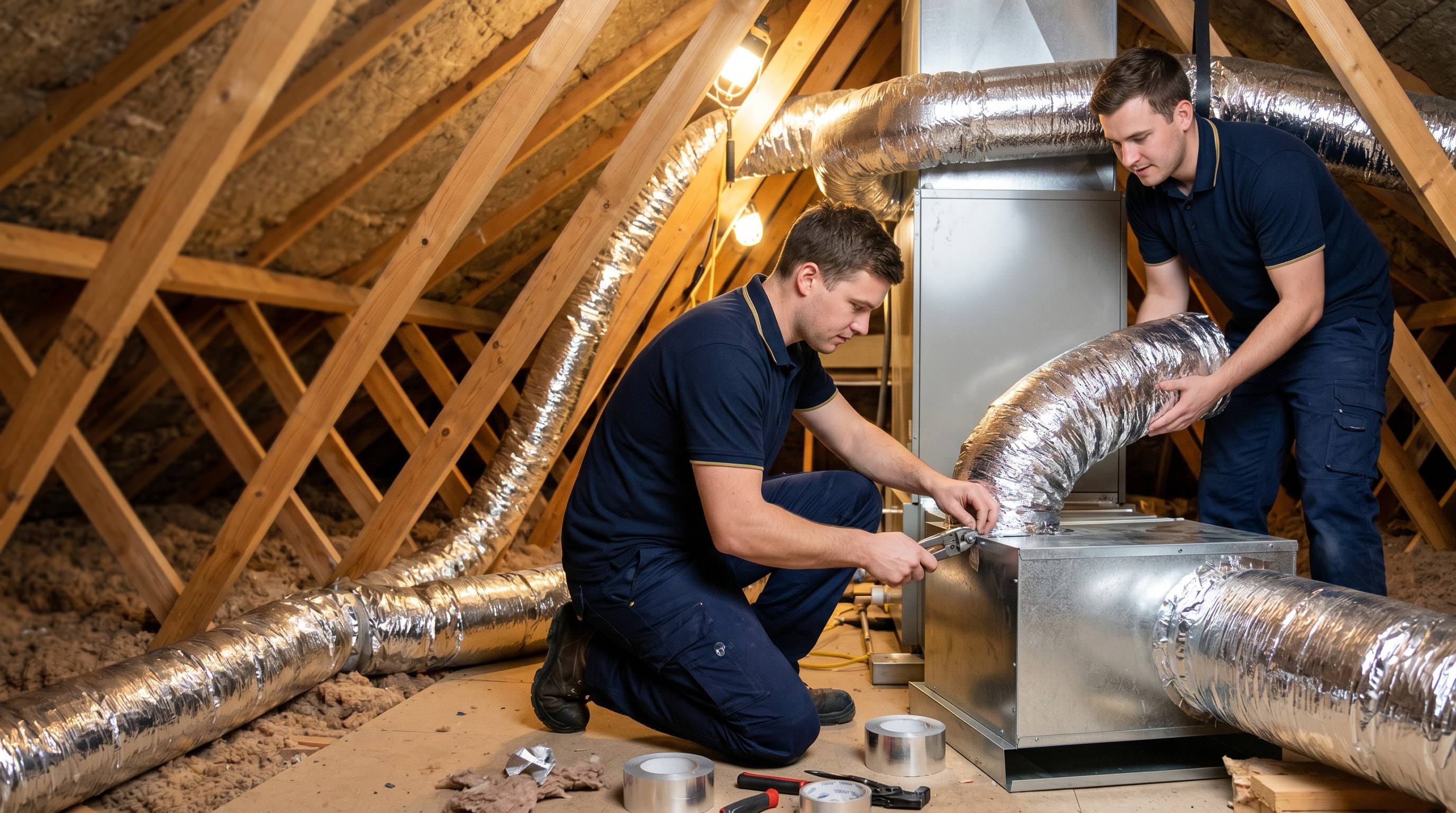
When new duct installation is needed
Not every airflow problem needs new ductwork. Most don’t. But there are five scenarios where replacement is the right call instead of patching:
- Major addition — a new room, ADU conversion, garage conversion, or second-story build. The existing trunk usually can’t absorb the new load, and a tap-in without resizing starves the original rooms.
- Complete ductwork replacement on aging systems — 30+ year old galvanized with asbestos cloth liner (common in 1950s–1970s LA tract homes), deteriorated original flex duct that has hardened and cracked, or rodent-damaged runs that read as Swiss cheese on a smoke test.
- HVAC system change requiring different airflow — going from a single-stage 13 SEER condenser to a communicating variable-speed system changes the static-pressure budget and the CFM-per-ton target. The old ducts often choke the new equipment.
- Failed pressure testing where Aeroseal isn’t viable — collapsed flex, asbestos-containing duct that must be abated rather than sealed, or insulation so far below current Title 24 minimums that sealing alone won’t pass HERS.
- Mini-split alternative doesn’t fit — sometimes a homeowner wants ducted comfort (whole-house thermostat, hidden equipment) and ductless is wrong for the architecture. New duct is the answer.
Duct material options
Four real-world choices for residential. Each has a place; the trick is matching the material to the access, budget, and lifespan you want.
Sheet metal (galvanized steel) — $$$. Premium choice. 30+ year lifespan, easier to seal long-term because joints are mechanical (locked, then mastic-sealed) rather than zip-tied. Wrapped externally with R-6 or R-8 insulation. Best for the main trunk on a forever-home, exposed industrial-look basements, and any spot where you want to forget about the ducts for three decades. Adds 30–50% over flex on a full system.
Insulated flex duct (R-6 / R-8) — $$. The standard for most LA residential branch runs. Inner liner, fiberglass insulation, vapor barrier jacket. Faster to install, bends around framing without sheet-metal elbows, R-value comes built in. Lifespan 15–25 years before the inner liner sags or the jacket tears. Sloppy installation kinks it and chokes airflow — that part is on the installer, not the material.
Rigid fiberglass ductboard — $. Older technology, fading out. Cheap, self-insulating, but the internal surface can shed fibers as it ages, the joints are harder to seal long-term, and modern Title 24 prefers exterior-insulated systems. We rarely install new ductboard unless a homeowner specifically requests it and we’ve walked through the tradeoffs.
Spiral pipe — $$$. Exposed-mount round metal duct, often left visible with painted finish. Growing in popularity in modern LA homes, lofts, and renovated industrial spaces in Glendale and the Arts District. Same lifespan as sheet metal, premium pricing. Insulation goes on the outside or it stays uninsulated in conditioned space.
Our default recommendation for most LA homes: sheet-metal trunk + R-8 flex branches. You get sheet-metal durability where the duct lives longest (the trunk, fewer movements) and flex-duct flexibility where the runs have to thread around framing.
Design considerations — Manual J + Manual D
The reason we keep getting called to fix “the back bedroom is always hot” on systems other contractors installed last year is simple: nobody did the math. Square-foot rule-of-thumb sizing is industry-standard sloppy. Real duct design uses two ACCA standards in sequence.
Manual J load calculation — square footage, insulation R-values, window glazing and orientation, infiltration, climate zone. Output: BTU/hour heating and cooling load per room. A south-facing bedroom in Northridge with three windows has a wildly different cooling load than the same footage on the north side.
Manual D duct design — takes the Manual J output and translates room-by-room BTU into CFM, then sizes each branch run to deliver that CFM at the right static pressure. Output: trunk diameter, every branch diameter, every register CFM, every return-air pathway.
Duct sizing per room — matched to heat gain and loss, not square footage. The west-facing master in Glendale at 4 PM in July might need 240 CFM; the north-side guest room only 120 CFM.
Return air sizing — the part most contractors get wrong. Returns should size to 50–100% of the total supply CFM. Undersized returns choke the blower, raise static pressure, drop capacity, and burn ECM motors. Many LA homes have one 14″×25″ central return doing the job of two.
Static pressure budget — 0.5″ w.c. or less. Anything higher and variable-speed equipment derates itself to protect itself. We measure at commissioning on every install and the reading goes on the invoice.
LA-specific install challenges
Four scenarios that come up constantly in our service area. Each one changes the labor budget meaningfully.
Crawlspace ductwork (pre-1965 homes). Cramped access, often 24″ or less of headroom, snake and rat damage on original flex, and original galvanized that’s usually been replaced piecemeal over 60 years. Expect 30–50% more labor than the same square footage in an open attic. Any pre-1980 joint mastic gets a sample sent to a lab for asbestos before we touch it.
Attic ductwork (most LA tract homes). Standard install in San Fernando Valley, Pasadena, and most post-1950 LA County tract construction. Easier access than crawlspaces — but the attic runs 130°F+ on summer afternoons. R-6 is the legal minimum; R-8 is what we install on every retrofit because the math on conditioned-air loss through R-6 in a 130°F attic is brutal.
Slab homes with no crawlspace (San Fernando Valley tract). A lot of 1960s–1970s SFV builds went slab-on-grade with attic-only mechanical. No floor chase available, so new duct threads through the attic and drops through soffits or new framed chases. Each new chase is 1–2 days of carpentry plus drywall finish work, $885–$2,485 per chase before HVAC labor.
Spanish Colonial / Craftsman (Pasadena, Hancock Park, Beverly Hills). Beautiful old houses, terrible attic access. Tile roofs make new attic vents impractical without removing and resetting the field. We sometimes recommend mini-split instead — a 3-zone ductless system in a 1925 Craftsman often beats forcing flex duct through ceiling soffits that ruin the original plaster lines.
Pricing
Real numbers from our service tickets across all five counties. Parts, labor, and standard sealing included; permit and HERS are listed separately because they vary by city.
| Project | Typical cost | Time |
|---|---|---|
| Single room duct extension (existing system) | $885–$1,485 | 4–6 hr |
| Multi-room addition (3–4 rooms, 1,200 sq ft) | $4,500–$8,500 | 2–3 days |
| Full ductwork replacement, 1,800 sq ft home, attic | $6,500–$12,500 | 3–4 days |
| Full ductwork replacement, 2,500 sq ft home, crawlspace | $8,500–$16,500 | 4–5 days |
| Sheet metal premium upgrade over flex duct base | +30–50% | — |
| New chase construction (slab home) | $885–$2,485 per chase | 1–2 days |
| Return air drop addition | $485–$885 | 4–6 hr |
| Supply register + boot upgrade (each) | $145–$285 | 30–60 min |
| Insulation wrap upgrade (R-6 → R-8) | +$485–$885 | +0.5 day |
| Title 24 / HERS test (required on new ductwork) | $185–$285 | 60–90 min |
| LADBS / city permit | $185–$485 | — |
| Manual J / Manual D engineering | $385–$685 | — |
Honest take on the cost-vs-mini-split decision: if you’re considering ductless mini-split as an alternative to ductwork replacement, run that math. On a 1,400 sq ft home, full ductwork replacement is $7,500–$12,000 + AC equipment. A 3-zone mini-split is $14,000–$18,000 but eliminates ductwork forever — no future leakage, no future Aeroseal, no future cleaning. Sometimes the apparent expensive option pencils better over 15 years. We’ll show you both numbers at the estimate and let you decide.
Code compliance (Title 24, 2026 California Energy Code)
California Energy Code requirements that apply to every residential duct install we do:
- R-6 minimum insulation on all new residential ducts in unconditioned spaces. We install R-8 by default because the cost delta is small and the performance gain in 130°F attics is large.
- HERS test required for all new duct systems — the system must measure 6% or less total leakage at 25 Pa to pass. Test is performed by a third-party HERS rater, not us, which keeps it honest. We coordinate the scheduling.
- Mastic or UL-181 listed sealant only on all joints. No duct tape, no cloth tape, no gray hardware-store sealant. Fabric duct tape is explicitly banned for permanent sealing under Title 24.
- Permit + plan check required for substantial replacement in most California jurisdictions. LADBS, Pasadena Building, Glendale, Burbank, Long Beach, and most OC cities all require it. We pull every permit and schedule every inspection.
Background on the testing regime and what HERS raters actually measure: California HERS testing guide and Title 24 HVAC compliance overview.
A real project — 1958 Northridge ranch
Composite example from a job we ran last summer. 1958 ranch tract home in Northridge, 1,650 sq ft, original galvanized ductwork in the attic with R-2 insulation (which was code in 1958 and is wildly inadequate now). Homeowner was replacing a 12-year-old single-stage Goodman with a 16 SEER2 variable-speed Carrier 24VNA6 and asked us to bid the install.
Pre-install HERS test on the existing ducts: 24% leakage. Way above the 6% Title 24 maximum. Three options on the table:
- Aeroseal the existing ducts — $3,500. Would likely drop leakage to 4–6% and pass HERS. But the R-2 insulation still violates current Title 24 minimum, so on a permitted job the system wouldn’t sign off without additional insulation work anyway.
- Full ductwork replacement + R-8 insulation — $9,800. Sheet-metal trunk, R-8 flex branches, new returns sized correctly, mastic-sealed throughout, HERS-tested at 4.2% leakage post-install.
- Recommended: full replacement. The new variable-speed Carrier’s efficiency gains are wasted on R-2 attic ductwork — you’d be paying for 16 SEER2 and running at maybe 12 SEER2 effective. Total combined project (AC + ducts): $24,500. With the homeowner’s LADWP $5,000 heat pump rebate (alternative-path quote we also priced), the math shifted significantly toward going heat-pump-electric instead of straight AC.
Final outcome: full duct replacement + the AC swap. The whole-house static pressure measured 0.42″ w.c. at commissioning. Even temperature distribution room-to-room. The back bedroom that the homeowner had complained about for years was within 1°F of the thermostat reading.
Related services
Sometimes new ductwork isn’t the right answer — or it’s only part of the answer. The closest neighbors to this work:
- Aeroseal duct sealing — sealant injection on intact-but-leaky ducts; often the right call before considering replacement.
- Duct repair — physical repair on localized damage, collapsed sections, animal damage.
- Duct cleaning — when contamination is the issue, not airflow.
- Ductless mini-split — the alternative-to-ducts conversation, especially in tile-roof Spanish or Craftsman homes.
- AC installation — usually scoped together when ducts and equipment are both being replaced.
Service area & response times
Duct installation across all five Southern California counties. Each region runs from its own dispatch line so calls don’t bounce:
| Region | Response time | Phone |
|---|---|---|
| West LA, Westside | 60–120 min | (424) 766-1020 |
| Pasadena, San Gabriel Valley | 60–120 min | (626) 499-5530 |
| Thousand Oaks, Ventura County | 90–150 min | (805) 977-9940 |
| Irvine, Orange County | 60–120 min | (949) 785-5535 |
| San Bernardino, mountains | 90–180 min | (909) 757-6455 |
| Riverside, Inland Empire | 90–180 min | (951) 744-9188 |
Response times above are for in-home estimate visits, not install start. Most projects start 2–3 weeks after the signed estimate, primarily because city permit processing runs 5–15 business days depending on jurisdiction.
Schedule a duct installation estimate
Free in-home estimate with Manual J + Manual D scope on every quote. CSLB License C-20 #1138898. Licensed, bonded, insured. Permit pulled under our license, HERS rater coordinated, inspection handled. Call your regional dispatch number above or use our free estimate form.