
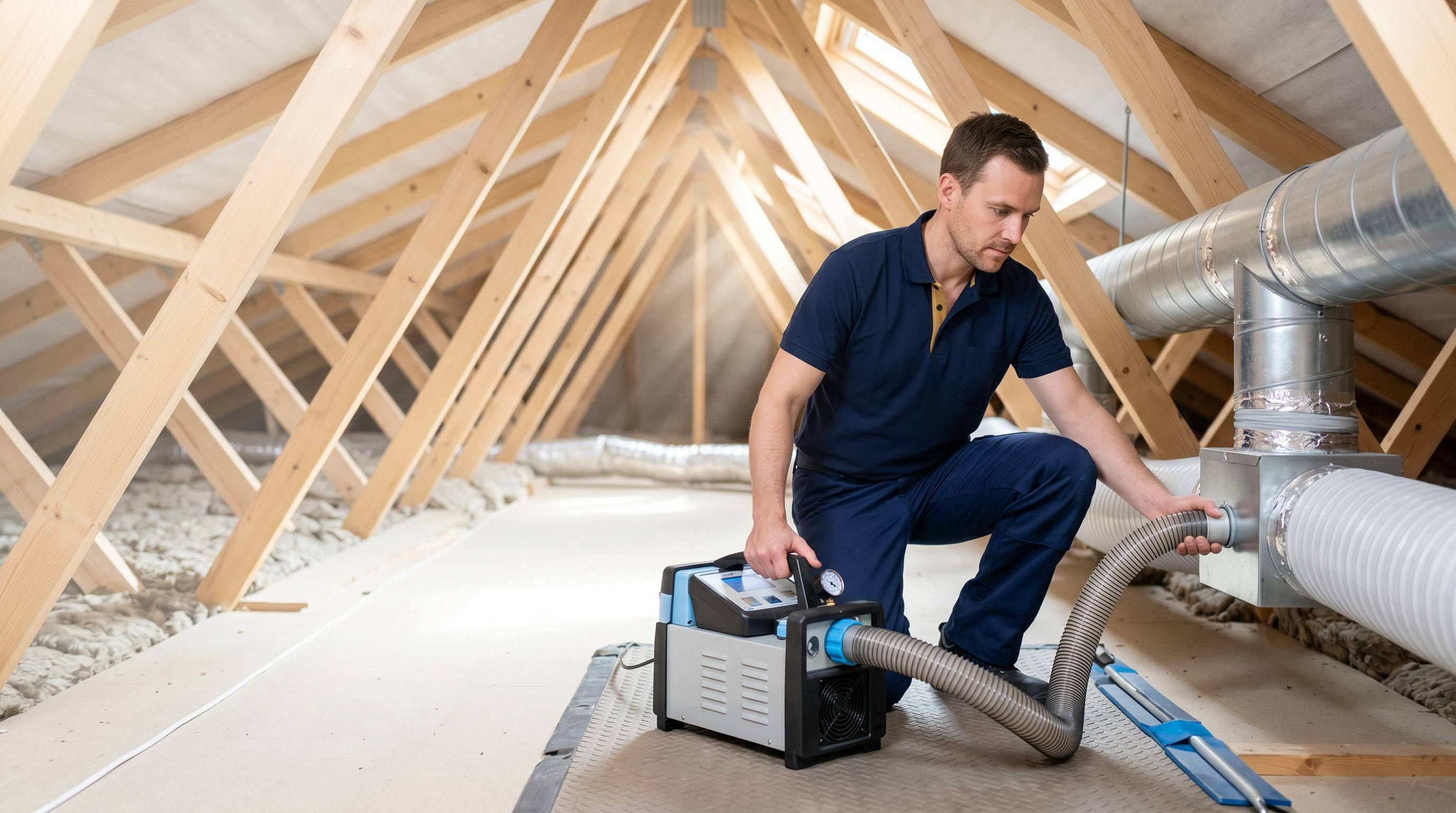
What Aeroseal actually does
Aeroseal is a patented duct-sealing technology invented at Lawrence Berkeley National Laboratory (LBNL) in 1994 by Mark Modera and team, originally developed under U.S. Department of Energy funding. The process injects a polymer aerosol — vinyl acetate polymer particles suspended in a fine mist — into your pressurized duct system. The particles are too small to deposit on the inside walls of the ducts, but at any point where air is escaping through a leak, the airflow concentrates them at the leak edge. They adhere to the edge, build up layer by layer, and close the gap from inside.
The sealant is UL 181 listed (the same standard that governs duct tape and mastic for HVAC systems) and meets the California Building Standards Code material requirements. It cures in 30–60 minutes at room temperature into a hard, flexible plug. The manufacturer warranties the sealant for 10 years against re-leakage at sealed points, and LBNL durability testing has documented stable seals on installations going back to the late 1990s.
Performance data from LBNL and the California Energy Commission has been consistent across more than two decades of residential studies: Aeroseal reduces duct leakage by 60–90% on typical residential systems. ASHRAE’s baseline assumption for unsealed residential ductwork is 20–30% air loss. When you cut that by 60–90%, the HVAC system can finally deliver the conditioned air it’s producing, and homeowner energy savings of $300–$1,000/year are typical post-seal. The CEC has documented HVAC energy reductions of up to 30% on the worst-leaking systems after sealing.
Why duct sealing matters in LA specifically
Three things make LA an unusually high-leverage market for Aeroseal.
Old housing stock with inaccessible ducts. Pre-1980 homes in Beverly Hills, Hancock Park, Pasadena, Larchmont, Windsor Square, and the historic neighborhoods of West Adams routinely test at 30–40% duct leakage on the first measurement. The ductwork is original or near-original, the metal seams have been moving for 60–90 years through earthquakes and thermal cycling, and the runs are routed through wall cavities and finished ceilings where you can’t reach them with mastic. Aeroseal is the only practical option short of opening up walls.
Attic-mounted ducts in 130°F+ summer attics. The standard SoCal install puts the air handler and supply trunk in the attic. Attic temperatures in the LA basin and Inland Empire regularly hit 130–145°F during summer afternoons. Every cubic foot of cool air that leaks out of a supply duct in that attic was paid for at the meter and is now heating the attic instead of the bedroom. Sealing typical attic leakage saves 25–30% on cooling costs — documented repeatedly by LBNL, SCE, and LADWP rebate program data.
Title 24 (2025 California Energy Code, effective for permits filed January 1, 2026). The code requires HERS duct leakage testing on most AC and heat-pump change-outs. If your contractor pulls a permit for an AC install in 2026 and the HERS rater fails the duct test, you can’t close out the permit until the ducts are brought into compliance. Aeroseal is the standard remedy that HERS providers recognize, and we coordinate the retest. Permit and code background: HVAC permits in Los Angeles.
Aeroseal vs manual mastic vs full replacement — which fits
Aeroseal isn’t always the right answer. Here’s how we decide on a real call:
Aeroseal wins when:
- Ductwork is concealed inside walls, floors, or ceilings (no physical access for mastic)
- Many small leaks across the system rather than a few big rips (5/8″ or smaller gaps)
- You failed a HERS duct leakage test and need to bring the system into Title 24 compliance
- You’ve already addressed obvious physical damage and the residual leakage rate is still high
- You want documented, certified before/after CFM25 numbers (for resale, refinance, or rebate paperwork)
Manual mastic wins when:
- Ductwork is exposed and physically accessible in an attic or crawlspace
- You have a small number of large, obvious gaps (anything over 5/8″)
- Budget is the constraint and you’re willing to leave concealed leaks in place
- A single boot or takeoff has separated and needs to be re-collared before sealing
Full replacement wins when:
- Ductwork is over 30 years old AND has asbestos liner or wrap (abatement plus replacement is the only safe path)
- Multiple sections have disconnected from the trunk and the system is barely delivering air
- Duct sizing is fundamentally wrong for the new equipment (you’re upgrading from 2-ton to 4-ton on undersized trunk)
- Flex duct insulation has degraded and the inner liner is shedding fiberglass into the airstream
If you’re not sure which category you’re in, we run a $385–$485 pre-seal diagnostic test first. The CFM25 number plus a quick attic inspection tells us whether Aeroseal is the right tool. If we recommend mastic or replacement instead, the diagnostic fee credits toward that work. Related: duct repair, duct installation & replacement, duct cleaning.
Specific situations Aeroseal solves
Three call types make up most of our Aeroseal volume.
1. Failed HERS test after a new AC install. Title 24 sets the pass threshold at 6% of nominal system airflow for new ductwork or 15% for altered ducts on an existing system. When the HERS rater shows up the day after install and the ducts measure 18–25%, the permit can’t close. Aeroseal brings most of these into compliance in a single visit. We’ve done this dozens of times across the basin — the typical flow is: install contractor finishes, HERS fails, homeowner calls us, we Aeroseal within 3–5 business days, retest passes, permit closes. Documentation: California HERS testing guide.
2. Hot or cold rooms that never reach setpoint. The most common version: a bedroom at the far end of a long supply run that sits 5–8°F warmer than the thermostat. The thermostat is in the hallway reading 72°F, the bedroom is at 79°F, and the air handler runs constantly because the system “feels” like it’s working. What’s actually happening is the long branch run is leaking 35–50% of its air into the attic before reaching the register. The bedroom is starving for airflow. Aeroseal closes those leaks; airflow rebalances; the bedroom hits setpoint with the rest of the house. We see this constantly on two-story homes where the master suite is over the garage or at the end of a long supply trunk.
3. High energy bills after a new AC install. Homeowner replaces a 14-year-old 13 SEER AC with a new 17 SEER2 unit, expects the bill to drop, and instead the bill stays flat or goes up. The new system is more efficient, but the ductwork is still leaking 25–35%, so 30–50% of the efficiency gains are evaporating into the attic. This is the most common “why doesn’t my new AC save money?” call we get. The answer is almost always ductwork. The new equipment is fine. Seal the ducts and the savings show up the next billing cycle. Related: AC installation, AC replacement.
The Aeroseal process step by step
What actually happens on the day of the job:
- System shutdown and prep. We turn off the HVAC system, cover every supply register and return grille with masking material, and seal off the air handler from the rest of the system. The goal is to make the duct system a closed pressurized loop that only leaks through actual defects.
- Pre-seal leakage test. We connect a calibrated fan and a manometer to the system and measure CFM25 — cubic feet per minute of airflow at 25 Pascals of pressure. This is the industry-standard leakage measurement. Numbers we typically see: 200–400 CFM on a leaky pre-1980 home, 80–180 CFM on a moderately tight 1990s build, under 60 CFM on a well-sealed modern system. Takes 30–45 minutes.
- Hand-patch large holes. The aerosol seals gaps up to 5/8 inch. Anything bigger — a torn flex-duct sleeve, a disconnected boot, a missing takeoff collar — gets hand-patched with mastic and metal mesh before injection. We do this inspection during pre-test so there are no surprises.
- Aerosol injection. We connect the Aeroseal machine to a single point on the duct system (usually at the air handler), heat the sealant to misting temperature, and pressurize the system. The aerosol travels through the entire duct network. A computer monitors pressure decay in real time and shows live leakage reduction on a graph — we watch the CFM25 number drop from 300 to 60 over 1–3 hours.
- Cure time. Sealant cures for 30–60 minutes at room temperature. We use this window to clean up the workspace and stage the post-seal test gear.
- Post-seal verification test. Same CFM25 measurement as pre-seal, same fan, same conditions. The before/after numbers go into the printed certificate. Takes about 30 minutes.
- Certificate generation. The Aeroseal machine prints a certified report showing pre-seal CFM25, post-seal CFM25, percentage reduction, and the date. This is the document HERS raters and rebate programs ask for.
- Tightness certification sticker. A permanent sticker goes on the air handler cabinet with the post-seal numbers. Future HVAC contractors, HERS raters, home inspectors, and appraisers can read it and know the ducts have been certified.
Pricing
Honest 2026 LA-market pricing, parts and labor included. Pre-seal diagnostic credits toward sealing if you proceed.
| Service | Typical cost | Time |
|---|---|---|
| Pre-seal diagnostic only (leakage measurement, no seal) | $385–$485 | 60–90 min |
| Aeroseal single system standard (≤60K BTU cooling) | $2,500–$3,500 | 3–5 hr |
| Aeroseal single system premium (≤125K BTU heating) | $3,200–$4,500 | 4–6 hr |
| Aeroseal + Title 24 / HERS compliance documentation | +$485–$985 | +60 min |
| Aeroseal + pre-job duct cleaning combo | +$485–$885 | +1–2 hr |
| Multi-system home (2 systems) | $4,200–$6,800 | 5–8 hr |
| Multi-system home (3+ systems) | Quote individually | varies |
| Manual mastic sealing (accessible ductwork) | $485–$1,485 | 2–4 hr |
| Combination Aeroseal + mastic for large gaps | $3,200–$5,500 | 4–7 hr |
| Title 24 HERS retest (third-party rater, billed separately) | $185–$285 | Scheduled |
| Travel surcharge (outside core service area) | $0–$285 | — |
| Diagnostic visit | $89 (waived if proceeding) | 30–60 min |
Honest line on pricing: Aeroseal isn’t always the right answer. If your ducts are accessible in an attic and you’ve got 4–5 obvious large rips, mastic sealing for $700 makes more sense than Aeroseal for $3,500. If your ducts are sealed inside walls, ceilings, or floors — Aeroseal is the only practical option short of demo. We’ll tell you honestly which one fits your situation, and we’ll run a $385 diagnostic test first if you’re not sure. We’d rather lose the sealing job and keep the diagnostic relationship than sell you a $3,500 job you didn’t need.
A note on rebates: LADWP and SCE both have duct sealing rebates ($200–$500 typical, varies by year and program funding). Aeroseal qualifies when the before/after measurements meet program requirements — we provide the documentation. The federal Section 25C tax credit ended December 31, 2025 under the One Big Beautiful Bill Act and does not apply to 2026 installs.
Composite real-world example: Hancock Park 1932 Spanish Colonial
A homeowner in Hancock Park called us in early 2024 after the electric bill jumped roughly $180/month following an AC replacement in 2024. The home is a 1932 Spanish Colonial, 2,400 sq ft, original plaster walls with concealed ductwork running through wall cavities and ceiling chases. Replaced equipment was a 3-ton single-stage Carrier 24ACA6 with a matched evaporator coil, properly sized, installed correctly. The customer expected the new 16 SEER2 unit to drop the cooling bill by 20–25% and instead saw it climb.
Pre-seal leakage test showed 38% duct leakage relative to system airflow — well above the Title 24 altered-duct threshold of 15% and consistent with what we see on pre-war homes that have never had duct work done. The old AC was so undersized for the actual delivered cooling load that the leakage didn’t show up on the bill; the new properly-sized unit was running long enough to expose how much air was being lost to the attic and wall cavities.
Aeroseal injection ran 2.5 hours. Hand-patching took another 45 minutes — one supply boot had partially separated from a ceiling takeoff and needed mechanical reconnection before sealing. Post-seal leakage came in at 8% — not quite the 6% new-duct threshold, but well under the 15% altered-duct threshold that applies to retrofit work on a 92-year-old home. Total cost: $3,850 (single system premium tier with documentation).
The next three months of electric bills averaged $95 below the pre-seal baseline. Annualized to roughly $1,140/year in savings, the math works out to a 3.4-year payback against the $3,850 invoice, with a 10-year sealant warranty backing the result. The customer also got the printed Aeroseal certificate, which we filed with the contractor for HERS documentation purposes. The bedroom over the detached garage — previously the hot spot — now reaches setpoint within 8–10 minutes of the system kicking on.
Service area & response times
Aeroseal duct sealing across all five Southern California counties. Each region dispatches from its own line:
| Region | Scheduling lead time | Phone |
|---|---|---|
| West LA, Westside | 3–5 business days | (424) 766-1020 |
| Pasadena, San Gabriel Valley | 3–5 business days | (626) 499-5530 |
| Thousand Oaks, Ventura County | 5–7 business days | (805) 977-9940 |
| Irvine, Orange County | 3–5 business days | (949) 785-5535 |
| San Bernardino, mountains | 5–7 business days | (909) 757-6455 |
| Riverside, Inland Empire | 5–7 business days | (951) 744-9188 |
Aeroseal jobs are scheduled rather than dispatched on emergency — the equipment lives on a single dedicated truck and we route it on a regional basis. Failed-HERS retests get scheduling priority when a permit deadline is pending. Documentation packages (Title 24, rebate applications, real estate disclosure) are turned around within 48 hours of the post-seal test.
Common service areas for Aeroseal work: Beverly Hills, Pasadena, Hancock Park, Windsor Square, Larchmont, Cheviot Hills, Brentwood, Pacific Palisades, Studio City, Sherman Oaks, Encino, Calabasas, Hidden Hills, Newport Beach, Irvine, Thousand Oaks, Westlake Village, Riverside, Redlands.
Schedule your duct leakage test
Most homes benefit from a $385 pre-seal diagnostic test first — the CFM25 number tells you whether you have a real leakage problem and whether Aeroseal is the right tool. The fee credits toward the sealing job if you proceed. Call your regional dispatch number above, or use our free estimate form. CSLB License C-20 #1138898. Licensed, bonded, insured. Serving Los Angeles, Orange, Riverside, San Bernardino, and Ventura counties.