
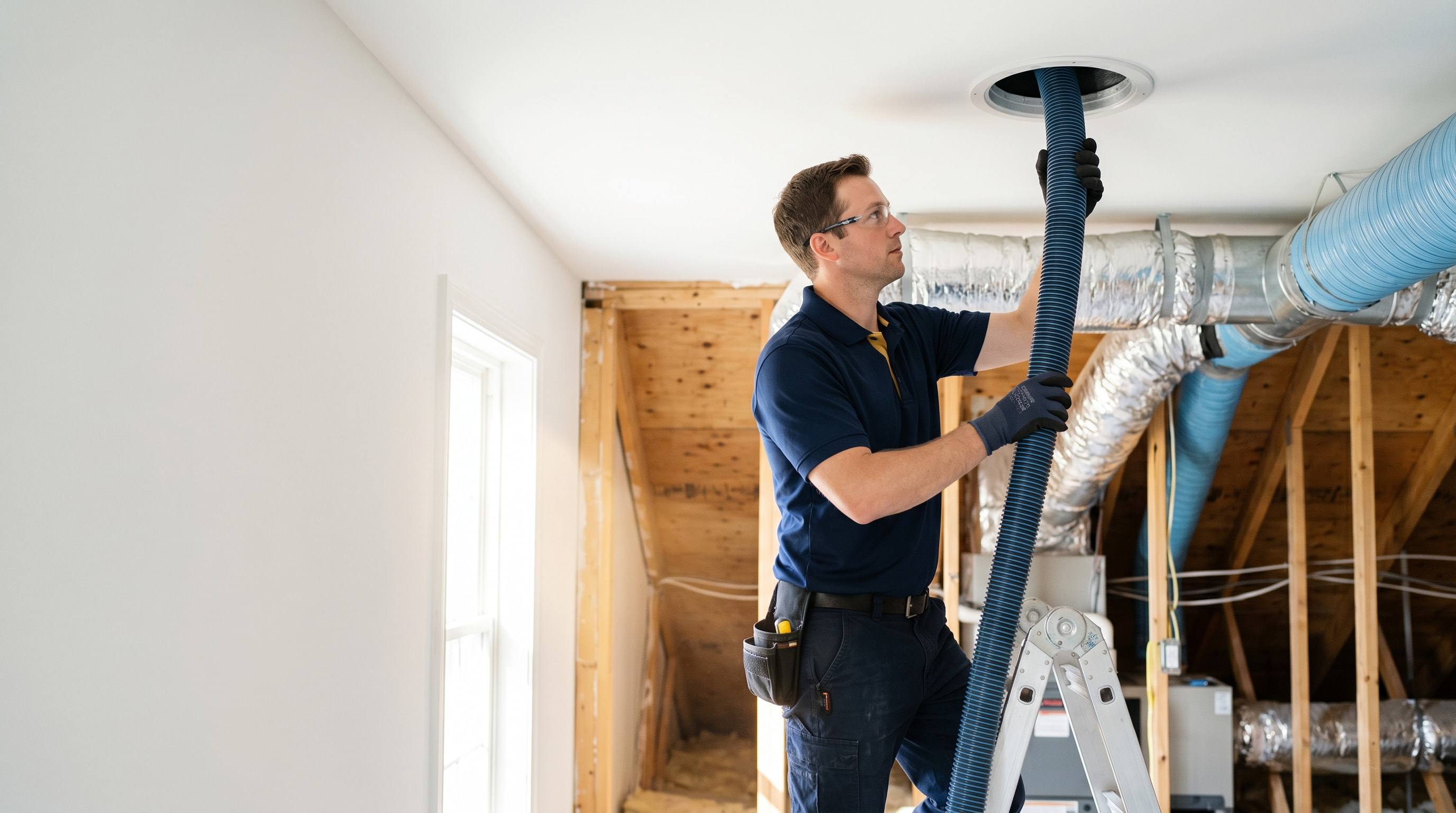
Common duct problems we see in LA
Duct failures in SoCal cluster around a handful of repeat patterns. Knowing what the symptom points to saves time — we bring the right material on the first truck.
Disconnected boots and registers. The single most common call. Flex slips off the sheet-metal register boot in the attic and dumps conditioned air into unconditioned space. Original installer used zip ties instead of a proper draw band plus mastic plus mesh tape; 15–20 years later the zip ties brittled and the flex pulled loose. Symptom: that one register barely blows anything, plus a noticeable warm or cold spot in the attic above the affected room. Repair: draw band, mastic the boot collar, mesh-tape the seam, wrap with R-8. Most close in under an hour.
Crushed and restricted ducts. Homeowner stored boxes on attic flex, the prior roofer stepped on them, a solar installer pulled wire across a trunk and pinched it. Flex that’s been compressed loses 40–70% of its airflow capacity even after the weight comes off — the internal wire helix takes a permanent set. We can usually splice in 4–8 feet of new flex; over 10 feet of damage, replacing the whole section is faster and the same money.
Rodent damage. The #1 cause of duct failure we see in foothill homes — Altadena, La Cañada, the Hollywood Hills, La Crescenta, parts of the SGV. Rats and roof squirrels chew through R-6 and R-8 flex insulation to nest inside the warm duct interior. Droppings and urine contaminate the airstream. The repair itself is replacing the chewed sections, but the repair only holds if the attic entry points get sealed concurrently — otherwise you’re re-infested within 6–18 months and we’re back doing the same work. We don’t do pest exclusion (separate trade) but we coordinate with specialists who do.
UV degradation. Flex duct exposed to direct attic sun through soffit vents or unfilled gable openings degrades faster than shaded runs. The outer jacket becomes brittle, cracks under flexing, and eventually splits along a run. Most pronounced in the Inland Empire (Riverside, San Bernardino, Fontana) and the high desert where attic temperatures hit 140°F and UV intensity is higher. Coastal flex duct routinely lasts 20+ years; inland flex often needs replacement at 12–15. Symptom: brittle, cracking insulation jacket; visible tears along longer runs.
Liner separation. Internal duct liner (fiberglass-faced lining inside older sheet-metal ducts) can peel away from the duct wall and partially block airflow. Symptom: drastically reduced airflow at one or more registers with no visible external damage. Diagnosis requires opening an inspection port and visually confirming. Repair is section replacement — you can’t reattach a peeled liner reliably.
Asbestos liner deterioration. Pre-1980 ductwork in LA may have asbestos-paper internal liner or asbestos-cloth external wrap. When that material deteriorates it sheds fibers into the airstream. We do NOT cut, remove, or disturb suspected asbestos — outside C-20 scope. We identify it, stop work in that area, and coordinate with a California-certified asbestos abatement contractor. After abatement and air clearance, we resume.
Crushed register boots. Under-cabinet register boots in kitchens routinely get compressed during cabinet installs — the cabinet installer trims around the floor opening without realizing the metal boot below is now load-bearing. Symptom: kitchen toe-kick register blows next to nothing. Repair: pull the cabinet kick panel, replace the deformed boot, reattach the flex. Most kitchen boot repairs run 45–90 minutes.
Repair vs Aeroseal vs replacement — which fits
Three different problems, three different right answers. Most contractors push whichever one they sell. We diagnose first.
Repair makes sense when:
- Damage is localized to 1–3 specific sections
- Majority of the system (70%+) is structurally intact
- No asbestos-containing materials anywhere in the duct chase
- Total repair cost is under $1,500
- System is under 20 years old and not at end-of-life elsewhere
Full replacement wins when:
- Widespread deterioration across multiple runs
- System is 30+ years old with multiple failures in the past 5 years
- Asbestos found — abatement plus replacement is usually cheaper than abatement plus repair plus future failures
- You’re doing a major renovation that changes the home layout anyway
- You’re upgrading from a 3-ton to 4-ton AC and the trunks are undersized
Aeroseal sealing is the answer when:
- Ducts are in good structural condition but failing a leakage test
- You can’t physically access the duct runs to seal manually (sealed wall chases, second-floor cavities)
- Title 24 compliance retest needs to pass and you can’t justify full replacement
- Diffuse leakage across many small joints rather than one obvious failure
If you have rodent damage in three sections and intact-but-leaky ductwork everywhere else, the right answer is repair the rodent damage first, then Aeroseal the rest. We sequence the work that way and bill it accordingly.
Pricing
Honest pricing, parts and labor included. These are real ranges from our service tickets across all five counties:
| Repair | Typical cost | Time |
|---|---|---|
| Diagnostic visit | $89 (waived with repair) | 30–60 min |
| Disconnected boot reattachment | $145–$285 | 30–60 min |
| Single section flex duct replacement (≤8 ft) | $245–$485 | 1–2 hr |
| Multiple section flex duct repair (3–5 connections) | $585–$985 | 2–4 hr |
| Damaged register boot replacement | $185–$345 | 45–90 min |
| Crushed metal duct repair | $385–$785 | 2–3 hr |
| Rodent damage repair + entry point sealing | $485–$985 | 2–4 hr |
| Asbestos abatement coordination (specialist required) | consultation only — abatement quoted separately ($1,500–$4,500) | — |
| Plenum repair (where ducts meet AC) | $485–$885 | 2–4 hr |
| Return duct repair | $385–$685 | 1.5–3 hr |
| Same-day emergency surcharge | +$185 | — |
| Travel surcharge (outside core area) | $0–$285 | — |
Honest line on these prices: tight attic access in 1950s and 60s tract homes adds 25–50% to labor — crawling instead of walking. We quote that overhead upfront after the diagnostic, not as a surprise add-on. If the diagnostic reveals asbestos-suspect materials, we stop and refer.
LA-specific patterns
Regional duct failures cluster differently depending on which part of SoCal you’re in. Our five dispatch routes see meaningfully different repair mixes:
Foothill homes — Altadena, La Cañada Flintridge, Hollywood Hills, La Crescenta. Rat damage is the dominant call. The mix of mature oak and sycamore canopy, large lots, and older housing stock with attic access points (gable vents, soffit gaps, eave penetrations) creates ideal rodent habitat. We’ve learned the hard way: replacing chewed flex without sealing the attic entry concurrently means we’re back in 6–18 months. Pest exclusion specialist first, then duct repair, then permanent attic sealing. Done in that order, the repair holds.
Coastal homes — Venice, Manhattan Beach, Malibu, Pacific Palisades. Salt corrosion eats metal ducts and register boots faster than inland equivalents. Galvanized trunks from the 1970s show pitting and rust-through at flange seams by year 30–40. Flex jackets actually fare well in the marine layer (UV is mild), but the metal components below have shorter lifespans — more boot and metal-section work per call here than anywhere else.
Inland Empire — Riverside, San Bernardino, Fontana, Moreno Valley. UV degradation accelerates everything. Intense summer sun through attic ventilation drives attic temperatures past 140°F for weeks at a stretch. Flex duct lifespan averages 12–15 years here versus 20+ on the coast. Outer jackets brittle, crack, and split along runs. We typically recommend full replacement at the 15-year mark in IE attics rather than chasing failures.
San Fernando Valley tract homes (1955–1975). Original ductwork in most of these homes is past expected life — patchwork repair is often what the homeowner wants, but we’re likely back within 18 months for the next section. Sherman Oaks, Reseda, Pacoima, North Hollywood tract homes from this era are typically due for full duct replacement. Tight attic clearances (under 30 inches at the eaves) make repair labor slower than in newer homes.
Asbestos awareness (pre-1980 homes)
If your home was built before 1980 and the ductwork is the original system, asbestos-containing materials are a real possibility. LA building practice used asbestos extensively in HVAC infrastructure through the late 1970s — asbestos-paper duct liner, asbestos-cloth wrap on round metal trunks, asbestos-cement (transite) ducts in some commercial conversions, asbestos-cement mastic at fittings.
- We do NOT remove or disturb suspected asbestos — not within scope of our C-20 license.
- We DO recognize suspect materials during the diagnostic and stop work in those areas.
- We coordinate with California-certified asbestos abatement contractors who carry the specialized license and equipment.
- Typical abatement cost: $1,500–$4,500 per section depending on linear footage, access, and disposal requirements.
- After abatement is complete and the post-removal air clearance test passes, we resume the duct repair or replacement work.
This sequencing matters: disturbing asbestos during routine cleaning or repair creates a real exposure hazard for your family and for our techs. The right path is testing first, abatement if positive, clearance verification, and HVAC work only after the area is documented asbestos-free.
Real-world example
Altadena hillside home, 1962, 1,800 sq ft.
- Symptom: back bedrooms not cooling, AC running 8+ hours per day, electric bill noticeably higher than the previous summer
- Diagnostic: walked the attic, found rat damage to 3 sections of flex duct (chewed through outer jacket and inner liner; nesting material visible inside one run). Original galvanized plenum from 1962 still structurally intact with no visible asbestos materials in the work area. Identified 4 attic entry points (gable vent corner gap, two soffit penetrations around plumbing vents, one open eave at the south rear corner).
- Repair scope: 3 section replacements (8 ft, 12 ft, 6 ft of R-8 flex) plus boot reattachment on the run that had pulled loose during the rodent activity, plus sealing the 4 attic entry points to prevent re-entry while the homeowner brought in pest exclusion
- Total: $1,485 HVAC repair, paid same day. Homeowner separately contracted pest exclusion ($650).
- Time on site: 5 hours
- Follow-up recommended: full system inspection in 6 months to verify rodent exclusion held; Aeroseal evaluation in 12 months since the rest of the ductwork is 60+ year old galvanized still in service, and Aeroseal extends usable life on otherwise intact trunks meaningfully
- Outcome: airflow restored to back bedrooms, AC runtime dropped back to 4–5 hours per day on comparable weather
Service area & response times
Duct repair across all five Southern California counties. Each region runs from its own dispatch line so calls don’t bounce:
| Region | Response time | Phone |
|---|---|---|
| West LA, Westside | 60–120 min | (424) 766-1020 |
| Pasadena, San Gabriel Valley | 60–120 min | (626) 499-5530 |
| Thousand Oaks, Ventura County | 90–150 min | (805) 977-9940 |
| Irvine, Orange County | 60–120 min | (949) 785-5535 |
| San Bernardino, mountains | 90–180 min | (909) 757-6455 |
| Riverside, Inland Empire | 90–180 min | (951) 744-9188 |
City pages: Altadena · Sherman Oaks · Glendale. Related: Aeroseal, duct installation, duct cleaning, HVAC maintenance.
Honest take on repair vs replace
Patch repairs on 25+ year old flex duct are usually a bandaid. We’ll do it if that’s what the customer wants, but we tell them: the next call will be another section of the same system failing in 12–18 months. At year 25+, full replacement starts making more sense than chasing failures. We’d rather have the honest conversation than collect $400 every year for the next 5 years.
Schedule duct repair
Most diagnostics before 2 PM result in same-day repair for accessible damage. Call your regional dispatch above or use our free estimate form. CSLB C-20 #1138898. Licensed, bonded, insured.