
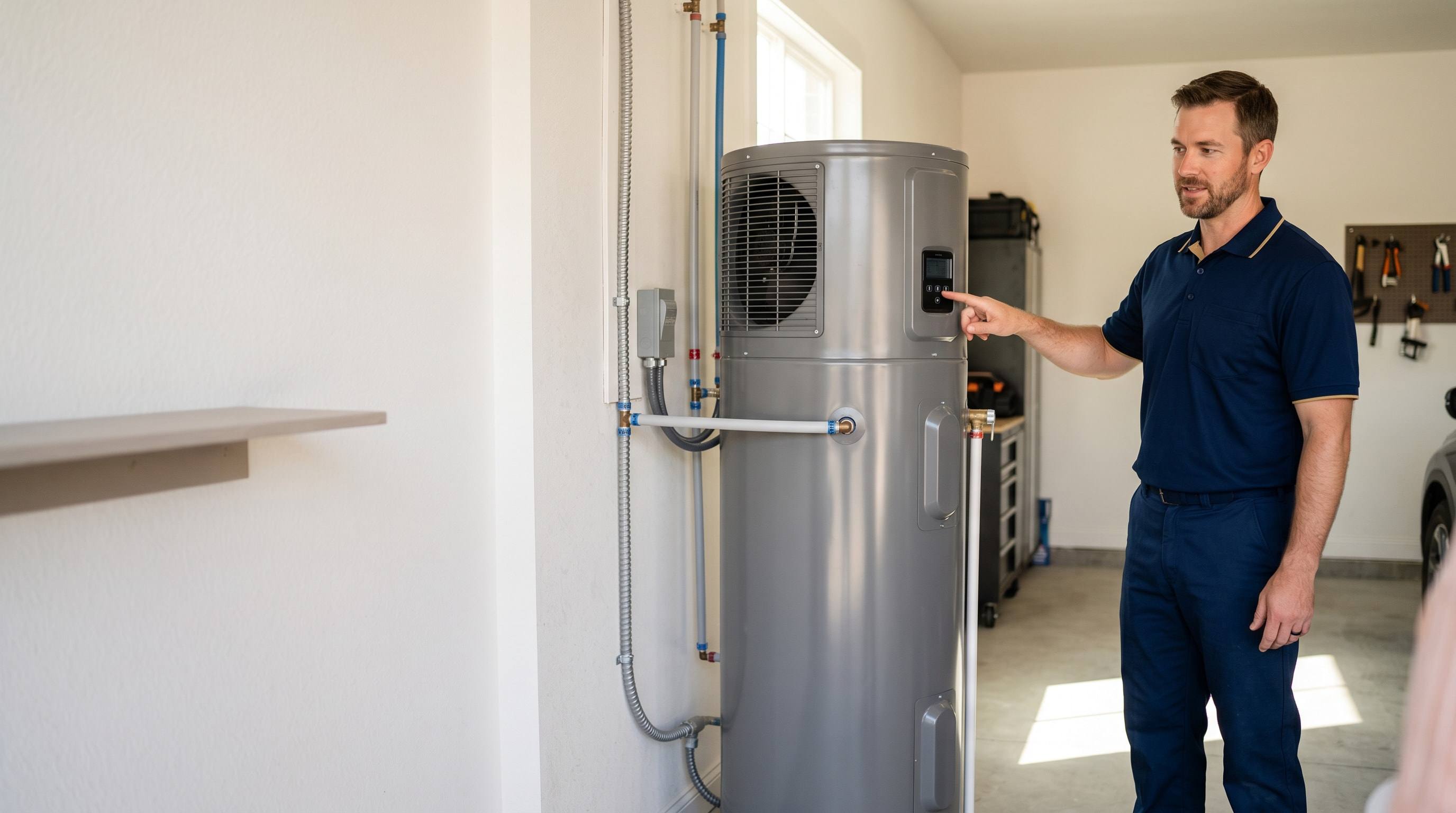
Common water heater problems we fix
Water heater failures cluster into a handful of patterns. Knowing the symptom narrows the likely failure point and lets us bring the right parts on the first visit.
No hot water at all. On a gas tank: pilot out, failed thermocouple, or gas control valve failed closed. Relight attempts that fail within a minute almost always trace to a bad thermocouple ($185–$345). On an electric tank, the upper heating element or upper thermostat has failed — the upper is the dominant control, and when it fails the lower never sees a call for heat. On a tankless, you’re probably staring at an error code on the front panel. Read the code aloud when you call — the dispatcher can pre-stage parts.
Not enough hot water. Three usual suspects on a tank: failed lower thermostat (the lower element runs the bulk of recovery; when it fails, the upper holds the top half warm but you run out fast), sediment buildup eating capacity, or a failed dip tube mixing cold inlet water into the hot outlet. On a tankless, scale buildup on the heat exchanger drops flow and temperature together — descaling is the answer. On an HPWH, the heat pump component may be running while the resistance backup never kicks in, presenting as “runs forever, never quite hot.”
Leaking from the base. Tank corrosion. The inner steel tank has rusted through from the inside; water is pooling under the unit. This is replacement only — not a repair scenario. Tanks fail from the inside out, the breach grows, and any “repair” fails again within weeks. We won’t quote it. See water heater replacement for same-day tank-out / tank-in pricing.
Leaking from the top. Different story. The cold or hot water nipple can corrode at the threads; the T&P (temperature & pressure) discharge tube can drip continuously when the valve itself fails; a union fitting can loosen with thermal cycling. All repairable: $145–$285 typical, 30–60 minutes on site.
Discolored or smelly water. Brown or rust-tinted hot water means the sacrificial anode rod has been fully consumed and the steel tank itself is now corroding. Replace the anode rod ($185–$385) and you buy 3–5 more years of tank life. Skip it and you accelerate toward base failure. On homes with magnesium anode rods in high-sulfur water (some Riverside and Inland Empire wells), a rotten-egg smell points to the anode — swap to aluminum or powered and the smell resolves.
Banging, popping, or rumbling noises. Sediment buildup on the tank bottom. Mineral content precipitates out as water heats, lays down as scale, water trapped beneath boils to steam, and the bubbles produce the noise. A sediment flush ($185–$285) restores efficiency and quiets the tank. Honest line: on a tank past 10 years with heavy popping, the corrosion damage underneath the sediment is usually already done.
Tankless error codes. Rinnai 11 (ignition failure) is usually the flame rod, gas pressure, or igniter. Rinnai 12 (flame failure during operation) adds gas valve modulation. Rinnai 14 (heat exchanger overheat) points at scale buildup or a blocked condensate drain. Rinnai 29 specifically calls out condensate. Navien 003 / 004 are flow-sensor and ignition-related; E series are operational faults; W series are warnings. We carry Rinnai and Navien flame rods, igniters, and flow sensors on every truck.
Heat pump water heater faults. Rheem ProTerra, AO Smith Voltex, and Bradford White AeroTherm all run a compressor, evaporator coil, fan, and control board like a small AC. Compressor fault ($785–$1,485 out of warranty), fan motor failure ($385–$685), temperature sensor ($245–$385), and condensate drain blockage (often a free fix) are the routine repairs. Most HPWH carry 6–10 year compressor warranties — we run a warranty claim first.
If your water heater is leaking under pressure across drywall, the T&P valve is venting continuously, or you smell gas, shut the gas or water supply off and call us before anything else.
Water heater repair cost in Los Angeles 2026
Flat-rate pricing, parts and labor included. These ranges are pulled from our service tickets across all five counties:
| Repair | Typical cost | Time |
|---|---|---|
| Diagnostic visit | $89 (waived with repair) | 30–60 min |
| After-hours diagnostic | $149 | 30–60 min |
| T&P valve replacement | $185–$285 | 45–60 min |
| Drain valve replacement | $145–$245 | 30–45 min |
| Anode rod replacement | $185–$385 | 45–90 min |
| Thermostat replacement (electric) | $185–$345 | 45–60 min |
| Gas control valve | $385–$685 | 1.5–2 hr |
| Pilot / thermocouple (gas) | $185–$345 | 45–60 min |
| Heating element (electric) | $185–$385 | 45–60 min |
| Tankless descaling / flush (annual on hard water) | $245–$385 | 60–90 min |
| Tankless control board | $585–$985 | 1.5–2 hr |
| Tankless heat exchanger | $885–$1,485 | 2–4 hr |
| HPWH compressor (out of warranty) | $785–$1,485 | 2–4 hr |
| HPWH evaporator coil | $485–$885 | 1.5–2.5 hr |
| Sediment flush (tank) | $185–$285 | 45–60 min |
| Same-day emergency surcharge | +$185 | — |
Honest line on tankless heat exchanger repair: at $885–$1,485 on a 12+ year-old unit, you’re inside replacement-conversation territory. A new Rinnai RUR199i installed runs $4,800–$7,400 and resets the 20-year service-life clock. On HPWH compressor work, check the warranty card first — if you’re under that window, you pay our labor only.
Repair vs replace — honest decision framework
The internet’s 50% rule (repair if under 50% of replacement) is a rough guide. The age and equipment type matter more than the raw repair number. This is the framework we apply on every call:
- Tank under 8 years + single component failure → repair, no question. Thermocouple, T&P valve, drain valve, anode rod, single element — all under $400, all buying you 4+ more years.
- Tank 10+ years + leaking from the base → replace. Tank corrosion is structural and not repairable. Same-day swap with a Bradford White or Rheem 40/50-gal lands $1,800–$2,800 installed.
- Tank 10–12 years + non-leak component failure → honest conversation. A $345 thermostat replacement buys 1–2 years before something else fails. Replacement at the next breakdown is likely. We’ll quote both.
- Tankless under 12 years + control issue or sensor → repair. Tankless lifespan is 15–20 years with descaling; you have plenty of runway.
- Tankless 12+ years + heat exchanger issue → replace. The heat exchanger is the most expensive single component; on a 12-year-old unit you’re replacing the heart of the system right before the rest fails.
- HPWH under 8 years + compressor fault → warranty claim first, then repair. Don’t pay out of pocket on a unit under manufacturer warranty.
- HPWH 10+ years → replacement is usually the better math. The current generation (Rheem ProTerra 5th gen, AO Smith Voltex 2) is meaningfully more efficient and qualifies for active rebates.
Manufacturer expected life: standard gas/electric tank 10–12 years, tankless 15–20 years, HPWH 10–15 years. Past those windows, major repairs rarely pencil out.
Common water heater emergencies in LA
Some failure patterns are specific to Southern California water, climate, and seismic activity.
Hard-water sediment in the Inland Empire. Riverside, San Bernardino, Fontana, and Rancho Cucamonga sit at 15–25 grains per gallon — the high end of the U.S. hardness range. Tankless installs out here need descaling every 6–12 months, not annual. Tanks accumulate sediment 2–3x faster than coastal LA. A tank that lasts 12 years in Santa Monica may fail at year 8 in Riverside without aggressive flushing. We see Rinnai and Navien heat exchangers choked solid at year 5–7 on neglected IE installs.
Coastal salt corrosion. Malibu, Manhattan Beach, Pacific Palisades, and the Long Beach coast see chloride-laden marine air that consumes anode rods at roughly twice the inland rate. A magnesium anode in a Malibu garage is gone at year 3–4 instead of year 6–7. We recommend a powered anode rod ($385 installed) on coastal homes — it doesn’t consume itself and extends tank life 3–5 years.
Post-earthquake water heater displacement. LA basin sees a meaningful seismic event every 5–10 years. California Plumbing Code requires two seismic straps (upper and lower third, anchored to studs or concrete). After any felt earthquake, inspect the straps for stretch, check the gas flex line for kinks, and verify the T&P discharge tube hasn’t rotated. A displaced water heater on a broken gas line is the actual fire risk people are warned about. We do post-earthquake strap inspections at no charge on any service call.
Composite real-world example
West Hollywood 2-bedroom condo, 2013 Rheem 50-gallon gas tank, 12 years old, popping noises and a slight wet spot under the unit.
- Diagnosis (45 min): heavy sediment producing the popping; T&P valve dripping continuously (the wet spot); anode rod fully consumed; tank wall sounded thin on tap test. No active base leak yet.
- Repair option: T&P valve ($245) + sediment flush ($185) = $430 total, diagnostic waived.
- Replacement option: Bradford White M-2-503S6FBN 50-gal installed, $2,400. New 6-year warranty.
- Honest take we gave the customer: at 12 years with these symptoms, the repair is throwing good money after bad. Base failure is the next thing that happens, likely within 6–12 months. Replacement is the right call.
- Customer chose the $430 repair — mid-renovation, didn’t want major work right now. We did it, told them honestly to budget replacement within 6 months, and put them on our calendar.
The repair was technically possible. It just wasn’t the right answer for a 12-year-old tank, and we said so before taking the money.
Honest opinion on repair vs replace
If your water heater is 10+ years old and starts showing problems, repair becomes throwing good money after bad. Manufacturer expected life is 10–12 years for a tank, 15–20 for a tankless, 10–15 for an HPWH. Major repair cost on a unit past expected life means replace.
One note for 2026: repairs are not rebated — only installations are. The federal Section 25C tax credit ($600 for water heaters, $2,000 for HPWH) expired December 31, 2025 under the One Big Beautiful Bill Act. Still active: SoCalGas rebate up to $1,500 on qualifying tankless (up to $2,250 in Eaton and Palisades rebuild ZIPs), LADWP $2,500 on HPWH in LADWP territory. Full picture: 2026 rebate guide.
Service area & response times
Water heater repair across all five Southern California counties. Each region runs from its own dispatch line so calls don’t bounce:
| Region | Response time | Phone |
|---|---|---|
| West LA, Westside | 60–120 min | (424) 766-1020 |
| Pasadena, San Gabriel Valley | 60–120 min | (626) 499-5530 |
| Thousand Oaks, Ventura County | 90–150 min | (805) 977-9940 |
| Irvine, Orange County | 60–120 min | (949) 785-5535 |
| San Bernardino, mountains | 90–180 min | (909) 757-6455 |
| Riverside, Inland Empire | 90–180 min | (951) 744-9188 |
Phones answered 24/7 by a real person. Truck dispatch 8 AM–8 PM, 7 days a week including holidays. After-hours emergency dispatch is available with a $185 surcharge for true emergencies — major leaks, gas smell, no hot water with infant or medical-need household. Calls that aren’t true emergencies are scheduled first thing the following morning with a confirmed arrival window. Full after-hours scope: 24/7 emergency HVAC.
Related water heater services
If repair isn’t the right call: Water Heater Hub, Replacement, Tank Installation, Tankless Installation, Heat Pump Water Heater.
Heaviest water heater repair call volume across our routes: West Hollywood, Pasadena, Santa Monica, Malibu, Irvine, Thousand Oaks, Riverside, and San Bernardino.
Schedule water heater repair today
Most water heater repairs scheduled before 2 PM are completed same day. Call your regional dispatch number above, or use our free estimate form. CSLB License C-20 #1138898. Licensed, bonded, insured. Serving Los Angeles, Orange, Riverside, San Bernardino, and Ventura counties.