
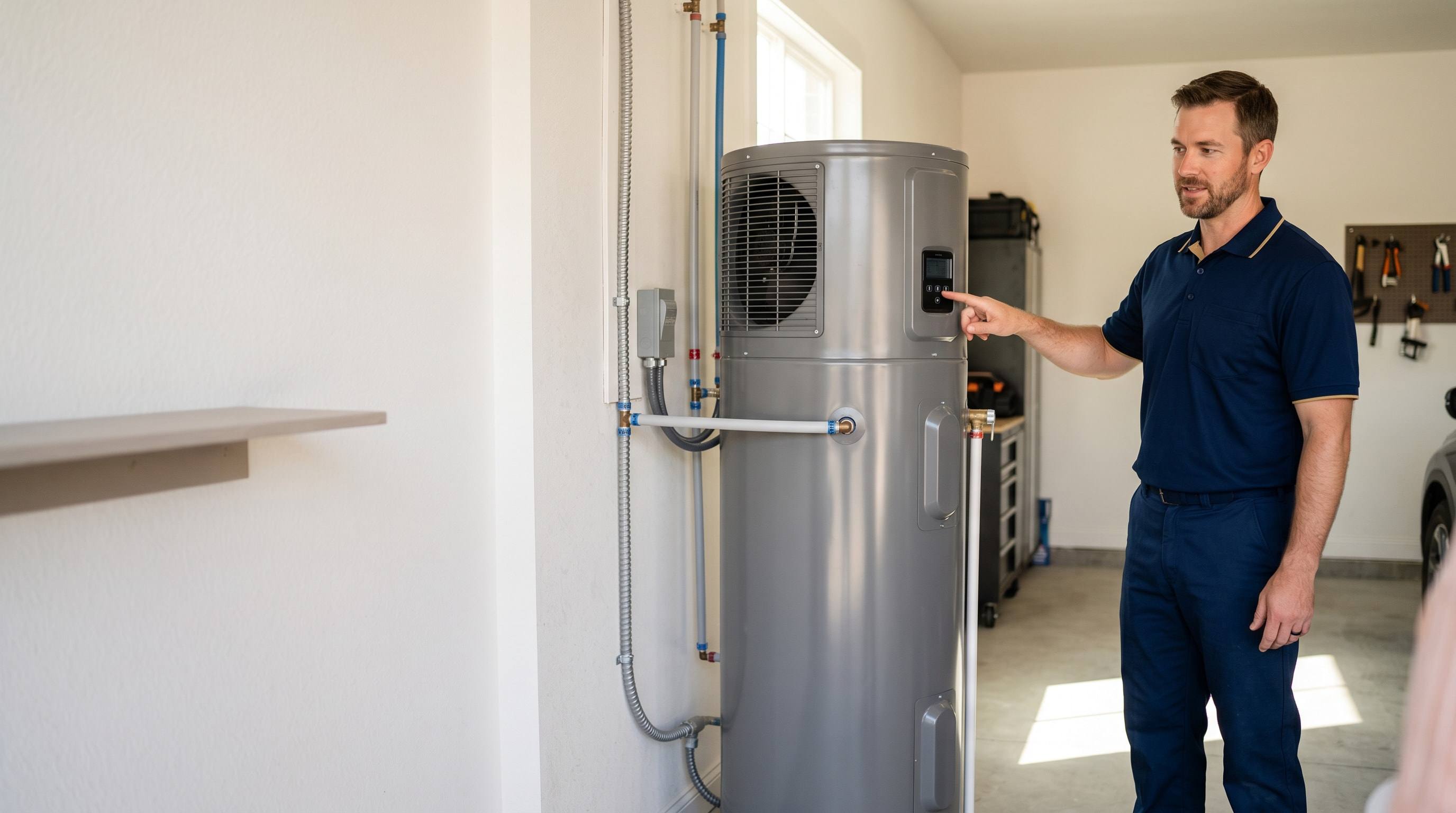
Why HPWH 2026 economics changed
The math on heat pump water heaters used to be a long-payback bet. As of 2026 in LADWP territory, it isn’t. Three things shifted between October 2025 and January 2026, and the net effect is that a qualifying HPWH now costs less year-one than a like-for-like gas tank replacement in LADWP service area.
1. LADWP HPWH rebate jumped from $1,500 to $2,500. Effective November 1, 2025, LADWP increased the heat pump water heater rebate to up to $2,500 per unit for qualifying gas-to-HPWH replacements. The rebate caps at the lower of $2,500 or 100% of installed equipment cost. Eligibility requires UEF 3.3 or higher, capacity 30 gallons or more, ENERGY STAR certification, and a final approved LADBS Building & Safety permit. Applications must be postmarked within 12 months of purchase. Processing runs 6–12 weeks.
2. Federal Section 25C expired December 31, 2025. The federal energy-efficient home improvement credit, which added up to $2,000 for HPWH installation through 2025, expired under the One Big Beautiful Bill Act (OBBBA), Public Law 119-21. Equipment installed in 2026 does not qualify. The net change for a LADWP customer comparing 2025-to-2026: the LADWP rebate added $1,000, but the federal credit subtracted $2,000. So a LADWP customer in 2026 pays about $1,000 more out-of-pocket than the same customer would have in 2025 — but still wins year-one against the gas tank alternative because the federal credit never applied to gas tanks in the first place.
3. Equipment costs are flat. HPWH units alone run $1,800–$3,200 from the major manufacturers, roughly the same as 18 months ago. The supply chain has stabilized after the 2023–2024 spikes. Premium 80-gallon units sit at the top of that range; entry 50-gallon premium units at the bottom.
Net result for LADWP customers in 2026: HPWH is the cheapest year-one option for replacing a working-but-aging gas water heater. We’ll show the address-specific math at the free in-home estimate — there’s no universal answer because the variable is whether your panel needs work and whether you sit in a SCAQMD GO ZERO eligibility zone for the stacked rebate.
HPWH models we install
Five product lines cover roughly 95% of our HPWH installs. We install the others where customer preference points elsewhere, but these are what we stock parts for and what we know the install quirks on.
Rheem ProTerra Gen 5 — the workhorse
- Rheem ProTerra 50 gal (Gen 5, model XE50T10HS45U1): UEF 3.88 — comfortably above the LADWP 3.3 threshold and one of the most efficient 50-gallon HPWH on the market. 10-year tank warranty. Equipment alone $1,800–$2,200. The default recommendation for a 2–4 person household.
- Rheem ProTerra 80 gal (XE80T10HS45U1): UEF 3.75, 10-year tank warranty. Equipment $2,400–$2,900. Right answer for 5+ person households or homes with two simultaneous high-demand showers. First-hour rating roughly 84 gallons.
AO Smith Voltex Hybrid Pro — premium tier
- AO Smith Voltex HPTU-50N (50 gal): UEF 3.45, 10-year tank warranty. Equipment $2,000–$2,400. Slightly quieter compressor than Rheem in our experience, premium build.
- AO Smith Voltex HPTU-80N (80 gal): UEF 3.45, 10-year warranty. Equipment $2,600–$3,200.
Bradford White AeroTherm — plumbing-supply channel
- Bradford White AeroTherm RE2H50R10B (50 gal): UEF 3.45, 10-year tank warranty. Equipment $2,100–$2,500. Bradford White sells exclusively through the plumbing-supply channel (not big-box), which means parts availability is excellent through California supply houses and field-service warranty work is straightforward.
State Premier Heat Pump 50 — AO Smith subsidiary
- State Premier Heat Pump 50 gal (HPTU-50N variant): UEF 3.45, same internal hardware as the AO Smith Voltex with State branding. Often spec’d on multi-unit and tract-rebuild projects where the GC has a State account.
Brand pages: Rheem. We also service HPWH installed by previous contractors on every major brand sold in California over the last 10 years.
LADWP eligibility — the $2,500 maximum
The full eligibility list for LADWP’s up-to-$2,500 HPWH rebate. Miss any of these and the rebate is reduced or denied. We verify all of them at the free in-home estimate.
- UEF ≥ 3.3. Uniform Energy Factor on the manufacturer spec sheet must be 3.3 or higher. All Rheem ProTerra, AO Smith Voltex, Bradford White AeroTherm, and State Premier models we install clear this threshold.
- Capacity ≥ 30 gallons. 50-gallon and 80-gallon units both qualify. The smaller 30-gallon HPWH options on the market are rarely the right size for an LA household, but they technically qualify.
- Replacing an existing gas water heater. The big one. Replacing electric resistance with HPWH does not qualify for the $2,500 — that’s a separate $1,500 rebate tier. New construction does not qualify. ADUs do not qualify.
- LADWP residential electric customer. Verify with the meter number on your LADWP bill. If your address sits in PWP (Pasadena), BWP (Burbank), GWP (Glendale), or SCE territory, the LADWP rebate doesn’t apply — see the Pasadena scenario below for what those customers actually get.
- Final approved LADBS Building & Safety permit. Required. We pull the permit in your name, schedule the inspection, and provide the permit-final documentation at close-out.
- Apply within 12 months of purchase. Postmark deadline, not received-by. We file the paperwork on your behalf at close-out so there’s no risk of missing it.
- ENERGY STAR certified. Every model we list above is ENERGY STAR certified.
Full rebate program landscape including SCAQMD GO ZERO (up to $3,000, stackable with LADWP in eligible geographies), HEEHRA (currently fully reserved for single-family statewide), and TECH Clean California (waitlisted statewide since February 24, 2026) lives at the 2026 rebate guide.
Installation specifics homeowners don’t know about
HPWH is mechanically more complex than a gas tank — there’s an electrical side, a refrigeration side, and a condensate-handling side. Four items quietly drive whether your install is straightforward or requires extra work.
1. 120V vs 240V. Most premium HPWH require a 240V 30-amp dedicated circuit. Pre-1990 LA homes with 100-amp panels often don’t have capacity without a panel upgrade ($1,200–$2,800). If the panel has capacity and we just need to run the new circuit to the install location, that’s $385–$885 depending on conduit run length. 120V plug-in HPWH alternatives exist for homes where the panel-upgrade math doesn’t work, but recovery time is slower and the UEF threshold for the LADWP $2,500 rebate is harder to clear — verify the model spec sheet before assuming a 120V unit qualifies.
2. Air volume. HPWH pulls heat from surrounding air to heat water. The compressor needs 700 cubic feet or more of conditioned air around the unit, OR a ducted intake/exhaust kit drawing from a larger space. A typical 2-car garage clears this easily — that’s 4,800+ cubic feet. A small utility closet (3×3×8 = 72 cubic feet) doesn’t come close, and a closet install needs a ducting kit ($385–$685) routing intake and exhaust to an adjacent garage or attic space. Tight installs without ducting will short-cycle the compressor and the unit will fall back to electric resistance mode, killing efficiency.
3. Drain pan and condensate. An HPWH produces 5–10 gallons of condensate per day during normal operation — same physics as an AC evaporator coil pulling moisture from air. That water has to go somewhere. Code requires a drain pan under the unit with a drain line routed to the nearest waste stack, floor drain, or laundry standpipe. $185–$385 added scope if no drain access exists at the install location. Skipping this is a callback waiting to happen — the pan fills, overflows, and we’re looking at drywall damage on top of the install.
4. Sound level. A modern HPWH runs 45–55 dB at one meter — slightly louder than a refrigerator, much quieter than a window AC. The compressor cycles on and off, so it’s not constant. Don’t install one on a wall directly adjacent to a bedroom. Garage installs are ideal acoustically. Utility closets on the opposite side of the house from sleeping areas work fine. We flag acoustic concerns at the in-home estimate before we quote — relocating the install after the fact is expensive.
Pricing matrix
Honest pricing, parts and labor included, from our service tickets. LADWP rebate and SCAQMD stack shown below the equipment lines; effective net cost in the highlighted row.
| Service / line item | Typical cost | Time |
|---|---|---|
| Rheem ProTerra 50 gal installed (basic, existing 240V circuit) | $3,200–$4,200 | 4–6 hr |
| Rheem ProTerra 80 gal installed | $3,800–$5,200 | 4–6 hr |
| AO Smith Voltex 50 gal installed | $3,400–$4,400 | 4–6 hr |
| AO Smith Voltex 80 gal installed | $4,000–$5,400 | 4–6 hr |
| Bradford White AeroTherm 50 gal installed | $3,500–$4,600 | 4–6 hr |
| Electrical panel upgrade (if needed) | $1,200–$2,800 | 4–8 hr |
| New 240V circuit (existing panel has capacity) | $385–$885 | 2–3 hr |
| Ducting kit (small closet install) | $385–$685 | 2–3 hr |
| Drain pan + condensate drain line | $185–$385 | 1–2 hr |
| LADBS plumbing permit | $145–$285 | — |
| LADWP rebate (gas-to-HPWH, qualifying) | −$2,500 (up to) | — |
| SCAQMD GO ZERO stack (if eligible) | −$3,000 (up to) | — |
| Effective net cost — LADWP customer | $700–$2,200 | — |
| Diagnostic visit (waived with install) | $89 | 30–60 min |
The effective net cost range assumes LADWP rebate approval (we file on your behalf and the approval rate on documented gas-to-HPWH replacements is very high) and may or may not include SCAQMD GO ZERO depending on your address. SCAQMD GO ZERO eligibility is geographic and program-funded; we check status at the time of quote. A note on permits: LADBS requires a plumbing permit and, where electrical work is involved, an electrical permit. We pull both in your name as part of the install. Skipping the permit voids the LADWP rebate entirely — the final approved permit is the document LADWP requires before they cut the check.
Three composite stack scenarios
Three real-shape scenarios from recent installs, with full math. The variable in every case is electrical scope and utility territory.
Scenario A — Sherman Oaks LADWP customer, simple install
Mid-1980s ranch home in Sherman Oaks, 200-amp panel with capacity, existing 240V 30-amp circuit at the garage where the old gas tank lived. Family of 3. We pulled the 14-year-old gas tank and dropped in a Rheem ProTerra 50-gallon Gen 5.
- Rheem ProTerra 50 gal installed: $3,800
- Existing 240V circuit reused — no electrical work
- LADBS plumbing permit: $185
- Subtotal: $3,985
- LADWP rebate (gas-to-HPWH, qualifying): −$2,500
- Net out-of-pocket: $1,485
- Comparison: like-for-like 50-gal gas tank replacement: $1,950 installed
- HPWH wins year-one by $465, plus saves roughly $130/year on operating cost going forward.
Scenario B — Encino LADWP customer, electrical work required
1970s ranch home off Hayvenhurst, 125-amp panel with capacity but no existing circuit at the water-heater location. Family of 4, replacing 16-year-old gas tank.
- Rheem ProTerra 50 gal installed: $3,800
- New 240V circuit (existing panel has capacity): $585
- LADBS plumbing + electrical permit: $185
- Subtotal: $4,570
- LADWP rebate: −$2,500
- Net out-of-pocket: $2,070
- Comparison: gas tank replacement: $1,950
- HPWH costs $120 more year-one, saves roughly $180/year operating cost — breakeven by month 8 of year 2.
Scenario C — Pasadena (NOT LADWP, on PWP)
Craftsman bungalow in Pasadena. Pasadena is served by PWP (Pasadena Water and Power), not LADWP, so the $2,500 LADWP rebate doesn’t apply. PWP runs a smaller HPWH rebate program — verify amount at quote time, but plan around roughly $800.
- Rheem ProTerra 50 gal installed: $3,800
- Existing 240V circuit reused
- Pasadena Building & Safety permit: $225
- Subtotal: $4,025
- PWP HPWH rebate (estimate): −$800
- Federal Section 25C: $0 (expired Dec 31, 2025)
- Net out-of-pocket: $3,225
- Comparison: gas tank replacement: $1,950
- HPWH costs $1,275 more year-one, ~5-year operating-cost payback at PWP rates.
The honest read on Scenario C: PWP territory, BWP (Burbank), GWP (Glendale), most of OC, Riverside, San Bernardino, and Ventura — HPWH math doesn’t work the same way it does in LADWP. The gas tank still wins year-one. HPWH wins on lifetime cost if you stay in the home 5+ years and care about operating cost trajectory. We quote both at every estimate so the customer decides on real numbers, not assumptions.
Operating cost reality
The other half of the HPWH math is what it costs to run, year after year. Real numbers, not advertised “up to 4x more efficient” claims.
- HPWH electricity use: ~700–1,100 kWh/year for a family of 4 in SoCal climate. Family of 2 lands ~450–650 kWh/year.
- Electric resistance tank: 3,000–4,000 kWh/year for the same family. HPWH uses roughly 1/4 the electricity of resistance because the compressor moves heat rather than generating it.
- Gas tank: ~200–280 therms/year for a family of 4 (varies with tank efficiency and household usage).
- HPWH operating cost at LADWP rate ($0.27/kWh, 2026 residential): $190–$300/year for a family of 4.
- Gas tank operating cost at SoCalGas ($1.65/therm, 2026 residential): $330–$460/year.
- Net annual savings on the switch: $80–$180/year for typical LADWP household.
- HPWH lifespan: 10–15 years tank. Gas tank: 10–12 years. Lifetime operating-cost savings on HPWH stack to $800–$2,500 over the unit’s service life.
The operating savings alone don’t make the case in 2026. The case is the LADWP rebate — that’s what pulls HPWH ahead year-one. Operating savings are the second-order win that compounds over the next decade. If you’re outside LADWP and the rebate stack is smaller, operating cost is the only argument left, and it’s a 4–7 year payback rather than a year-one win.
Honest opinion — when HPWH is the wrong answer
HPWH is the right answer for most LADWP customers in 2026, but not for everyone. If you’re outside LADWP territory (Pasadena, Burbank, Glendale, most of OC, the Inland Empire), the rebate stack is smaller and HPWH economics are closer to break-even or slightly negative year-one. We tell you honestly which side of that line your address is on. We also push back on HPWH when:
- The install location is a tight interior closet without ducting access — short-cycling will tank efficiency and you’ll fall back to resistance mode constantly.
- The install location shares a wall with a bedroom — the 45–55 dB acoustic floor will get complaints.
- The home is in an extreme-cold microclimate (Big Bear, mountain communities) where ambient temperatures drop below 35°F regularly — HPWH efficiency drops below that threshold and you’re running on resistance mode through winter.
- The panel-upgrade scope pushes total cost past the rebate benefit — for some 1950s Westside homes with overloaded 100-amp panels, the $2,800 panel upgrade kills the math even with the $2,500 rebate.
In those cases we recommend a high-efficiency gas tank, tankless, or — if electrification is the goal regardless of economics — the 120V plug-in HPWH route with eyes-open about the lower UEF and longer recovery. Side-by-side quotes at every estimate.
Service area & response times
HPWH installation across all five Southern California counties. Each region runs from its own dispatch line so calls don’t bounce. Free in-home estimates within 24–48 hours of call; install scheduling typically 1–2 weeks out for HPWH (equipment delivery timing).
| Region | Response time | Phone |
|---|---|---|
| West LA, Westside | 60–120 min | (424) 766-1020 |
| Pasadena, San Gabriel Valley | 60–120 min | (626) 499-5530 |
| Thousand Oaks, Ventura County | 90–150 min | (805) 977-9940 |
| Irvine, Orange County | 60–120 min | (949) 785-5535 |
| San Bernardino, mountains | 90–180 min | (909) 757-6455 |
| Riverside, Inland Empire | 90–180 min | (951) 744-9188 |
LADWP territory cities where HPWH math is strongest right now: Sherman Oaks, Woodland Hills, Encino, Tarzana, Studio City, Van Nuys, North Hollywood, plus the Westside (West LA, Brentwood, Mar Vista, Palms, Cheviot Hills, Beverlywood). If you’re unsure whether your address is LADWP or another utility, check the top of any recent electric bill — meter number prefix and provider name are printed at the top.
Why choose Venta for HPWH installation
CSLB licensed C-20 #1138898. California requires a C-20 license for residential HVAC work. We carry C-20 plus C-36 plumbing. Our license number appears on every invoice and on the side of every truck. Verify any contractor at cslb.ca.gov before signing.
TECH Clean California certified. Required for HEEHRA paperwork (which is currently waitlisted) and credentialing under several state heat-pump programs. The certification means our techs have completed manufacturer-approved HPWH installation training on the Rheem ProTerra, AO Smith Voltex, and Bradford White AeroTherm product lines.
LADWP rebate paperwork handled. We file the rebate application at job close-out with the completed permit-final, invoice formatted to LADWP’s requirements, equipment serial number, and AHRI certificate. Processing 6–12 weeks; you receive the check from LADWP directly.
Permits pulled in your name. LADBS plumbing and electrical permits as scope requires. The final approved permit is what unlocks the LADWP rebate — we don’t skip this step, and we won’t work for contractors who do.
Panel capacity check before the quote. We measure existing panel load with an amp-clamp during the estimate and run the load calculation on paper, not by eyeballing it. If the panel needs an upgrade, you see the number before we cut anything. If it doesn’t, you don’t pay for work you don’t need.
Manometer and combustion-analyzer gear on the truck. When we decommission the old gas water heater, we cap the gas line per code and pressure-test the remaining gas runs (range, furnace, dryer) so we don’t leave you with a slow leak after the demo. Gas-to-HPWH conversions are where corner-cutting causes real problems six months later.
Schedule a free in-home HPWH estimate
Free in-home assessment includes panel capacity check, install-location walkthrough with air-volume and acoustic evaluation, side-by-side quote against gas tank and tankless options, and address-specific LADWP rebate eligibility verification. Call your regional dispatch number above or use our free estimate form. CSLB License C-20 #1138898. Licensed, bonded, insured. Serving Los Angeles, Orange, Riverside, San Bernardino, and Ventura counties.
Related pages: water heater services hub, gas tank installation, tankless installation, water heater repair, water heater replacement, space heat pump installation, 2026 California rebate guide.