
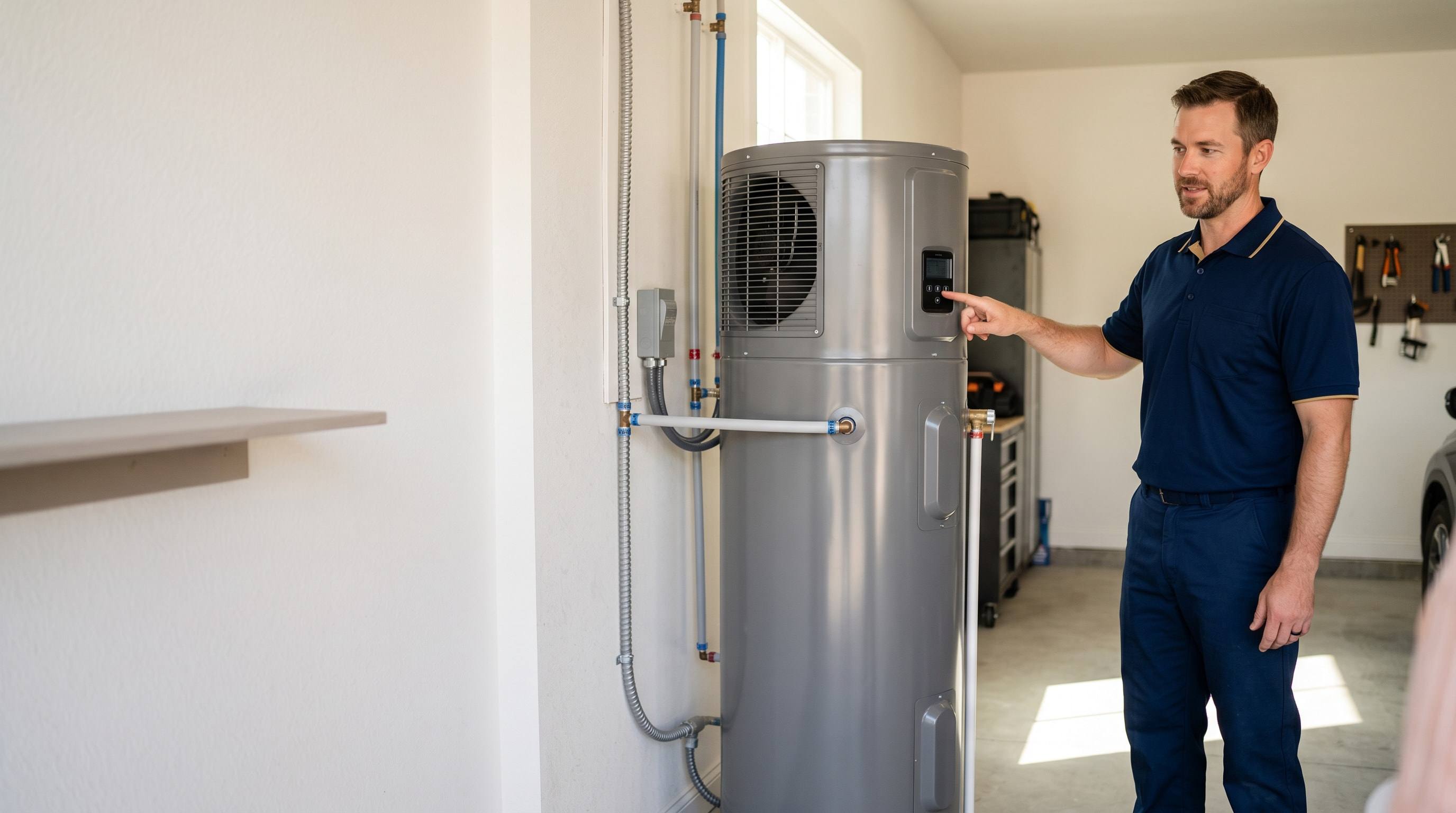
When tank installation is the right choice (vs tankless or HPWH)
The honest answer most contractors won’t give you: roughly 60% of LA homeowners replacing a water heater should buy another tank, not a tankless and not a heat pump. The internet is loud about the alternatives because the alternatives carry bigger sticker prices, bigger rebates, and bigger contractor margins. Some of those upsells are genuinely the right call. Many aren’t. The decision should turn on usage, infrastructure, and how long you’re staying — not on a glossy brochure.
Standard tank is the right choice when:
- Budget-driven replacement. Tank is the cheapest option, period. A $1,950 install gets you hot water for 10–12 years. A tankless is $4,500–$7,800 installed and a heat pump water heater is $4,200–$6,500 net of rebate. If cash is the constraint, the math is simple.
- 1–2 person household. Low hot water demand means the alternatives never pay back. A single resident in a 1-bath condo uses 15–25 gallons a day — a 30 or 40-gallon tank is the right answer, not a $5,800 condensing tankless.
- Existing 1/2" gas line undersized for tankless. A condensing tankless typically needs 3/4" or 1" gas line, and the re-pipe from the meter runs $485–$2,400 depending on length and access. That cost alone eats most of the energy savings a tankless offers for the first 10 years.
- No 240V/30A capacity for HPWH. Heat pump water heaters need a dedicated 240V circuit. Older LA panels (60A or 100A service, fully loaded) often don’t have headroom — adding a sub-panel or upgrading service tacks on $2,400–$6,800 to the project. Tank gas needs zero electrical work.
- Coastal corrosion zones. Salt air in Long Beach, Hermosa, Manhattan Beach, and the South Bay eats HPWH electronics faster than the rest of the country sees. Tank gas equipment is mechanically simpler and lasts the full 10–12 years even in coastal exposure.
- Renters or short-term homeownership. If you’re planning to sell within 3–5 years, or you’re a landlord replacing a tank in a rental, there’s no payback time on premium equipment. The capital cost of tankless or HPWH doesn’t recover before the property changes hands.
The other half of the conversation is when the alternatives genuinely earn their keep. A family of 5 in Sherman Oaks running two showers and a dishwasher simultaneously most mornings is a real tankless candidate. A homeowner in LADWP territory with a 200A panel and a desire to electrify is a real heat pump water heater candidate — the $2,500 LADWP rebate changes the math materially. Outside those cases, tank is fine, tank is fast, tank works.
Standard tank sizes and applications
Sizing isn’t about gallons in the tank — it’s about first-hour rating (FHR), which is gallons of usable hot water the unit can deliver in the first hour of demand. The capacity-to-household mapping we use:
- 30-gallon: Single resident, no laundry running simultaneously with showers. Typical condo or studio install. Equipment $550–$850.
- 40-gallon: 2–3 people, basic single-bathroom use. Most affordable mainstream size. The right answer for many Whittier and Lakewood tract homes.
- 50-gallon: 3–4 people with one or two bathrooms. The most common LA install by a wide margin — probably 70% of our tank work. Equipment $700–$1,250.
- 75-gallon: 5+ people, or a master bathroom with a soaking tub holding 40–60 gallons. Equipment $1,150–$1,650.
- 80-gallon: Large home, multiple bathrooms running simultaneously on weekday mornings, or master suites with rain-head showers and body sprays. Equipment $1,250–$1,850.
Honest sizing pushback: a lot of contractors over-size to avoid complaints. Going from a 50 to a 75 "just in case" wastes $250–$400 upfront, costs more in standby heat loss every day for 12 years, and on a gas tank often needs a bigger flue and more clearance — which can mean additional permit work. We’ll size by actual demand, not by upselling to the next tier.
Brands we install
Four manufacturers cover almost every tank install we do. Each has a reason it ends up on the truck.
Rheem Performance Plus — entry tier, 6-year warranty
- The right choice for rentals, short-term homeownership, and budget-driven replacements.
- Equipment $700–$1,050 for 40–50 gallon gas; $550–$850 for electric.
- Standard atmospheric-vent gas units. Anode rod is smaller, which is why the warranty stops at 6 years — in LA water you’ll typically see 9–11 years of service before the anode is fully consumed and corrosion starts.
AO Smith Signature Premier — mid-tier, 9-year warranty
- The most common Venta install. Hits the sweet spot of price and longevity for owner-occupied homes.
- Equipment $850–$1,250 for 40–50 gallon gas.
- Heavier anode rod than the Rheem entry tier, slightly thicker tank lining. Most units run 12–14 years in moderately hard LA water.
Bradford White Defender Safety System — premium, 10-year warranty
- The premium pick. FVIR (Flammable Vapor Ignition Resistant) safety system meets California code for garage installs without a raised platform in some jurisdictions, and adds a meaningful safety margin everywhere else.
- Equipment $950–$1,450 for 40–50 gallon gas; $1,200–$1,700 for 75-gallon.
- Trade-supply channel only — you can’t buy a Bradford White at Home Depot, which is exactly why the brand has the reputation it does among contractors. Heaviest anode rod of the four, 12–15 year service life is common.
State Premier — AO Smith subsidiary, plumbing-supply channel
- Same parent company as AO Smith, same factory, slightly different model lineup sold through the plumbing-wholesaler channel.
- Equipment $800–$1,200 for 40–50 gallon gas.
- Common in older Pasadena and Glendale plumbing-trade installs because the local supply houses stock State alongside AO Smith. Service life and warranty similar to AO Smith Signature.
Tank installation pricing (2026)
Honest pricing, parts and labor included, from our service tickets across all five counties. Same table format as our AC repair pricing:
| Service | Typical cost | Time |
|---|---|---|
| 40-gal gas tank, standard install | $1,650–$2,400 | 2–3 hr |
| 50-gal gas tank, standard install | $1,850–$2,800 | 2–3 hr |
| 50-gal gas mid-tier (AO Smith Signature Premier) | $2,000–$3,000 | 2–3 hr |
| 50-gal gas premium (Bradford White Defender) | $2,200–$3,200 | 2–3 hr |
| 50-gal high-efficiency (SoCalGas $300 eligible, 0.64+ UEF) | $2,300–$3,300 | 2–3 hr |
| 75-gal gas tank | $2,400–$3,800 | 3–4 hr |
| 50-gal electric tank | $1,950–$2,800 | 2–3 hr |
| 80-gal electric tank | $2,400–$3,400 | 3–4 hr |
| Expansion tank (Pasadena / Beverly Hills, often required) | $145–$245 | 30–45 min |
| Earthquake strap update to code | $85–$165 | 15–30 min |
| LADBS / city permit | $145–$385 | — |
| Old tank disposal | Included | — |
Honest line on these prices: the spread inside each row is real. A 50-gallon gas install in a clean garage with shutoff valves that turn, a flue that’s in good shape, and a platform that’s already to code lands at the bottom of the range. The same install in a 1930s Spanish bungalow with a corroded shutoff, a B-vent that needs new sections, and earthquake straps that haven’t been touched since the ’94 Northridge update lands near the top. We quote the high end of the realistic scope before we start, not after.
A note on rebates. The SoCalGas storage tank rebate of $300 is active in 2026 for qualifying Tier I high-efficiency tanks (0.64–0.67 UEF). Most mainstream 50-gallon gas tanks fall in this efficiency range. We file the paperwork at job close-out and hand you a copy. If you want the larger $1,500 SoCalGas rebate, that requires a tankless — tank rebates max out at $300. Full breakdown of every active 2026 rebate at our rebate guide. And to head off the question we get every week: yes, the federal Section 25C tax credit expired December 31, 2025 under OBBBA. Equipment installed in 2026 does not qualify for any federal credit.
The install process — what actually happens
A standard tank replacement is a 2–3 hour job. The work breaks down as follows so you know what your install fee buys:
- Shut off water + gas (or electric). Cold-water inlet valve closed, gas valve at the appliance closed, gas at the meter shut where the bib valve is corroded. For electric units, breaker tagged out at the panel.
- Drain the old tank. Hose from the drain valve to an exterior point or floor drain. 45–90 minutes depending on sediment buildup — older tanks with calcium plate in the bottom drain slowly through a partly-clogged valve.
- Disconnect supply lines and flue. Cold inlet, hot outlet, T&P discharge line, gas line at the union, B-vent at the draft hood (atmospheric units) or PVC vent connection (power-vent units).
- Remove the old tank. A full 50-gallon tank weighs 150+ lbs after partial drain; we use a hand truck or dolly, and 75 and 80-gallon removals are routinely a two-tech job. The tank goes on the truck for recycling.
- Inspect the platform, straps, and gas line. Code-required platform height in a garage, condition of the existing earthquake straps, integrity of the existing gas line and shutoff. If anything needs updating, you see the cost before we proceed.
- Position the new tank and level on shims. A tank that’s out of level by more than 1/2" stresses the inlet and outlet fittings and produces dip-tube noise.
- Connect water lines. Flex connectors (or hard pipe where the jurisdiction requires it), with new dielectric unions if the existing connections were copper-to-galvanized.
- Connect gas with a sediment trap. Yellow CSST flex or black iron pipe, with a sediment trap (dirt leg) before the gas control. Manometer test for leaks after pressurization.
- Connect the flue. B-vent sections for atmospheric units, PVC for power-vent and direct-vent units. Proper rise and slope per manufacturer spec.
- Install T&P relief valve and discharge line. Temperature and pressure relief valve threaded into the dedicated port; discharge tube terminating within 6" of floor or to an approved drain.
- Install expansion tank if required. Pasadena, Beverly Hills, most post-2010 new construction, and any home with a pressure-reducing valve or backflow preventer require an expansion tank on the cold inlet side.
- Update earthquake straps to code. Two straps minimum, located in the top one-third and bottom one-third of the tank, anchored to studs — not just drywall.
- Fill, purge air, fire the unit. Cold inlet open, hot taps run until air clears, gas reopened, pilot lit or electronic ignition triggered.
- Leak check. 5–10 minutes of observation at every connection — both water and gas. Manometer confirms no gas drift.
Total typical time: 2–3 hours on a clean replacement. We don’t leave until hot water is restored at every fixture and the install is signed off on our checklist.
California-specific code (Plumbing Code §504)
Every tank install in California has to meet a handful of code points the inspector will check on the final walk-through. The non-obvious ones:
- Raised platform 18" minimum in garage installs. The ignition source on a gas tank has to sit 18" above the garage floor to prevent ignition of flammable vapors that pool at floor level. FVIR-equipped tanks (Bradford White Defender) are an exception in some jurisdictions but most LA inspectors still require the platform.
- Earthquake straps, two minimum. Located in the top one-third and bottom one-third of the tank, anchored to wall studs with lag bolts or to concrete with appropriate anchors. The plastic strapping kits at the big-box stores meet the letter of the code; we use heavier galvanized steel strapping that actually survives a magnitude-6 event.
- T&P discharge tube terminates within 6" of floor, visible drain. The temperature and pressure relief valve discharge line has to terminate where a leak is visible, not into a wall cavity or below grade where you’d never notice.
- Drain pan required in attic, upstairs, or above finished space. Any install where a leak would damage drywall or flooring needs a metal drain pan plumbed to an approved drain.
- 18" minimum clearance above the tank for T&P access. Common gotcha in older homes where shelves or storage have been built over the water heater closet.
Composite example — Whittier rental replacement
2011 Bradford White 50-gallon gas tank in a single-family rental in Whittier, 14 years old. Anode rod fully consumed (we pulled it during the diagnostic), corrosion starting at the bottom of the tank, T&P discharge showing minor weep. The customer was a landlord with a long-term tenant in place — wanted like-for-like, no interest in tankless or HPWH because there’s no payback time on premium equipment in a rental.
The math:
- AO Smith Signature Premier 50-gallon gas: $1,850 installed (equipment + labor).
- City of Whittier plumbing permit: $185.
- New expansion tank (existing PRV on the service): $185.
- Earthquake straps updated to current code: included in install labor.
- Total: $2,220.
Two-hour install. SoCalGas $300 rebate filed at permit close-out (the AO Smith Signature Premier 50-gal qualifies on UEF), arriving 6–8 weeks later. Effective net cost: $1,920. Customer got 12–14 years of hot water in a property they intend to keep, paid less than the cheapest tankless option by a factor of two, and skipped every premium upsell that would have made no economic sense in a rental.
Honest opinion — what we tell every homeowner
Standard tank replacement is what 60% of LA homeowners actually need — not tankless, not HPWH. If your hot water demand is moderate, you’re not eligible for major rebates, and your gas line / electrical isn’t already set up for an upgrade, a like-for-like tank is fastest, cheapest, and works fine. Don’t let anyone upsell you into $5,800 of equipment you don’t need.
The cases where the upsell is genuinely the right call: large family with simultaneous hot water demand (tankless), LADWP-territory electrification with the $2,500 HPWH rebate stacking (heat pump), or a home where the existing tank location is so cramped that the wall-mount footprint of a tankless actually frees up usable square footage. Outside those cases, write the check for the tank and use the savings for something else.
Service area & response times
Tank water heater installation across all five Southern California counties. Each region runs from its own dispatch line so calls don’t bounce:
| Region | Response time | Phone |
|---|---|---|
| West LA, Westside | 60–120 min | (424) 766-1020 |
| Pasadena, San Gabriel Valley | 60–120 min | (626) 499-5530 |
| Thousand Oaks, Ventura County | 90–150 min | (805) 977-9940 |
| Irvine, Orange County | 60–120 min | (949) 785-5535 |
| San Bernardino, mountains | 90–180 min | (909) 757-6455 |
| Riverside, Inland Empire | 90–180 min | (951) 744-9188 |
City pages where tank installation is our most common water-heater call: Whittier, Lakewood, Long Beach, Pasadena, and Irvine. Phones answered 24/7 by a real person. Truck dispatch 8 AM–8 PM, 7 days a week. After-hours leak emergency: shutoff guidance over phone, scheduled first-thing-next-morning dispatch.
Schedule a tank installation quote
Free in-home assessment, honest side-by-side quote against the tankless and HPWH alternatives where they make sense, permit pulled in your name. Call your regional dispatch number above, or use our free estimate form. CSLB License C-20 #1138898. Licensed, bonded, insured. Serving Los Angeles, Orange, Riverside, San Bernardino, and Ventura counties.