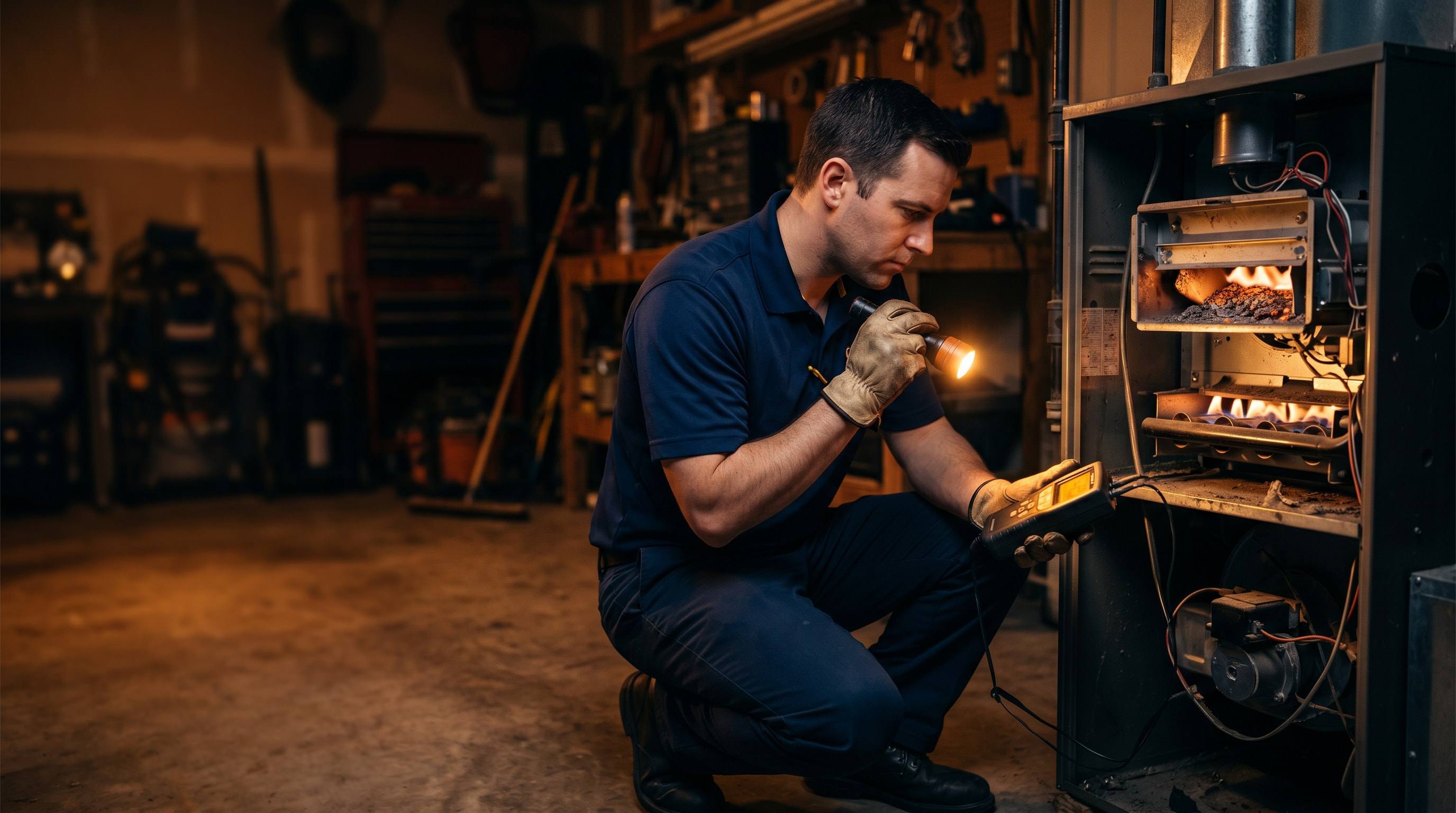
This is the failure-mode companion to our main furnace repair service. The gas valve is the component that lets fuel reach the burners on demand, and because it controls live gas, it is the furnace repair we are most firm about leaving to a licensed technician.
What the gas valve does
The gas valve is an electrically controlled valve that opens to feed gas to the burners when the control board calls for it — but only after the inducer has proven draft and the ignitor is hot. It also regulates the manifold pressure that sets how much gas reaches the burners. Single-stage valves are simply open or closed; two-stage and modulating valves vary the gas rate for comfort and efficiency. When the valve sticks, fails closed, or fails to open on signal, the burners will not light even though everything upstream worked.
Signs the gas valve is the fault
- Ignitor glows bright, no flame. Everything sequences correctly but gas never reaches the burners.
- Weak or partial burner flames from low manifold pressure or a failing valve.
- Delayed ignition — a small "whoomp" as gas pools then lights.
- Inconsistent lighting — the furnace fires some cycles, not others.
A glowing ignitor with no flame can also be a gas-supply problem or a control board not sending the valve its signal, so we verify the valve is energized and measure manifold pressure before condemning it. The full no-light decision tree is on our furnace won’t ignite page; if the furnace lights then quits instead, that points at the flame sensor.
Why this is licensed work — not DIY
We let homeowners change filters and even clean a flame sensor, but the gas valve is where we draw a hard line. It controls live fuel, and an incorrect install, a missed leak at a fitting, or a wrong manifold-pressure setting creates a genuine fire and carbon-monoxide risk. A correct replacement means shutting and verifying the gas, matching the exact valve, leak-checking every joint, and setting manifold pressure with a manometer against the nameplate spec. California treats gas-appliance work as licensed for exactly this reason. If you smell gas, leave and call SoCalGas (1-800-427-2200) or 911; keep CO alarms on every floor, required by California code in homes with gas appliances.
Replacement pricing
| Repair | Typical cost |
| Diagnostic (waived with repair) | $89 / $149 after-hours |
| Gas valve (single-stage) | $385–$555 |
| Gas valve (two-stage / modulating) | $485–$685 |
| Control board (if the cause) | $480–$950 |
Leak check and manifold-pressure verification are included in every gas-valve replacement — not add-ons.
The SoCal angle
A Southern California furnace runs only 200–500 hours a year and sits idle eight to nine months, and one pattern stands out on the gas valve: solenoids stiffen from long disuse, especially on furnaces older than 12 years, and then fail to open cleanly on the first hard cold call in November. It is the same idle paradox behind most SoCal furnace failures — the part does not wear out from use, it seizes from sitting. A fall furnace tune-up that cycles the furnace before the season can surface a marginal valve early.
Repair or replace
At $385–$685 the valve is a mid-range repair: replace it on a sound furnace under about 15 years; run it against a replacement quote past 15–20 years or when it joins other aging parts. A cracked heat exchanger found on the same visit makes it replacement outright — we red-tag and shut the gas. See furnace repair vs. replace for the full framework.
Every major brand
We replace gas valves on every furnace line. Brand-specific no-heat diagnostics: Carrier, Trane, Lennox, Rheem, Goodman, and York furnace not heating.
Frequently asked questions
How much does it cost to replace a furnace gas valve? +
A furnace gas valve replacement runs $385–$685 in Southern California, flat-rate parts and labor, and our $89 diagnostic ($149 after-hours) credits to the repair. The price varies with the valve type — a single-stage valve is at the lower end, a two-stage or modulating valve higher. Because the gas valve controls the fuel itself, replacement includes a leak check on every fitting we touch and verification of correct manifold gas pressure afterward. We confirm the valve is actually the fault before quoting, since a no-flame symptom has several possible causes.
What are the signs of a bad furnace gas valve? +
The classic sign is that everything else in the ignition sequence works — the inducer runs, the ignitor glows bright — but the burners never light, because no gas is reaching them. Sometimes you get partial or weak burner flames, delayed ignition with a small "whoomp," or a furnace that lights inconsistently. A gas valve can fail open, fail closed, or stick. Because a glowing ignitor with no flame can also be a gas-supply or control-board issue, we verify the valve is receiving its signal and check manifold pressure rather than condemning it on symptoms alone.
Can I replace a furnace gas valve myself? +
No. This is the one furnace repair we most strongly steer homeowners away from doing themselves. The gas valve is the component that controls live fuel, and an incorrect installation, a missed leak, or a wrong manifold pressure setting creates a genuine fire and carbon-monoxide risk. California treats gas-line and gas-appliance work as licensed work specifically because of this. Replacing a gas valve requires shutting and verifying the gas, matching the exact valve, leak-checking every joint, and setting manifold pressure with a manometer. That is licensed-technician work, not a DIY project.
Is a furnace gas valve problem dangerous? +
It can be, which is why it is diagnosed and repaired by a licensed technician. A valve that leaks gas, fails to shut fully, or causes delayed ignition (gas pooling then igniting with a "whoomp") is a real hazard. The safety systems — flame sensor, pressure switch, limit switches — are designed to shut things down when ignition is not clean, but a failing gas valve should never be ignored or worked around. If you smell gas at any time, leave the house and call SoCalGas (1-800-427-2200) or 911 — do not flip switches or use phones inside. Keep CO alarms on every floor.
Why won’t my furnace light even though the ignitor glows? +
When the ignitor glows bright orange-white but the burners never catch, gas is not reaching or igniting at the burners. The leading causes are a closed or failing gas valve, a gas-supply problem (a closed manual shutoff, an empty tank on propane, or low pressure), or a control board not sending the valve its open signal. Less often it is a draft or pressure-switch fault interrupting the sequence right at the gas step. We confirm the valve is getting its signal and measure gas pressure to separate a valve fault from a supply or board issue. The full tree is on our furnace won’t ignite page.
Should I replace the gas valve or the whole furnace? +
At $385–$685 the gas valve is a mid-range repair, so furnace age and overall condition decide. Under about 15 years and otherwise sound, replacing the valve is a reasonable fix that restores the furnace for years. Past 15–20 years — especially if the valve failure comes alongside a tired heat exchanger, a worn inducer, or other aging parts — we run the repair against a replacement quote, because a string of repairs on an old furnace rarely beats replacing it. A cracked heat exchanger found during the same visit changes the answer to replacement outright. We give you both numbers.
What is manifold gas pressure and why does it matter? +
Manifold pressure is the gas pressure delivered to the burners, and it must be set within the manufacturer’s spec for the furnace to burn safely and efficiently — commonly around 3.5 inches of water column for natural gas on many residential furnaces, but it varies by model and fuel. Too high wastes gas and can overheat the heat exchanger; too low causes weak flames and poor heating. Whenever we replace a gas valve we set and verify manifold pressure with a manometer against the unit’s nameplate. It is one of the steps that separates a correct gas-valve replacement from a dangerous one, and a reason this is licensed work.