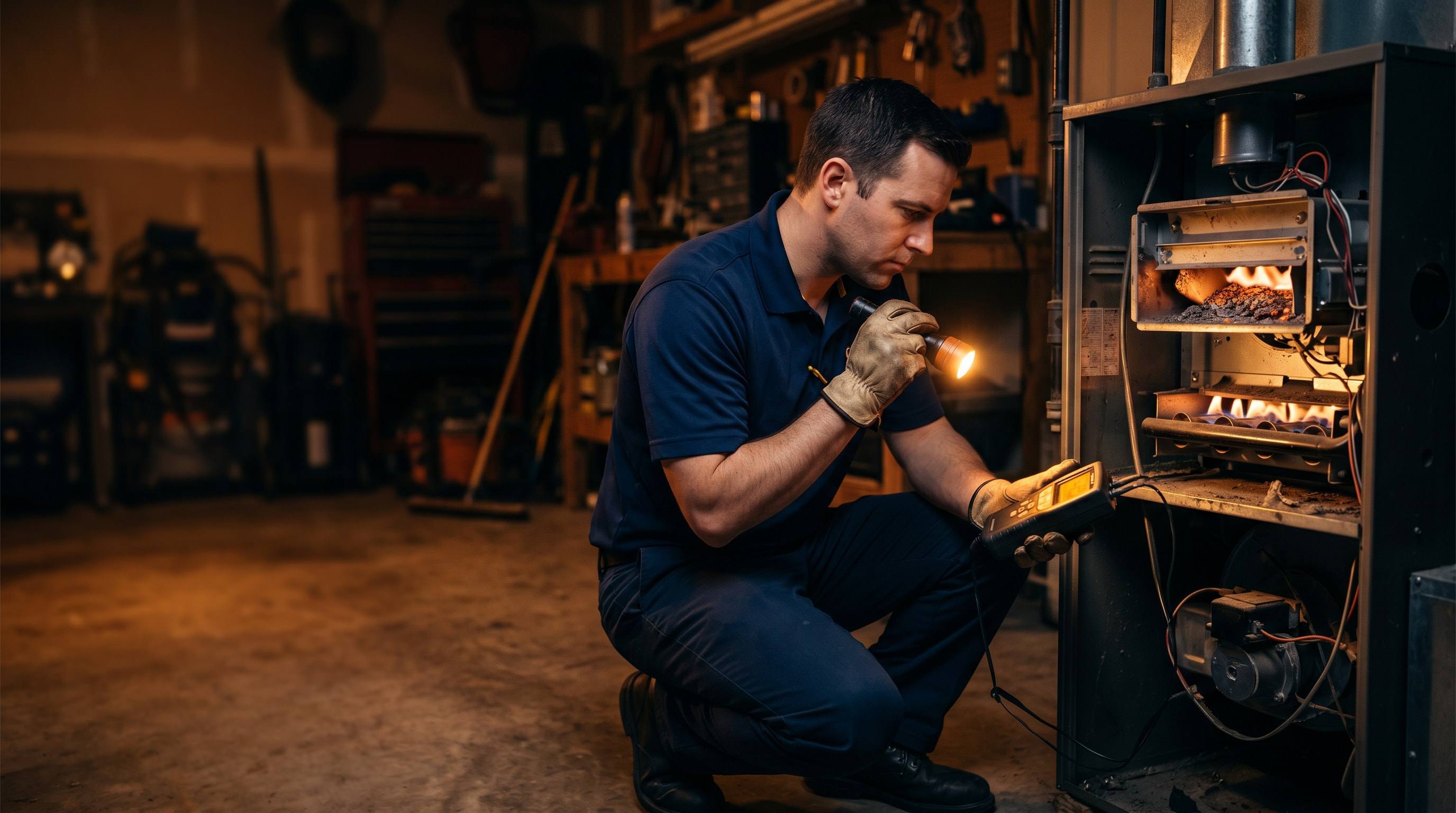
This is the failure-mode companion to our main furnace repair service. The draft inducer is the first thing that spins up when your furnace starts, and when it fails the furnace simply will not fire.
What the inducer motor does
At the start of every heating cycle the draft inducer runs for a few seconds before ignition. It pulls combustion air through the burners and heat exchanger and pushes the exhaust out the flue, establishing the draft the furnace needs to burn cleanly and carry carbon monoxide outdoors. A pressure switch senses that the inducer is actually moving air; only when the switch closes does the control board energize the ignitor and open the gas valve. The inducer is the first safety gate in the ignition sequence: no proven draft, no flame.
Signs of a failing inducer
- Loud noise at startup — humming, grinding, rattling, or a high-pitched whine from worn bearings.
- Furnace won’t light at all because the pressure switch never closes to prove draft.
- Intermittent operation — the inducer runs sometimes, stalls others.
- A hum with no spin — a seized motor drawing current but not turning.
Because the inducer must prove draft before ignition, a failure usually shows up as a no-heat call with the burners never lighting — the same end symptom as several other faults, which is why we diagnose the sequence rather than guessing. The full tree is on our furnace won’t ignite page.
The CO safety angle
The inducer-and-pressure-switch interlock exists for a serious reason: it guarantees the furnace never burns gas without venting the exhaust. Running combustion without proper draft would let carbon monoxide back up into the home. So a dead inducer producing a no-heat call is the safety system working exactly as intended — do not try to defeat the pressure-switch interlock to force the furnace to run. Keep CO alarms on every floor (required by California code in homes with gas appliances), and if one sounds, leave and call 911.
Replacement pricing
Flat-rate, from our SoCal tickets; diagnostic $89 ($149 after-hours), credited to the repair:
| Repair | Typical cost |
| Diagnostic (waived with repair) | $89 / $149 after-hours |
| Draft inducer motor / assembly | $580–$1,100 |
| Pressure switch (often related) | $245–$385 |
| Control board | $480–$950 |
The range is wide because some furnaces use a simple motor and others a sealed motor-and-housing assembly; condensing 96% furnaces differ from 80% units. We confirm the exact part for your furnace before quoting.
Why inducers fail in SoCal — the idle paradox
A Southern California furnace runs only 200–500 hours a year against 1,500-plus in a cold climate, and sits idle eight to nine months. Inducer bearings stiffen and dry out over that long off-season, then get asked to spin up cold on the first November call — which is when noisy or seized inducers show up. On high-efficiency condensing furnaces we also see inducer housings fouled by condensate and corrosion. A fall furnace tune-up exercises and inspects the inducer before the season, catching a noisy bearing before it strands you mid-cold-snap. A noisy inducer is a plan-ahead repair, not an emergency — but it rarely improves on its own.
Repair or replace
At the top of the single-part price range, inducer replacement is where furnace age starts to matter. Under about 12 years and otherwise healthy, replace the inducer. Past 15 years, or alongside a tired heat exchanger, we run the repair against a full furnace replacement quote — see furnace repair vs. replace. Spending $900 on an inducer in a furnace due for replacement within a year rarely pencils out, and we will say so.
Every major brand
We replace inducers on every furnace line — Carrier, Trane, Lennox, Rheem, Goodman, and York furnace not heating cover the brand-specific draft and ignition diagnostics.
Frequently asked questions
How much does it cost to replace a furnace draft inducer motor? +
A draft inducer motor replacement runs $580–$1,100 in Southern California, flat-rate parts and labor, and our $89 diagnostic ($149 after-hours) credits to the repair. The range is wide because inducer assemblies vary a lot by furnace — some are a simple motor, others a sealed motor-and-housing assembly that costs more, and high-efficiency condensing furnaces use a different inducer than 80% units. We confirm the exact part for your furnace and quote it before any work begins. If the bearings are just noisy but the motor still moves air correctly, we tell you how long you realistically have before replacement.
What does the draft inducer motor do? +
The draft inducer is a small fan that runs at the start of every heating cycle, before the burners light. It pulls combustion air through the heat exchanger and pushes exhaust gases out the flue, creating the safe draft the furnace needs to burn cleanly and vent carbon monoxide outdoors. A pressure switch confirms the inducer is actually moving air; only then does the control board allow ignition. No inducer, no draft, no ignition — the furnace will not light at all as a safety interlock. It is the first thing that spins up when you hear the furnace start.
What are the signs of a bad inducer motor? +
Common signs: a loud humming, grinding, rattling, or high-pitched whine from the furnace at the very start of the cycle; the furnace not igniting at all because the pressure switch never closes; or an inducer that runs intermittently. A motor with worn bearings often gets noisy for weeks or months before it quits. Sometimes a seized inducer just hums and does not spin. Because the inducer must prove draft before ignition, a failed one usually shows up as a no-heat call with the burners never lighting. We confirm with an electrical and airflow check rather than condemning the motor on sound alone.
Can a furnace run with a bad inducer motor? +
No, and that is by design. The furnace will not allow the burners to light until the pressure switch confirms the inducer is pulling proper draft. If the inducer is failing or seized, the pressure switch never closes, and the control board blocks ignition as a safety interlock so you never get combustion without venting. This is a good safety feature — running a furnace without proper draft would let exhaust and carbon monoxide back up into the home. So a dead inducer means no heat, but it also means the furnace is protecting you. Do not try to defeat the interlock.
Is a noisy inducer motor an emergency? +
Not usually an emergency, but it is a warning worth acting on. A humming or grinding inducer typically has worn bearings and is on a path to failure, often within weeks during heavy use. It is not dangerous to run short-term as long as the furnace is still igniting and venting normally, but it tends to fail at the worst time — the first hard cold snap. If the noise is paired with the furnace failing to light, or you notice any soot, odd smells, or a CO alarm, stop using it and call. Otherwise, plan the replacement before the cold rather than during it.
Why would an inducer motor fail in Southern California? +
The same idle paradox that drives most SoCal furnace failures. These furnaces run only 200–500 hours a year and sit unused eight to nine months, so inducer bearings stiffen and dry out during the long off-season and then are asked to spin up cold on the first November heating call. We also see inducer housings on high-efficiency condensing furnaces fouled by condensate and corrosion, and the occasional control-board or pressure-switch fault masquerading as an inducer problem. The fix is preventive: a fall tune-up exercises and inspects the inducer before the season, catching a noisy bearing before it strands you.
Should I replace the inducer or the whole furnace? +
At $580–$1,100, the inducer is one of the pricier single-part furnace repairs, so the furnace age matters. Under about 12 years and otherwise sound, replace the inducer — it is well short of replacement cost and buys many more years. Past 15 years, or if the inducer failure comes alongside a tired heat exchanger or other aging parts, we run the repair against a furnace-replacement quote, because spending $900 on an inducer in a furnace that needs replacing within a year or two rarely makes sense. We show you both numbers and let you decide.