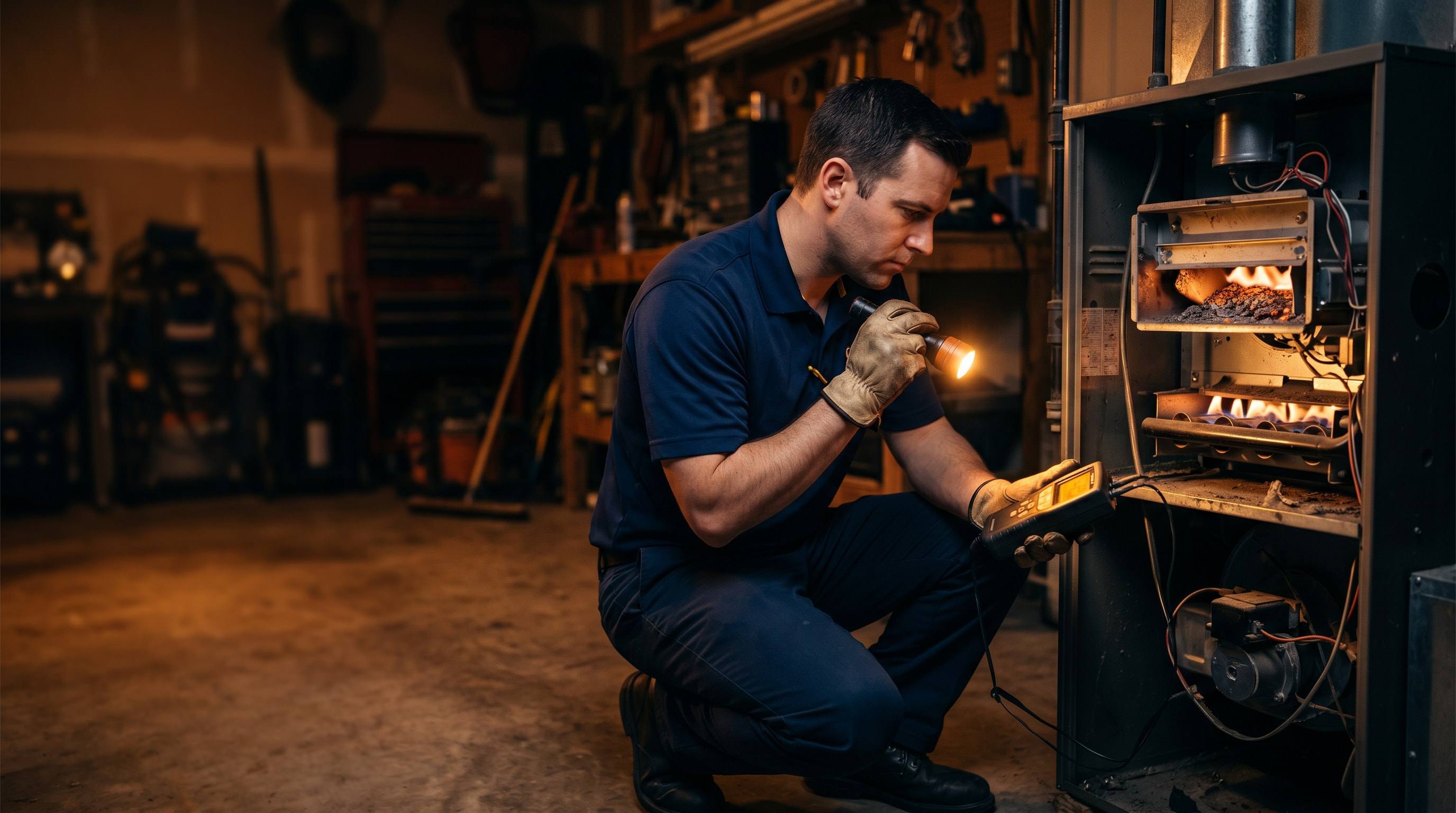
This is the failure-mode companion to our main furnace repair service. The pressure switch is a small safety device that causes a big symptom: when it reads open, the furnace will not light at all.
What the pressure switch does
When the thermostat calls for heat, the draft inducer spins up first and creates a slight vacuum in the venting system. The pressure switch senses that vacuum through a small rubber hose; if the draft is correct, the switch closes and the control board proceeds to fire the ignitor and open the gas valve. If the switch does not close, the board treats it as “open’’ and refuses to light. It is the gate that guarantees the furnace never burns gas without proven venting — the protection that keeps combustion exhaust and carbon monoxide going outdoors.
What "stuck open" actually means
- Clogged condensate trap or drain — the top cause on 90%-plus condensing furnaces. Water backs up and draft cannot be proven.
- Blocked or restricted vent / intake pipe — debris, a bird or rodent nest, or ice in mountain installs.
- Cracked, disconnected, or water-filled switch hose.
- Weak draft inducer not pulling enough vacuum to close the switch.
- A genuinely defective switch — the case where the part really is the fault, but the least common one.
“Stuck open’’ is the board telling you draft was never proven. The fix is finding the restriction, not reflexively swapping the switch. The full no-light chain is on our furnace won’t ignite page.
Pressure switch vs. inducer — the measurement that decides
Because the switch only closes when the inducer creates enough vacuum, a weak inducer makes a good switch read open. We measure the actual vacuum the inducer produces against the switch’s rated set-point: if the inducer pulls spec and the switch still will not close, the switch (or a blocked hose or vent) is the fault; if the inducer is below spec, the inducer is. That single measurement is what separates a $245–$385 switch job from a $580–$1,100 inducer job — and why we never guess.
Never bypass the switch — the CO connection
Homeowners sometimes jump out a pressure switch to force the furnace to run. Do not. The switch is the protection that keeps the furnace from burning gas when venting is blocked — defeating it can route carbon monoxide back into the home. CO is colorless, odorless, and lethal. Keep CO alarms on every floor (California code requires them in homes with gas appliances), and if one sounds, leave and call 911. We test CO and inspect the full venting path on every furnace diagnostic.
Replacement pricing
| Repair | Typical cost |
| Diagnostic (waived with repair) | $89 / $149 after-hours |
| Pressure switch | $245–$385 |
| Condensate trap clear / vent clearing | quoted with diagnosis |
| Draft inducer motor (if the cause) | $580–$1,100 |
The SoCal angle
Two patterns stand out here. On the many high-efficiency condensing furnaces installed across newer Inland Empire and OC tract homes, a clogged condensate trap after a long idle summer is the most common pressure-switch trigger on the first fall run. And in mountain installs — Big Bear, Wrightwood — a vent or intake partially blocked by ice or a nest shows up when the furnace finally runs hard in winter. Because SoCal furnaces sit idle 8–9 months and run only 200–500 hours a year, a fall tune-up that clears the condensate path and checks the vent heads off most of these.
Every major brand
Pressure-switch faults occur on every furnace line. The brand pages carry the model-specific codes — Carrier, Trane, Lennox, Rheem, Goodman, and York furnace not heating.
Frequently asked questions
How much does it cost to replace a furnace pressure switch? +
A furnace pressure switch replacement runs $245–$385 in Southern California, flat-rate parts and labor, and our $89 diagnostic ($149 after-hours) credits to the repair. As with the limit switch, the part is inexpensive but the diagnosis is the value: a pressure switch usually opens because of a real venting or condensate problem, not because the switch failed. Replacing the switch without clearing a clogged condensate trap or a blocked vent just repeats the fault. We confirm whether the switch itself is bad or it is correctly reporting a draft problem before quoting.
What does a furnace pressure switch do? +
The pressure switch is a safety device that confirms the draft inducer is actually moving air before the furnace is allowed to light. When the inducer spins up, it creates a slight vacuum the switch senses through a small rubber hose; if the vacuum is correct, the switch closes and the control board proceeds to ignition. If the inducer is not moving enough air — or the vent is blocked — the switch stays open and ignition is blocked. It is the gate that guarantees the furnace never burns gas without proper venting, which is what keeps combustion exhaust and carbon monoxide going outdoors.
What does "pressure switch stuck open" mean? +
It means the control board energized the inducer but the pressure switch never closed, so the board reads it as open and refuses to light the burners. The most common real causes are a clogged condensate trap or drain line on a high-efficiency furnace, a blocked or restricted vent or intake pipe, a cracked or disconnected pressure-switch hose, a weak draft inducer not creating enough vacuum, or water sitting in the switch hose. Occasionally the switch itself is defective. "Stuck open" is the board telling you draft was never proven — and the fix is finding why, not just swapping the switch.
Why does my furnace pressure switch keep tripping? +
Repeated pressure-switch faults almost always trace to venting or condensate. On 90%-plus condensing furnaces, the number-one cause we find is a clogged condensate trap or drain — water backs up and the switch cannot see proper draft. Other repeat causes: a partially blocked flue or intake (debris, a bird nest, or ice in mountain installs), a sagging or water-filled switch hose, or a draft inducer that is wearing out and no longer pulling full vacuum. A switch that trips again right after replacement is proof the cause was never the switch. We clear and verify the venting path as part of the repair.
Can I clean or fix a furnace pressure switch myself? +
This is not a homeowner-reasonable repair. The pressure switch sits in the combustion and venting system of a gas appliance, and a wrong diagnosis — or defeating the switch to force the furnace to run — removes the protection that keeps carbon monoxide venting outdoors. People do sometimes jump the switch to get heat back; that is genuinely dangerous and we will not do it. The one adjacent thing a homeowner can safely check is whether the condensate drain looks obviously clogged, but clearing it correctly and verifying draft is licensed work. We diagnose and confirm on the meter.
Is a pressure switch problem dangerous? +
The switch itself opening is the safety system working — it is preventing the furnace from burning gas without proven venting, which is exactly what you want. The danger comes from two things: an underlying venting blockage that, if defeated, would let carbon monoxide back into the home; and homeowners bypassing the switch to force heat. Never jump out a pressure switch. Keep CO alarms on every floor (required by California code in homes with gas appliances), and if one sounds, leave and call 911. We test CO on every diagnostic and check the full venting path.
Pressure switch or inducer — which one is bad? +
They are linked, which is why they get confused. The pressure switch only closes if the draft inducer creates enough vacuum, so a weak or failing inducer makes a perfectly good switch read open. During the diagnostic we measure the actual vacuum the inducer produces against the switch’s rated set-point: if the inducer is pulling spec and the switch still will not close, the switch (or a blocked hose or vent) is the fault; if the inducer is not pulling spec, the inducer is the fault. That measurement is what separates a $245–$385 switch job from a $580–$1,100 inducer job.