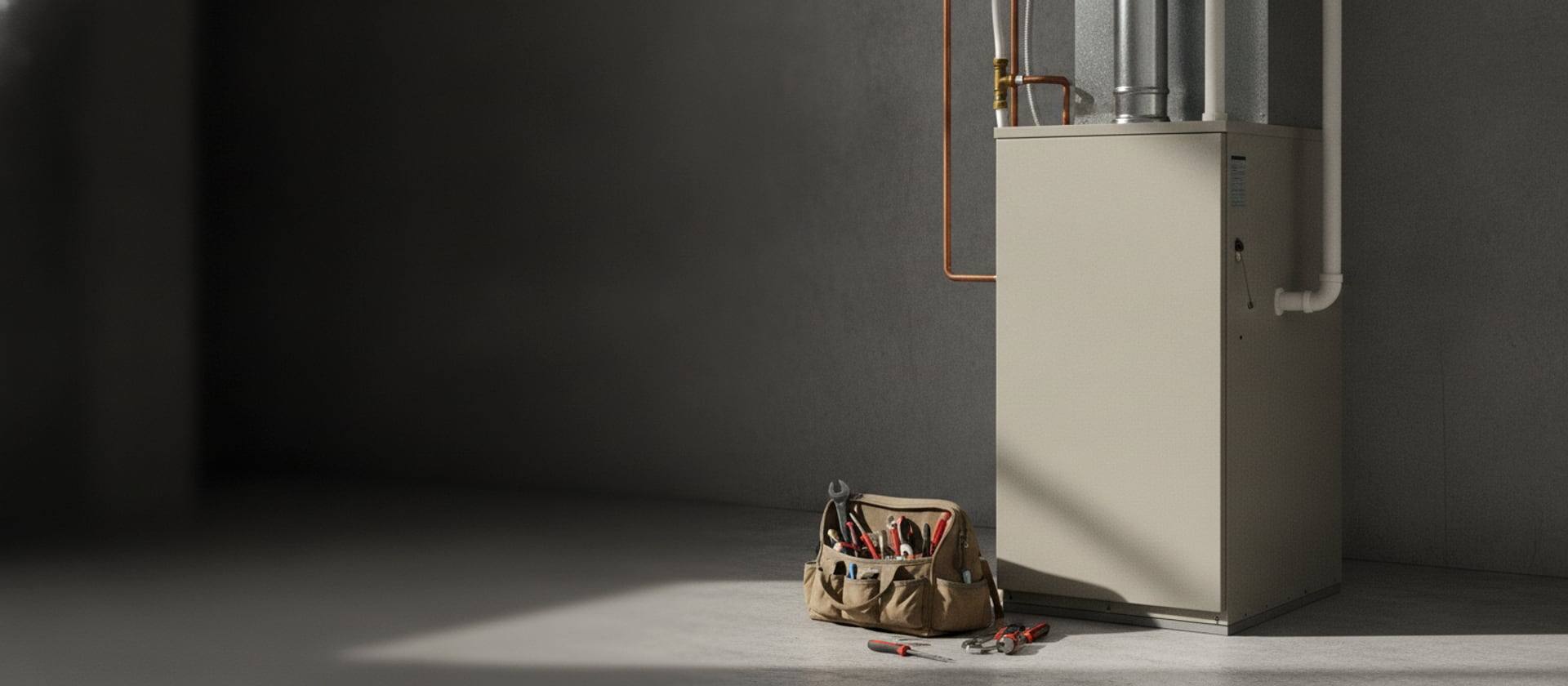
No-heat is the call that defines a SoCal winter: the furnace ran fine in March, sat idle all summer, and now refuses to fire on the first cold night in November. The good news is the failures are predictable and most are inexpensive single-visit fixes. This page is the Rheem-specific companion to our general furnace repair service and our Rheem furnace repair page. Common failure modes have dedicated guides: ignitor replacement, flame sensor, won’t ignite, limit switch, pressure switch, inducer motor, and gas valve.
Why a Rheem furnace stops heating
From years of Rheem and Ruud no-heat calls across SoCal, the causes cluster in a predictable order:
- Hot-surface ignitor wear — the most common no-heat fault. The silicon-nitride ignitor degrades over hundreds of cycles and eventually cracks or no longer reaches ignition temperature. Symptom: blower and inducer run, no flame. $245–$485 installed.
- Flame-sensor fouling — the furnace lights, then shuts down after 3–7 seconds because a dust-coated sensor cannot prove flame to the board. Clean or replace, $185–$295.
- Draft / pressure-switch fault — the inducer cannot prove safe venting, so ignition never starts. Often a clogged condensate trap or a weak inducer on an R96V or R98V.
- Integrated control-board failure — frequently after a Santa Ana voltage transient. $480–$950.
- Gas-valve failure — less common, $385–$685.
- ECM blower motor failure on the air-handling side, $480–$890.
Read the Rheem fault code first
How a Rheem furnace reports a fault depends on its generation, and knowing which you have saves a wrong turn. A communicating furnace on the EcoNet platform shows an alert at the EcoNet Control Center, logged with a time-and-date stamp, and the same fault flashes on the indoor control-board LED. An older or conventional furnace flashes a diagnostic LED on the control board, viewed through the inspection port. Either way the code narrows the fault to a subsystem — ignition, airflow and limit, or pressure and venting — but it is a starting point, not a diagnosis. The full reference is on our Rheem error codes page. Do not keep resetting a furnace that locks out repeatedly; a lockout is a safety response, not a glitch.
The first-cold-night pattern
An LA-basin furnace runs 200–500 hours a year against 1,500-plus in a cold climate, and that long idle stretch from April to October is where no-heat breeds. Dust settles on the flame sensor, the ignitor ages without being exercised, inducer bearings stiffen, and control-board capacitors drift. The first November cold snap asks an untouched furnace to fire cleanly, and the predictable failures surface all at once. Mountain installs in Big Bear and Wrightwood run real heating hours and fail on a different curve — more wear, fewer idle-related faults. Either way, fall maintenance in October is the cheapest insurance; the cold-air and ignition chains are in our furnace blowing cold air and furnace ignitor failure guides, and older standing-pilot units are covered in pilot light won’t stay lit.
Rheem no-heat repair pricing
Flat-rate, parts and labor, from our SoCal service tickets. Diagnostic is $89 ($149 after-hours), credited to the repair if you proceed:
| Rheem furnace repair | Typical cost |
| Diagnostic (waived with repair) | $89 / $149 after-hours |
| Hot-surface ignitor | $245–$485 |
| Flame sensor (clean or replace) | $185–$295 |
| Gas valve | $385–$685 |
| Blower motor (ECM) | $480–$890 |
| Integrated control board | $480–$950 |
| Draft inducer motor (R96V / R98V) | $580–$1,100 |
| Heat exchanger (crack — we quote replacement) | $1,500–$3,500 |
Rheem heat exchangers carry a 20-year limited warranty on most furnaces (lifetime on the Prestige R98V); other parts are warranty-covered when registered. Labor is separate. These are the same flat rates on our Rheem furnace repair page.
Repair or replace your Rheem furnace
Under 10 years old with a repair under roughly a third of replacement cost, repair it — an R96V with a failed ignitor or inducer at year 9 has plenty of cabinet and heat-exchanger life left, and many parts are warranty-covered. Over 15 years, or any age with a cracked heat exchanger, replace it: a cracked exchanger is a carbon-monoxide path, and we red-tag and shut the gas before leaving. The 10-to-15-year window is judgment, and we give you the repair figure and a written replacement quote side by side. See furnace installation when replacement is the call.
Ruud furnaces
Ruud and Rheem furnaces are the same equipment under different badges — same integrated control board, gas valve, ignitor, inducer, and ECM blower, cross-referencing to the same parts and the same no-heat diagnosis. We service both with the same meters and warranty channels. For the cooling side of a Rheem system, see Rheem AC repair, and the full lineup on our Rheem brand page.
Frequently asked questions
Why is my Rheem furnace blowing cold air or not heating at all? +
On a Rheem furnace, no-heat almost always traces to one of four things, in order: a worn hot-surface ignitor that no longer glows hot enough to light the burners, a fouled flame sensor that lets the furnace light then drops it after a few seconds, a draft or pressure problem that stops ignition before it starts, or an integrated control-board fault. If the blower runs and pushes room-temperature air, the control is calling for heat but the burners are not staying lit. The EcoNet alert (on communicating models) or the control-board LED (on older models) narrows it to a subsystem, but the code is a starting point, not a diagnosis. We read it, confirm it on the meter, and name the actual part.
My Rheem furnace will not ignite — what is the most common cause? +
Hot-surface ignitor wear is the single most common Rheem no-ignition call we run. The silicon-nitride ignitor degrades over hundreds of on-off cycles and eventually cracks or no longer reaches ignition temperature. Symptom: the blower and inducer run through the sequence, but no flame ever appears. A close second is flame-sensor fouling, where the furnace lights normally then drops out after three to seven seconds because a dust-coated sensor cannot prove flame to the control board. Both are inexpensive single-visit fixes, and both spike on the first cold night of the season when an idle furnace is asked to fire hard for the first time in months.
My Rheem furnace lights then shuts off after a few seconds — what is that? +
That is the textbook flame-sensor signature. The flame sensor is a thin metal rod that sits in the burner flame and generates a tiny current to prove to the control board that a flame is present. When dust or oxidation coats the rod, the current drops below the threshold, the board assumes there is no flame, and it shuts the gas valve within a few seconds as a safety response. After a few failed cycles the board (or EcoNet) logs a flame-sense fault. Cleaning or replacing the sensor resolves it — we measure the flame-sense microamps to confirm rather than just cleaning and hoping.
How much does it cost to fix a Rheem furnace that is not heating? +
It depends on which part is at fault, and our flat $89 diagnostic ($149 after-hours) credits to the repair. From our SoCal service tickets: hot-surface ignitor $245–$485, flame sensor (clean or replace) $185–$295, gas valve $385–$685, integrated control board $480–$950, blower motor (ECM) $480–$890, draft inducer $580–$1,100. A cracked heat exchanger runs $1,500–$3,500, and at that point we always quote replacement against the repair because it rarely pencils out on an older furnace. We quote the part before any work begins.
Why did my Rheem furnace fail on the first cold night of the year? +
Because that is exactly when an idle furnace gets stress-tested. SoCal furnaces sit unused from spring through October, then the first November cold snap demands a clean first fire. Dust settles on the flame sensor over the summer, a tired ignitor near the end of its life finally cracks, an inducer with worn bearings struggles, or a control-board capacitor that drifted over the idle months gives out. The failures are predictable and they cluster on that first cold call, which is why we push fall maintenance in October — catching them before the cold is far cheaper than an emergency call during it.
Should I keep resetting my Rheem furnace when it locks out? +
No. Repeatedly cycling power to clear a lockout is the trap homeowners fall into, and it can hide a real problem or stress the control board. A lockout — including the one-hour lockout a Rheem control enters after repeated failed attempts — is a safety state, not a glitch. The furnace locked out because it could not safely complete ignition or because a limit or pressure switch tripped. Forcing it to retry over and over can mask a venting or limit problem. Note the EcoNet alert or the LED flash pattern, stop resetting, and call. We read the code on arrival, confirm it on the meter, and fix the cause.
When does a no-heat Rheem furnace mean replace instead of repair? +
Honest dividing line: under 10 years old with a repair under roughly a third of replacement cost, repair it. An R96V or R98V with a failed ignitor, inducer, or ECM blower at year 9 is worth fixing — the cabinet and heat exchanger have life left, and many of those parts are warranty-covered if registered. Over 15 years, or any age with a cracked heat exchanger, replace it: a cracked exchanger is a carbon-monoxide path and we red-tag and shut the gas before leaving. The 10-to-15-year window is judgment, and we give you the repair figure and a written replacement quote side by side.