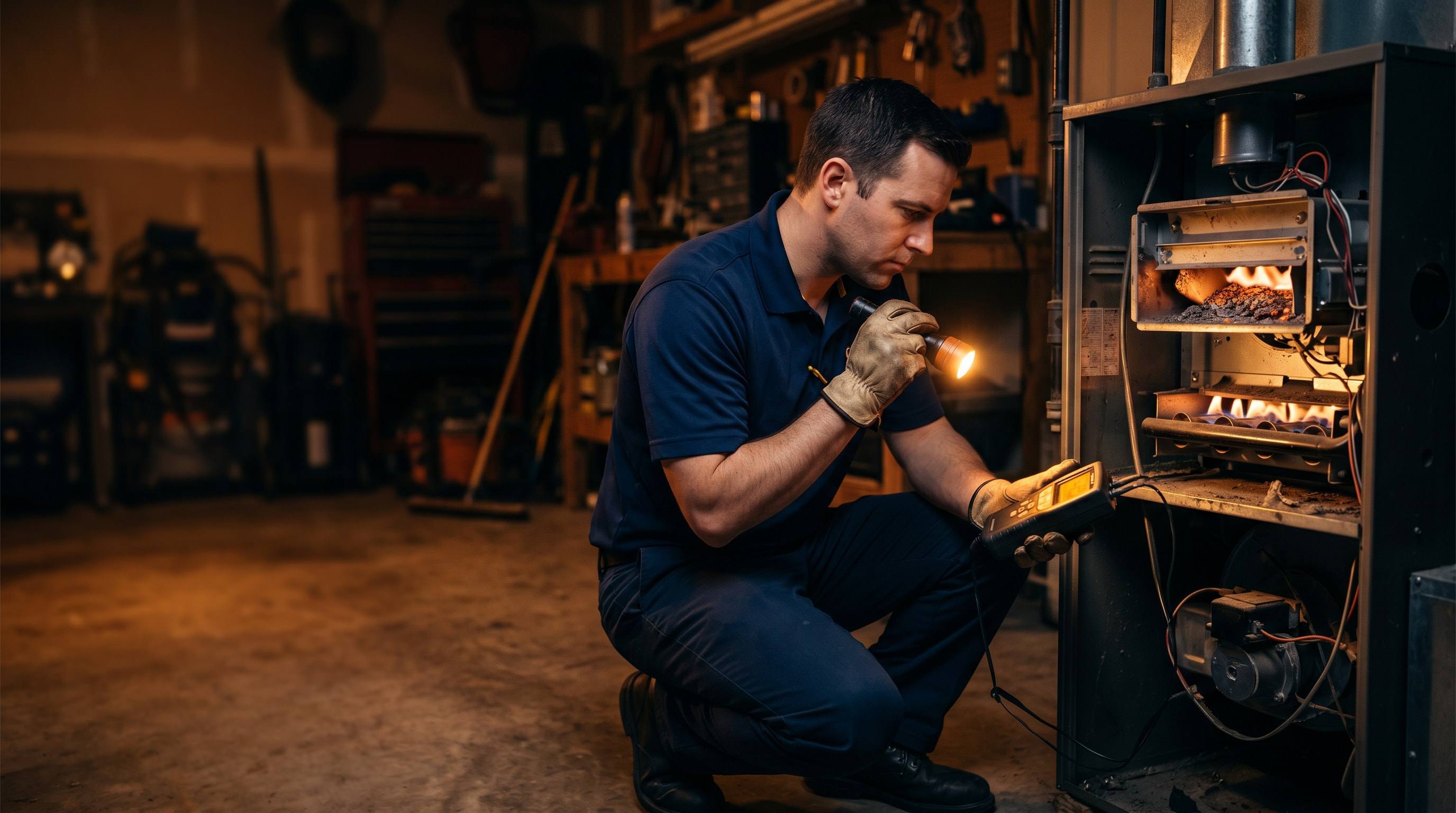
This is the diagnostic hub for our main furnace repair service. “Won’t ignite’’ is an end symptom with several possible causes; this page walks the chain so you know what is likely and where each path leads.
The ignition sequence — and where it breaks
A modern gas furnace lights in a fixed order, and a failure at any stage stops everything downstream:
- Call for heat. Thermostat closes the circuit. Rule out a dead thermostat, flat batteries, the furnace switch, or gas being off.
- Draft proven. The draft inducer spins up and a pressure switch confirms airflow. No proven draft, no ignition.
- Ignitor heats. The hot-surface ignitor glows to over 2,000°F. A cracked or worn ignitor never gets hot enough.
- Gas opens. The gas valve opens and the burners light off the glowing ignitor.
- Flame proven. The flame sensor confirms the flame. If it cannot, the board shuts the gas in seconds.
Match your symptom to the cause
- Blower/inducer run, no glow, no flame → worn ignitor (most common). $245–$485.
- Lights then shuts off after 3–7 seconds, repeating → fouled flame sensor. $185–$295.
- Nothing happens, or inducer hums/won’t spin → inducer or pressure switch. $245–$1,100.
- Ignitor glows fine but burners never light → closed gas valve or gas supply. $385–$685.
- Three tries then lockout → ignitor or flame sensor failing the prove step.
- Standing pilot won’t stay lit → thermocouple, not an ignitor. See pilot light won’t stay lit ($185–$295 thermocouple).
What you can safely check first
Three things are free and homeowner-reasonable before you call: replace the air filter (a severe clog can overheat the furnace and interrupt the cycle), confirm the thermostat is on HEAT with fresh batteries, and verify the furnace switch and gas supply are on. If the furnace still will not light after that, the problem is in the ignition chain and needs a meter. Do not keep cycling a furnace through repeated failed lights — each attempt can release a little unburned gas, and repeatedly clearing a lockout hides the real fault. If you ever smell gas, leave and call SoCalGas (1-800-427-2200) or 911.
Repair pricing across the ignition chain
| Part | Typical cost |
| Diagnostic (waived with repair) | $89 / $149 after-hours |
| Hot-surface ignitor | $245–$485 |
| Flame sensor (clean or replace) | $185–$295 |
| Thermocouple (standing pilot) | $185–$295 |
| Pressure switch | $245–$385 |
| Gas valve | $385–$685 |
| Draft inducer motor | $580–$1,100 |
| Control board | $480–$950 |
Why no-ignition spikes on the first cold night in SoCal
A Southern California furnace runs only 200–500 hours a year and sits idle from spring through October. The ignitor ages without being exercised, summer dust settles on the flame sensor, inducer bearings stiffen, and gas-valve solenoids stiffen from disuse. The first November cold snap asks an untouched furnace to fire cleanly, and the predictable failures surface at once — which is why no-ignition is the defining first-cold-night call. A fall furnace tune-up in October catches most of them before the cold; the cold-air and ignitor chains are detailed in furnace blowing cold air and furnace ignitor failure.
Every major brand
The brand pages carry the model-specific status codes and quirks: Carrier, Trane, Lennox, Rheem, Goodman, Daikin, and York furnace not heating.
Frequently asked questions
Why won’t my furnace ignite? +
In order of how often we see it: a worn hot-surface ignitor that no longer glows hot enough to light the burners; a fouled flame sensor that lets the furnace light then drops it after a few seconds; a draft or pressure-switch fault that stops the sequence before ignition; a closed or failing gas valve; or a control-board fault. On older standing-pilot furnaces, a dirty thermocouple is the usual cause. The pattern tells us which: no glow points at the ignitor, lights-then-quits points at the flame sensor, and nothing happening at all points at draft, gas, or the board. We read the sequence on the meter to confirm.
My furnace clicks but won’t light — what does that mean? +
A clicking sound with no flame usually means the ignition system is trying to fire but the burners are not catching. On a spark-ignition furnace the click is the igniter sparking; if you hear it but get no flame, the gas may not be reaching the burner (a closed gas valve, a draft fault stopping the sequence, or a gas-supply problem) or the spark is not strong enough. On a hot-surface system there is no click, so a clicking relay can also be the control board cycling. The diagnostic is to watch the full sequence and meter each stage. Repeated clicking without ignition ends in a lockout.
My furnace tries to start 3 times then stops — why? +
That is a textbook ignition lockout. The control board gives the furnace three attempts to light and prove a flame; if it cannot, it locks out and stops trying to avoid pumping unburned gas into the heat exchanger. The most common reasons it fails all three: a worn ignitor that will not light the gas, or a fouled flame sensor that lets it light but cannot prove the flame so the board shuts the gas within seconds. You can clear a lockout once by cycling power, but if it locks out again, stop — repeated resets can mask a venting or gas problem. We diagnose the cause rather than reset and hope.
How much does it cost to fix a furnace that won’t ignite? +
It depends entirely on which part in the ignition chain failed, and our flat $89 diagnostic ($149 after-hours) credits to the repair. From our SoCal tickets: hot-surface ignitor $245–$485, flame sensor (clean or replace) $185–$295, gas valve $385–$685, pressure switch $245–$385, draft inducer $580–$1,100, control board $480–$950. On a standing-pilot furnace, a thermocouple is $185–$295. The diagnostic exists precisely so we identify the real fault before quoting, instead of replacing parts one at a time and billing you for each guess.
Is it safe to keep trying to light a furnace that won’t ignite? +
A couple of attempts are fine, but do not keep forcing it. Each failed ignition cycle can release a small amount of unburned gas before the safety shuts it off, and repeatedly clearing a lockout can hide a real venting, draft, or gas-valve problem. If you smell gas at any point, stop, leave the house, and call SoCalGas (1-800-427-2200) or 911 — do not flip switches. If the furnace simply will not light after two or three clean attempts, the right move is to stop and have it diagnosed rather than cycling it over and over.
Could a dirty filter stop my furnace from igniting? +
Indirectly, yes. A severely clogged filter restricts airflow and can cause the furnace to overheat and trip the high-limit, which interrupts the heating cycle and can look like an ignition failure. More often a dirty filter causes short cycling rather than a hard no-ignition, but it is always worth ruling out first because it is free. Replace the filter, make sure supply registers are open, and try again. If the furnace still will not light, the problem is in the ignition chain itself — ignitor, flame sensor, gas, or draft — and that is our diagnostic.
Should I call a pro or try to fix this myself? +
The one homeowner-reasonable check is the air filter, plus confirming the thermostat is set to HEAT with good batteries and the furnace switch and gas are on. Beyond that, a furnace that will not ignite involves gas, combustion, and safety circuits, and California treats gas-appliance internals as licensed work for good reason. Cleaning a flame sensor is the one internal task we consider safe to attempt. Replacing an ignitor, gas valve, pressure switch, or board on a furnace that will not light is a job to confirm on the meter and install correctly — that is our call.