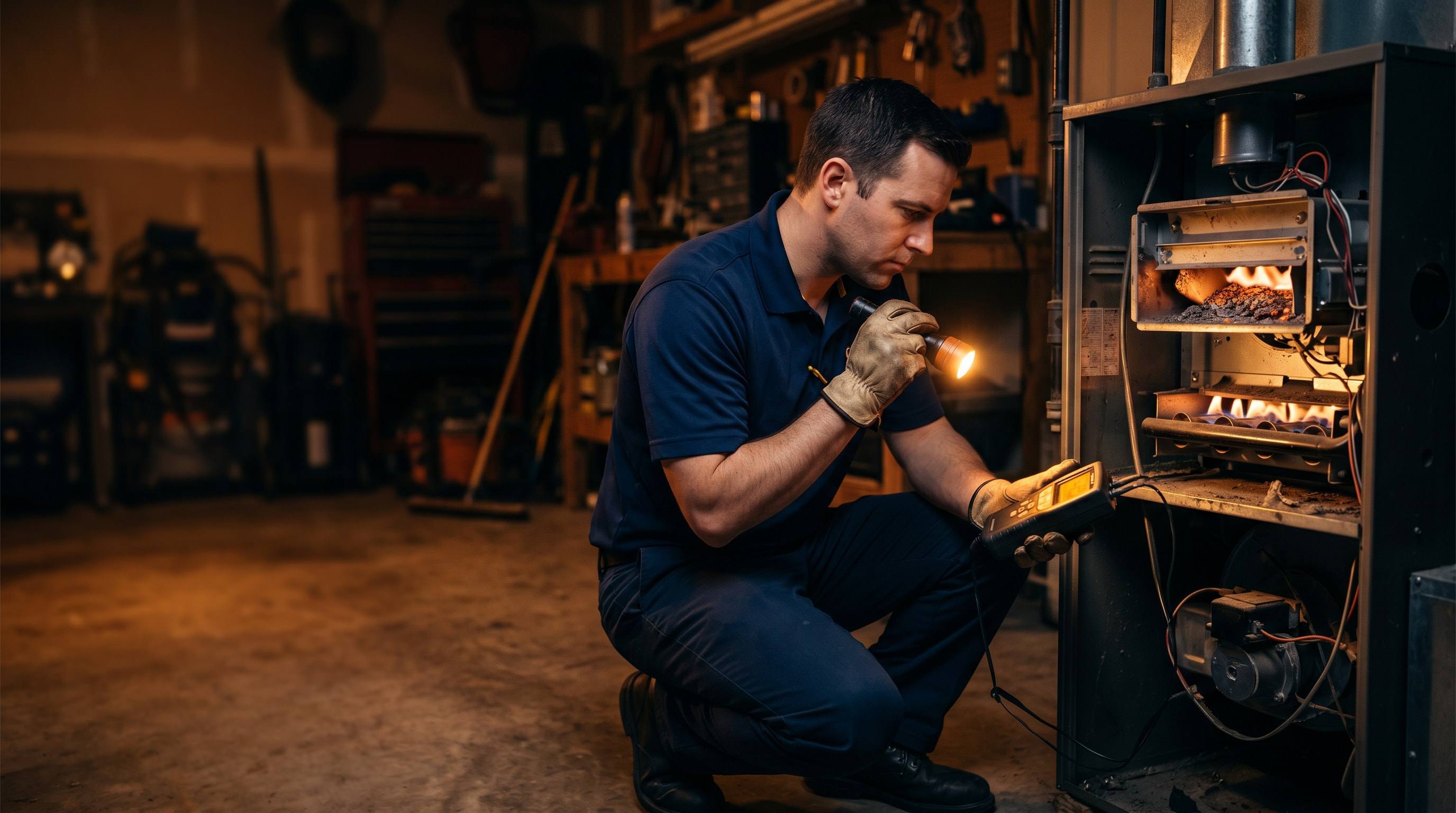
This is the failure-mode companion to our main furnace repair service. The flame sensor is one of the cheapest parts in the furnace and one of the most common reasons a furnace cuts out seconds after lighting.
What the flame sensor does
After the burners light, a thin metal rod sitting in the flame generates a tiny electrical current — flame rectification — that tells the control board a real flame is burning. This is a safety circuit: if the board does not sense that current within a couple of seconds, it assumes ignition failed and slams the gas valve shut so it never floods the heat exchanger with unburned gas. When the rod gets coated with dust, oxidation, or carbon, the current drops below the threshold and the board shuts the furnace down even though a flame is actually present.
The signature symptom
- Lights then quits. Burners ignite normally, run 3–7 seconds, then shut off — and the cycle repeats.
- Multiple short cycles before the furnace gives up and locks out.
- Intermittent at first. Early fouling causes occasional dropouts that become constant as the coating builds.
Because the burners do light, you know the ignitor and gas valve are basically working — the problem is downstream at flame proving. If the furnace never lights at all, that is a different chain; see furnace won’t ignite.
Cleaning vs. replacement — and the microamp test
We read the flame-sense current in microamps at the control board test port. Most furnaces want a few microamps of clean signal; a reading under roughly 1.5 microamps is marginal and explains a dropout. If cleaning the rod brings the reading back into range, that is the fix. If the rod is cracked, the ceramic insulator is breaking down, or it fouls again within weeks, we replace it. Either way the labor is the same $185–$295 line and we prove the repair with a second reading before we leave.
Cleaning a flame sensor yourself
This is the rare furnace-internal task we consider homeowner-reasonable. Power off, gas valve off. The sensor is a single rod held by one screw near the burners. Polish the metal rod gently with fine steel wool or an emery cloth, never grit sandpaper, never bend the rod, and do not handle the ceramic insulator with oily fingers. Reinstall, restore power, and test. If it lights and stays lit, you saved a service call. If it drops out again, stop — the reading is telling us something the eye cannot, and that is when to call. Unlike most gas-furnace work, this one is safe to attempt; almost everything else inside the cabinet is licensed work.
Why SoCal furnaces foul their sensors
A Southern California furnace runs only 200–500 hours a year and sits idle from spring through October. Eight to nine months of settled dust bakes onto the sensor the first time the burners fire, which is exactly why flame-sensor dropouts cluster on the first cold night in November across the Valley, Pasadena, and the foothills. It is the most common single fault behind a first-cold-snap no-heat call. An annual cleaning at the fall furnace tune-up heads it off; details on the cold-air version of this symptom are in furnace blowing cold air.
Every major brand
Flame-sensor faults are universal across Carrier, Trane, Lennox, Goodman, Rheem, York, and the rest — same part, same symptom, same fix. For the brand-specific no-heat walkthrough see Carrier, Trane, Lennox, Rheem, Goodman, Daikin, and York furnace not heating.
Frequently asked questions
How much does it cost to replace or clean a furnace flame sensor? +
Flame-sensor service runs $185–$295 in Southern California, whether we clean the existing sensor or replace it, flat-rate parts and labor. Our $89 diagnostic ($149 after-hours) credits to the repair. The sensor itself is a $10–$30 part; the value is in measuring the flame-sense current to confirm the sensor is actually the fault, cleaning or swapping it correctly, and verifying the microamp reading comes back into range afterward. Cleaning often restores a fouled sensor, but if the rod is cracked or the ceramic insulator is failing we replace it instead.
How do I know if my flame sensor is bad? +
The textbook signature is that the furnace lights normally, runs for three to seven seconds, then shuts the burners off — and it repeats that cycle. The flame sensor proves to the control board that a flame is present; when dust or oxidation coats the rod, the sensed current drops below the threshold, the board assumes there is no flame, and it closes the gas valve as a safety response. If your furnace fires then quits a few seconds later, over and over, a fouled flame sensor is the most likely cause. We confirm it by reading the flame-sense microamps at the test port rather than just cleaning and hoping.
Can I clean a furnace flame sensor myself? +
This is the one furnace-internal task we consider homeowner-reasonable, with caution. Turn off power to the furnace and shut the gas valve first. The sensor is a single thin rod held by one screw near the burners; remove it, gently polish the metal rod with fine steel wool or an emery cloth (never sandpaper grit that leaves residue, and never bend the rod), wipe it clean, and reinstall. Do not touch the ceramic insulator with oily fingers. If the furnace still drops out after a careful cleaning, stop — the reading is telling us the sensor or something upstream needs a meter, and that is our call.
How often should a flame sensor be cleaned? +
Once a year is the right cadence in Southern California, and the natural time is the fall furnace tune-up before the heating season. Because SoCal furnaces sit idle for eight to nine months, a summer of settled dust is exactly what fouls the sensor and causes that first-cold-night short-cycle. Cleaning the flame sensor is a standard line item in our maintenance visit. Homes near construction, in dusty inland areas, or with pets may need it more often. A sensor that fouls again within weeks of a good cleaning usually means the rod is degraded and due for replacement.
What is a normal flame sensor microamp reading? +
Most residential gas furnaces want a flame-sense current in the range of roughly 2 to 6 microamps, with manufacturers commonly flagging anything under about 1.5 microamps as marginal and headed for a dropout. A clean, healthy sensor on a good flame typically reads in the mid-single-digit microamps; a fouled one reads a fraction of that. The exact threshold varies by manufacturer and control board, so we read against the spec for your unit. The point of measuring is to confirm the sensor is the real fault and to prove the fix worked, not to swap parts on a hunch.
Why does my furnace keep shutting off after a few seconds? +
The short-cycle-then-quit pattern almost always means the flame is lighting but not being proven. A fouled or failing flame sensor is the most common cause, but the same symptom can come from a cracked sensor rod, a poor ground at the furnace, a marginal flame from a dirty burner, or a control-board issue reading the signal. Because it lights first, you know the ignitor and gas valve are basically working — the problem is downstream at flame proving. We measure the microamp draw and check the burner flame and ground before deciding between a clean and a replacement.
Is the flame sensor the same as the ignitor? +
No, and mixing them up is common. The ignitor is what lights the burners — on modern furnaces a hot-surface element that glows red-hot, on older units a standing pilot. The flame sensor is a separate thin metal rod that sits in the burner flame after ignition and tells the control board the flame is actually burning. An ignitor failure means the burners never light at all; a flame-sensor failure means they light then shut off seconds later. Different parts, different symptoms, different fixes. See our furnace ignitor replacement page for the ignition side.