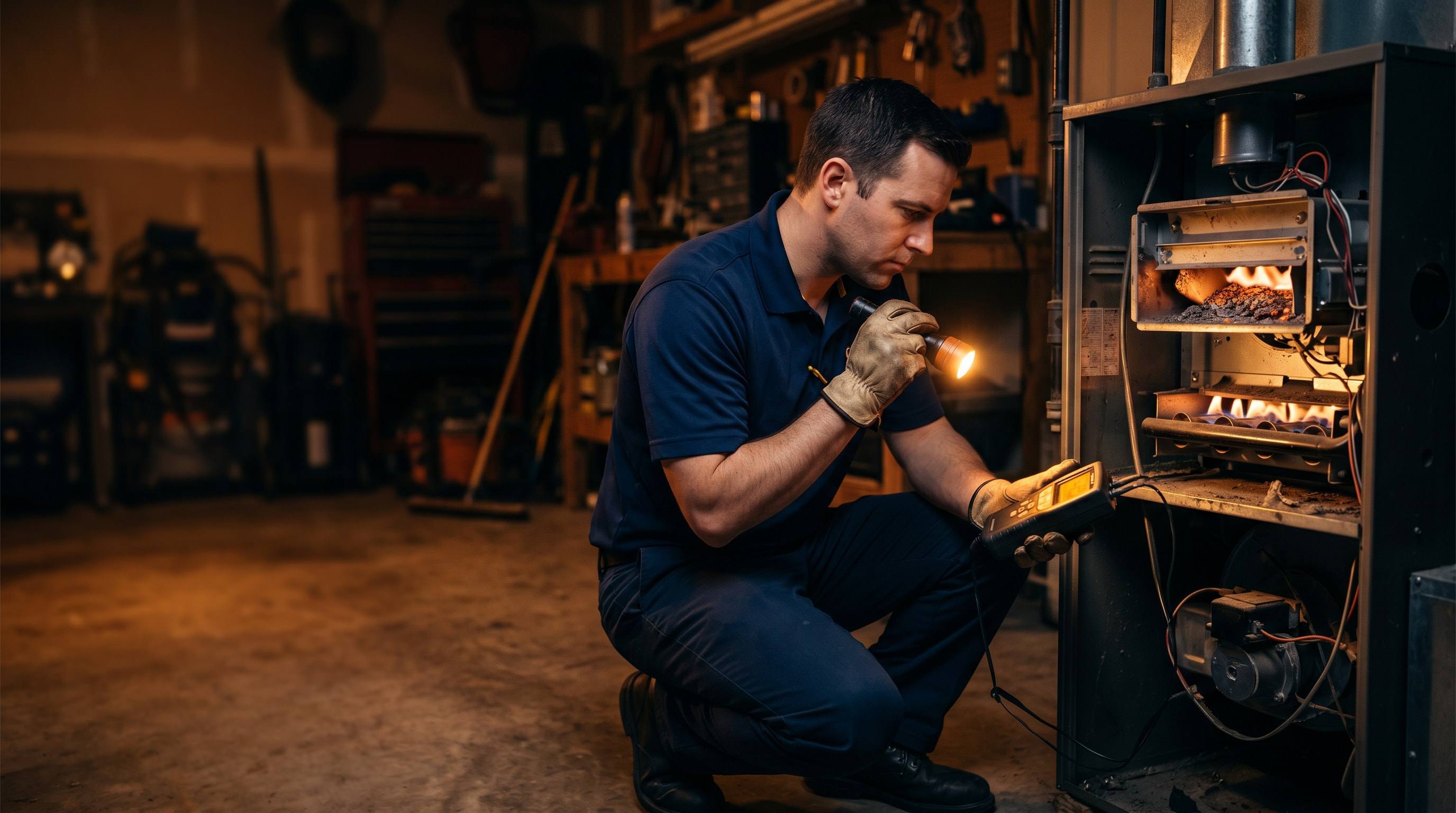
This is the failure-mode companion to our main furnace repair service. The high-limit switch is one of the most misunderstood furnace parts: people want to replace it, when usually it is doing its job and pointing at an airflow problem.
What the limit switch does
The high-limit switch sits in the heat-exchanger plenum and monitors air temperature. When the air leaving the heat exchanger climbs past a set threshold, the switch opens, cuts power to the gas valve to stop the burners, and typically keeps the blower running to dump the excess heat. It is protecting the heat exchanger from overheating to the point of cracking — which is both an expensive failure and a carbon-monoxide hazard. Most furnaces also carry a rollout limit (watches for flame escaping the burner box) and sometimes an auxiliary limit. When the furnace overheats, the limit is the part that saves it.
Why a limit switch trips
- Dirty air filter — the single biggest cause. Restricts airflow, the plenum overheats, the limit opens.
- Closed or blocked supply registers and furniture over the returns.
- Dirty blower wheel or a failing blower/inducer motor not moving enough air.
- Undersized, crushed, or disconnected return ducts.
- A genuinely weak limit switch tripping below its rated temperature — the case where the part actually is the fault.
- A dirty or cracked heat exchanger — the serious case, with CO risk.
Limit switch & short cycling are the same problem
The classic short-cycle — burners light, run briefly, shut off while the blower keeps going, then repeat — is very often the high-limit opening on an overheat and resetting as the plenum cools. A dirty filter drives the majority of these. So a tripping limit and short cycling are usually two ways of describing one airflow restriction. The full pattern, including the 60%-are-the-filter statistic, is in our furnace short-cycling guide, and the cold-air version in furnace blowing cold air.
Never bypass the limit — the CO connection
Jumping out a limit switch to keep the heat on is dangerous and we will not do it. The limit is the protection that keeps an overheating furnace from cracking the heat exchanger, and a cracked heat exchanger leaks carbon monoxide — colorless, odorless, lethal — into the home. Resetting a manual-reset limit once to restore heat is reasonable, but a limit that keeps tripping is reporting a real overheat. Make sure CO alarms are installed on every floor (California code requires them in homes with gas appliances), and if one sounds, leave and call 911. We test CO on every furnace diagnostic.
Replacement pricing and the root-cause rule
Flat-rate, from our SoCal tickets; diagnostic $89 ($149 after-hours), credited to the repair:
| Repair | Typical cost |
| Diagnostic (waived with repair) | $89 / $149 after-hours |
| High-limit switch | $185–$295 |
| Blower motor (if airflow cause) | $480–$890 |
| Heat exchanger (crack — we quote replacement) | $1,500–$3,500 |
We will not sell you a limit switch and leave the airflow problem that tripped it — that just buys the next trip. The diagnostic confirms the cause first.
The SoCal angle
Because Southern California furnaces run only 200–500 hours a year and sit idle most of the year, the filter is often the same one from last winter — or older — when the first cold call comes. That dust-loaded filter is exactly what overheats the plenum and trips the limit on the first hard run in November. A fall furnace tune-up with a fresh filter heads off most limit trips before the season starts.
Every major brand
Limit-switch trips happen on every brand — Carrier, Trane, Lennox, Rheem, Goodman, and York furnace not heating cover the brand-specific diagnostics.
Frequently asked questions
How much does it cost to replace a furnace limit switch? +
A furnace high-limit switch replacement runs $185–$295 in Southern California, flat-rate parts and labor, and our $89 diagnostic ($149 after-hours) credits to the repair. The switch itself is inexpensive; the important part of the job is finding out why it tripped. A limit switch almost never fails on its own — it trips because the furnace genuinely overheated, usually from restricted airflow. Replacing the switch without fixing the airflow cause just sets up the next trip, so our diagnostic confirms the root cause before we quote the part.
What does a furnace limit switch do? +
The high-limit switch is a safety device that watches the temperature in the heat-exchanger plenum. If the air coming off the heat exchanger gets too hot — typically because airflow is restricted — the switch opens, shuts off the burners, and usually keeps the blower running to cool things down. It is doing exactly its job: protecting the heat exchanger from cracking and preventing a fire hazard. Many furnaces also have a separate rollout limit and an auxiliary limit. When people say "the limit switch tripped," they almost always mean this main high-limit cutting the burners on an overheat.
Why does my furnace limit switch keep tripping? +
Nine times out of ten it is restricted airflow, and the number-one culprit is a dirty air filter. When the filter is clogged, not enough air moves across the heat exchanger, the plenum overheats, and the limit opens to protect the furnace. Other airflow causes: closed or blocked supply registers, a dirty blower wheel, undersized or crushed return ducts, or a failing blower motor. Less commonly the limit switch itself is weak and trips early, or the heat exchanger is dirty. We find the actual restriction rather than just resetting or swapping the switch, because a switch that keeps tripping is reporting a real problem.
Can I just bypass or reset the limit switch? +
Never bypass it. The high-limit is the safety that prevents the heat exchanger from overheating to the point of cracking — and a cracked heat exchanger is a carbon-monoxide path into your home. Jumping it out removes that protection entirely and is genuinely dangerous. Resetting a manual-reset limit once to get heat back is reasonable, but if it trips again, stop and have it diagnosed. A limit that keeps tripping is telling you the furnace is overheating; the fix is removing the restriction, not silencing the warning. We treat a repeatedly tripping limit as a real overheat until proven otherwise.
Is a tripping limit switch related to short cycling? +
Very often, yes. The classic short-cycle pattern — burners light, run briefly, shut off, blower keeps running, then it repeats — is frequently the high-limit opening on an overheat and resetting once the plenum cools. A dirty filter causes the majority of these cases. So a limit-switch trip and short cycling are usually two descriptions of the same airflow problem. If your furnace is cycling on and off too quickly, start with the filter, then look at airflow and the limit. The full pattern is walked through in our furnace short-cycling guide.
How do I know if the limit switch or the heat exchanger is the problem? +
They can look similar from the thermostat, so this is a diagnostic call. A limit switch tripping on restricted airflow improves dramatically the moment airflow is restored — a fresh filter or opened registers and the overheating stops. A cracked or fouled heat exchanger, on the other hand, can cause overheating that persists after airflow is corrected, and it carries CO risk. During the diagnostic we check airflow, plenum temperature rise against the furnace nameplate spec, and inspect the heat exchanger directly. If we find a crack we red-tag the furnace and shut the gas before leaving.
Should I replace the limit switch or the whole furnace? +
If the limit is genuinely weak on an otherwise healthy furnace under about 15 years old, replace the $185–$295 switch and fix any airflow cause — easy call. But if the limit is tripping because the heat exchanger is dirty or cracked on an aging furnace, that changes the math. A cracked heat exchanger is a replacement decision, not a switch swap, and on a furnace past 15 years it rarely pencils out to keep repairing. We give you the repair figure and a written replacement quote side by side so the decision is yours on real numbers.